
Published on
July 3, 2026

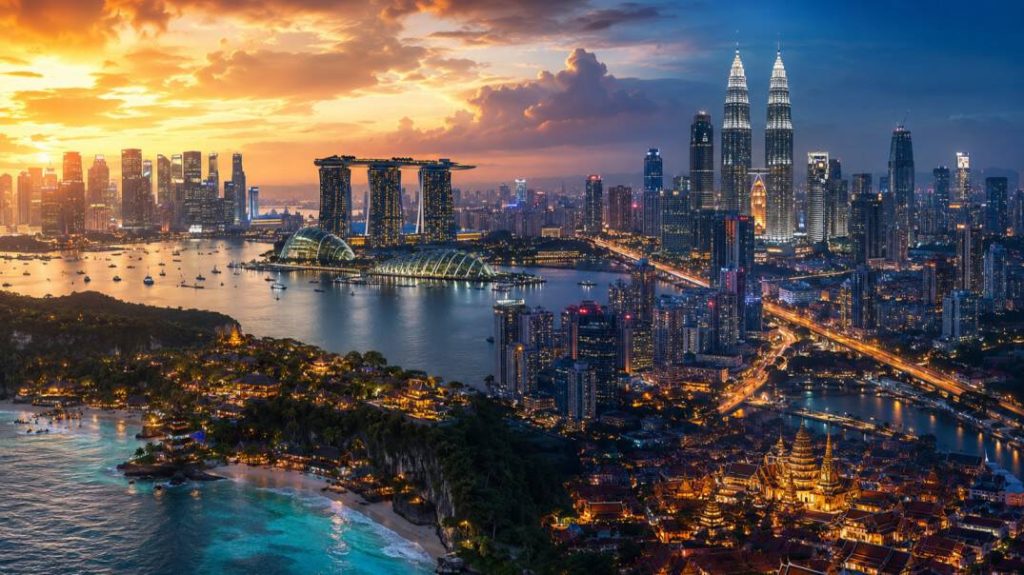
Image generated with Ai
Southeast Asia’s tourism sector in 2026 is expanding in scale but weakening in balance. Across Singapore, Bangkok, Bali and Kuala Lumpur, visitor numbers are rising sharply. Yet official regional data shows a troubling contradiction. Arrivals are increasing, but revenue growth is slowing or declining in several markets. This creates a structural imbalance in Tourism across ASEAN. The competition is no longer about volume alone. It is about value extraction per visitor. Singapore, Bangkok, Bali and Kuala Lumpur are now locked in a direct economic rivalry that is reshaping pricing models, hotel performance and visitor behaviour across the region.
SINGAPORE TOURISM FACES HIGH ARRIVALS BUT LOW REVENUE MOMENTUM

Image generated with Ai
Singapore continues to show strong inbound recovery, supported by business travel and premium tourism demand. According to official statistics, visitor flows remain robust, but spending patterns are shifting downward in mid-market segments. The Singapore Tourism Board highlights pressure on overall tourism receipts even as arrivals remain high. This creates a paradox where Tourism grows in numbers but weakens in yield. Singapore’s challenge is maintaining premium positioning while preventing mid-tier collapse. Competition from Bangkok, Bali and Kuala Lumpur intensifies this pressure, as regional travellers shift spending toward short, value-driven stays rather than extended high-value consumption.
OFFICIAL DATA SHOWS SINGAPORE ARRIVALS REMAIN STRONG BUT FRAGILE
Official government datasets confirm that Singapore continues to attract significant international arrivals. However, the structure of this growth is uneven. Short stays dominate and spending concentration is heavily skewed toward luxury districts. Mid-tier hotels face declining occupancy rates despite overall tourism strength. This signals a structural issue in Tourism economics. Singapore is becoming a high-efficiency premium hub, but losing balance in mid-market support. The gap between arrivals and revenue is widening. This imbalance is central to the regional rivalry involving Bangkok, Bali and Kuala Lumpur, where pricing competition is far more aggressive.
SINGAPORE OFFICIAL TOURISM BOARD SIGNALS REVENUE PRESSURE
According to the Singapore Tourism Board, tourism receipts are under pressure despite stable arrivals. The board notes a shift in visitor behaviour toward shorter, more selective spending patterns. Retail and hospitality mid-segments are the most affected. This creates a dual-speed Tourism economy. Premium hotels and luxury experiences remain strong, while mid-range offerings struggle. The structural issue is not demand, but distribution of spending. Singapore now competes directly with Bangkok, Bali and Kuala Lumpur for high-value travellers. Each city attempts to capture a larger share of luxury demand while managing declining mid-tier stability.
Advertisement
Advertisement
BANGKOK TOURISM EXPANDS BUT FACES MARKET POLARISATION

Image generated with Ai
Bangkok remains one of the most dynamic tourism hubs in Asia. Visitor numbers continue to rise, supported by global connectivity and strong regional demand. However, the market is increasingly polarised. Luxury hotels are expanding rapidly, while mid-market properties face pricing pressure. Tourism in Bangkok is shifting toward high-end consumption zones, shopping districts and premium hospitality clusters. This creates uneven distribution of income across the sector. As Singapore, Bangkok, Bali and Kuala Lumpur compete, Bangkok’s challenge is balancing rapid luxury expansion with sustainable mid-tier performance across a highly competitive regional environment.
BALI TOURISM STRUGGLES WITH VOLUME DEPENDENCY AND VALUE LIMITS
Bali continues to attract strong visitor flows, but its Tourism structure remains heavily volume-driven. The island’s economy depends on mass tourism, which limits per-visitor spending potential. Infrastructure pressure and accommodation density add further strain. Official Indonesian tourism frameworks highlight the need for value-based restructuring. Bali’s challenge is converting high arrival numbers into higher revenue per visitor. Compared to Singapore, Bangkok and Kuala Lumpur, Bali lags in premium segmentation. This creates vulnerability in the 2026 regional rivalry, where revenue efficiency matters more than visitor volume alone.
Advertisement
Advertisement
KUALA LUMPUR FACES STRATEGIC IDENTITY CHALLENGES IN TOURISM
Kuala Lumpur remains a strong regional hub, but its Tourism positioning is complex. The city relies heavily on intra-ASEAN travel and price-sensitive markets. While arrivals remain steady, average visitor spending is lower than Singapore and Bangkok. Kuala Lumpur competes primarily on affordability and accessibility. However, this limits its ability to capture high-value segments. As regional competition intensifies, Kuala Lumpur must reposition itself within ASEAN Tourism. The challenge is to balance affordability with premium attraction, especially as Bali and Bangkok expand luxury offerings and Singapore strengthens its premium dominance.
ASEAN TOURISM RIVALRY IS NOW STRUCTURAL NOT CYCLICAL

Image generated with Ai
The rivalry between Singapore, Bangkok, Bali and Kuala Lumpur is no longer seasonal. It is structural. Each destination is targeting different segments of the same global traveller base. ASEAN Tourism has entered a phase where pricing, experience design and revenue optimisation dominate strategic planning. Governments now focus on yield per visitor rather than total arrivals. This shift is redefining competition. Cities are no longer just destinations. They are competing economic platforms. The rivalry is intensifying because all four cities depend on overlapping regional and international travel flows.
Advertisement
Advertisement
MID-MARKET HOTELS FACE THE HARDEST PRESSURE ACROSS ASEAN
One of the most severe consequences of this rivalry is the collapse of mid-market hotel stability. Across Singapore, Bangkok, Bali and Kuala Lumpur, mid-tier properties face declining occupancy and weaker pricing power. Luxury hotels attract high-spending travellers, while budget accommodation benefits from cost-conscious tourists. The middle segment is squeezed from both ends. Tourism demand is not disappearing, but it is redistributing unevenly. This creates financial stress for operators. The mid-market, once the backbone of ASEAN hospitality, is now the weakest link in the system.
PRICING COMPRESSION RESHAPES TOURISM ECONOMICS IN 2026
Pricing pressure is intensifying across ASEAN Tourism markets. Increased airline connectivity and competitive hotel supply have created downward pressure on mid-tier pricing. Singapore, Bangkok, Bali and Kuala Lumpur all experience this trend. Travellers now compare destinations more aggressively, forcing hotels and services to adjust rates frequently. This results in reduced profit margins. Even in high-demand cities, price elasticity is shaping performance. The regional competition is no longer just about attracting tourists. It is about maintaining sustainable pricing structures in a highly transparent digital travel economy.
AIR CONNECTIVITY BOOSTS REGIONAL TOURISM COMPETITION
Air connectivity across Southeast Asia continues to expand rapidly. Low-cost carriers and regional aviation networks connect Singapore, Bangkok, Bali and Kuala Lumpur more efficiently than ever before. This increases tourist mobility but also intensifies competition. Travellers can now switch destinations easily based on price and experience. This reduces loyalty to any single city. Tourism markets become interchangeable. The result is a highly competitive regional system where small price or experience differences can shift demand instantly between ASEAN capitals.
SHIFT IN TRAVELLER BEHAVIOUR TOWARD SHORTER AND CHEAPER STAYS
Traveller behaviour in 2026 shows a clear shift toward shorter stays and more controlled spending. Extended vacations are declining in favour of multi-city regional travel. Singapore, Bangkok, Bali and Kuala Lumpur all experience this shift. Visitors are increasingly budget-conscious, even in premium destinations. This reduces average revenue per visitor. Tourism boards are now forced to rethink strategies. The focus is no longer just attraction, but conversion of visits into meaningful economic value within limited stay durations.
Advertisement
Advertisement
LUXURY TOURISM GROWTH CREATES SHARP MARKET DIVIDE
Luxury Tourism continues to grow across ASEAN, but this growth is uneven. High-end hotels and premium experiences are expanding rapidly in Singapore and Bangkok. However, this creates a widening gap between luxury and mid-market segments. Bali and Kuala Lumpur experience similar trends at different scales. The result is a fragmented Tourism economy. High-value travellers drive revenue growth, while mid-market operators struggle. This divide is reshaping investment patterns and forcing destinations to re-evaluate their tourism strategies for long-term sustainability.
SINGAPORE STRATEGY FOCUSES ON HIGH VALUE EXTRACTION
Singapore is shifting its Tourism strategy toward high-value extraction rather than volume expansion. The city-state prioritises premium retail, business tourism and luxury hospitality. Mid-market restructuring is becoming essential. Singapore aims to maintain global competitiveness by focusing on quality rather than quantity. However, competition from Bangkok, Bali and Kuala Lumpur adds pressure. Each destination is targeting overlapping premium segments, increasing rivalry. Singapore’s success depends on maintaining its premium brand while adapting to changing visitor spending behaviour.
BANGKOK STRATEGY BUILDS A DUAL LUXURY AND MASS MODEL
Bangkok is adopting a dual Tourism strategy. It combines mass tourism strength with rapid luxury expansion. High-end hotels and lifestyle districts are growing quickly. At the same time, Bangkok maintains strong affordability for regional travellers. This dual model creates resilience but also complexity. Managing mid-market stability remains a challenge. As Singapore, Bali and Kuala Lumpur compete for similar travellers, Bangkok’s flexibility gives it a competitive advantage in ASEAN Tourism rivalry.
BALI STRATEGY FOCUSES ON SUSTAINABILITY AND VALUE SHIFT
Bali is increasingly focused on Tourism sustainability. The goal is to shift from volume-driven tourism to value-driven tourism. Infrastructure constraints and environmental concerns drive this change. Bali must increase per-visitor spending while controlling overcrowding. Compared to Singapore, Bangkok and Kuala Lumpur, Bali faces more structural limitations. However, its global brand strength remains significant. The success of this transition will determine Bali’s position in the ASEAN Tourism hierarchy in the coming years.
KUALA LUMPUR STRATEGY SEEKS BALANCED REGIONAL POSITIONING
Kuala Lumpur aims to maintain balance between affordability and competitiveness. The city focuses on regional accessibility and value-based Tourism. However, it must improve premium segmentation to compete with Singapore and Bangkok. Bali’s tourism model also influences Kuala Lumpur’s positioning. The challenge is upgrading without losing mass-market appeal. In ASEAN’s competitive landscape, Kuala Lumpur’s success depends on strategic repositioning within the evolving Tourism economy.
FINAL OUTLOOK: ASEAN TOURISM ENTERS A HIGH-STAKES ECONOMIC RESET
The Tourism landscape across Singapore, Bangkok, Bali and Kuala Lumpur is undergoing a fundamental reset. The region is no longer defined by visitor numbers alone. It is defined by revenue efficiency, pricing power and market segmentation. Singapore leads in premium control. Bangkok expands aggressively. Bali seeks structural reform. Kuala Lumpur balances affordability and growth. The 2026 Tourism cycle marks a turning point where ASEAN destinations must compete not only for tourists but for economic survival in a rapidly polarising travel economy.
Singapore’s tourism performance is supported by multiple government platforms. These include statistical datasets and official tourism dashboards that track arrivals, revenue and visitor behaviour trends. Key sources include:

Advertisement
Advertisement
