
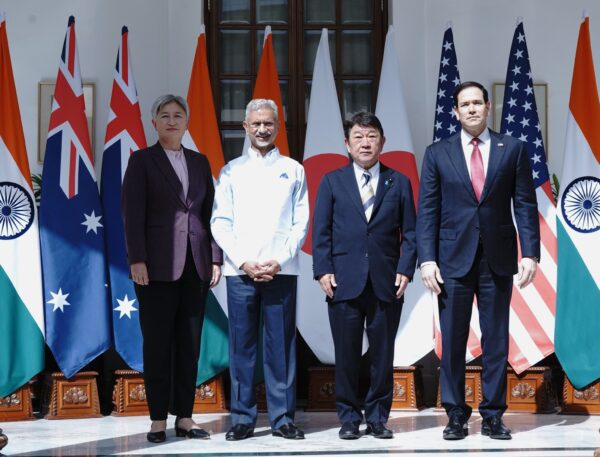
During their meeting at New Delhi on May 26, the Quad foreign ministers announced a major new maritime security initiative: the Indo-Pacific Maritime Surveillance Collaboration (IPMSC).
The initiative, proposed by India, will initially focus on the Indian Ocean. It will use the latest tracking technologies and satellite data to provide real-time information on the kind of vessels operating in the region. In the words of U.S. Secretary of State Marco Rubio, the initiative seeks to leverage each of the Quad countries’ maritime surveillance capabilities to enhance information sharing.
IPMSC complements the existing Indo-Pacific Partnership for Maritime Domain Awareness (IPMDA) initiative, which was launched in Tokyo in April 2022. Through IPMDA, Quad countries, which include India, Japan, Australia, and the United States, provide friendly regional countries with technology and training to support shared maritime domain awareness and develop a common operating picture of the Indo-Pacific waters.
At a special press briefing by the Indian Ministry of External Affairs, Additional Secretary Nagaraj Naidu explained that IPMSC provides an “additional layer,” which would “top up” IPMDA.
With specific details about IPMSC still limited, the initiative appears to be designed to strengthen surveillance coordination and real-time information sharing, including through subject matter expert exchanges and tabletop exercises, among Quad members. Unlike IPMDA, it is unclear if the information generated will be shared with partner countries outside the Quad framework. At a press conference in New Delhi, Australian Foreign Minister Penny Wong explained that the initiative seeks to “involve India more, particularly in the Indian Ocean” in maritime surveillance cooperation, highlighting how such cooperation was already underway among the United States, Japan, and Australia.
Without explicitly naming China, IPMSC’s focus on the Indian Ocean is a clear effort to counter Beijing’s growing maritime assertiveness and to maintain the regional status quo. Unsurprisingly, Chinese media reacted sharply against the initiative, claiming that it turns “development issues into bloc-based competition with clear strategic aims.” Indian diplomats were, however, quick to issue defensive caveats that the initiative in no way reflects the “militarization of the Quad.”
From an operational standpoint, as with IPMDA, the information gathered through IPMSC is unclassified satellite tracking data. Nevertheless, as highlighted by Indian Ocean security expert Arzan Tarapore, the initiative can make maritime surveillance cooperation a “routine feature of strategic cooperation” by potentially allowing members to use interoperable military technology, such as P-8 aircraft, to supplement ongoing maritime domain awareness efforts. Currently, such cooperation is centered around the Malabar naval exercise, which first began in 1992 as an India-U.S. bilateral exercise, but later was expanded to include Japan as a permanent member in 2015 and Australia in 2020. Further supporting coordinated surveillance and maritime domain awareness activities in the Indian Ocean, New Delhi will be hosting the next iteration of the coast guards’ Quad-at-Sea Ship Observer Mission.
Notwithstanding legitimate concerns over Chinese militarization of the Indian Ocean and participation in maritime crimes such as illegal, unreported and unregulated (IUU) fishing, for IPMSC to effectively contribute to regional security, it would need to invest more in strategic buy-in from regional countries. While Quad has made considerable investment in recasting itself as an actor that can support the development ambitions of countries in the region, many smaller countries, especially in South Asia, continue to view it as an “exclusive military alliance.” The inclusivity aspect will be crucial to reassure partners that the initiative will constructively contribute to regional security, rather than bring great power competition closer to their territorial waters.
Although IPMSC is a step in the right direction toward greater transparency around maritime activities in the Indian Ocean, the Quad must begin with engagements with littoral states to address existing deficiencies within IPMDA. Despite being launched in 2022, the initiative remains in its nascent stage and is limited in terms of geography, being primarily focused on the Pacific and in Southeast Asia. While an Indian Ocean-focused initiative is a welcome development, its efficacy will be determined by how it can support a democratic information-sharing culture, ensuring that it can attract participation from all regional countries over the long term. In its current form, IPMSC is ill-suited to support holistic and robust maritime domain awareness in the Indian Ocean.