
74
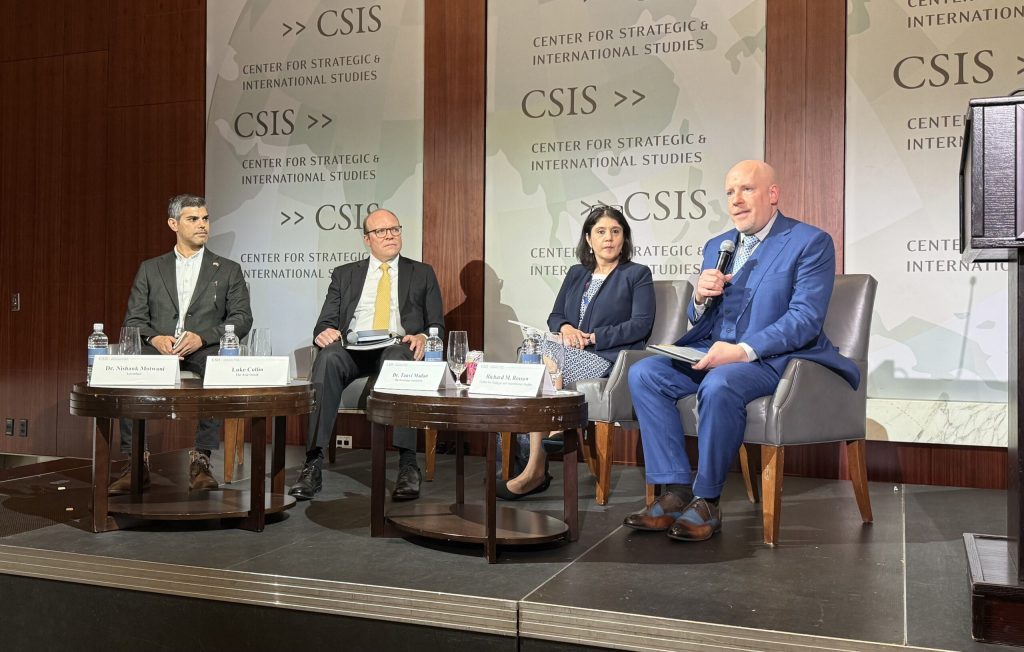
The Center for Strategic and International Studies (CSIS) Chair on India and Emerging Asia Economics hosted a discussion titled “The Quad Convenes: Priorities, Partnerships and the Indo-Pacific,” on May 28 at CSIS Headquarters in Washington, D.C.
The discussion explored the outcomes of the recent Quad foreign ministers’ meeting in New Delhi and examined what the grouping’s next phase could mean for maritime security, critical minerals cooperation, and the broader Indo-Pacific region.
The panel featured Luke Collin, principal at The Asia Group; Nishank Motwani, vice president at Levenhall and Senior Fellow at the Australian Strategic Policy Institute; and Tanvi Madan, senior fellow for Foreign Policy at the Center for Asia Policy Studies at Brookings. The discussion was moderated by Richard M. Rossow, senior adviser and Chair on India and Emerging Asia Economics at CSIS.
Discussing the elevation of the Quad to the leaders’ summit level, Madan said the development was “good,” but emphasized that the real measure of success lies in the group’s ability to achieve the objectives for which it was originally established. She noted that ministerial meetings can help advance initiatives that Quad members themselves have identified as priorities.
Madan pointed to the second Quad ministerial meeting held in July last year, where a wide-ranging agenda was streamlined into four key areas: maritime security, economic security, technology security, and humanitarian assistance and disaster relief.
About the recently concluded New Delhi Quad meeting, Madan said she observed “some movement” while noting that much more remains to be done.
Addressing critical minerals cooperation, Collin said the emphasis on the sector reflects a shared understanding among the four Quad countries that critical minerals are essential to economic prosperity and technological competitiveness. He also highlighted concerns about the concentration of global critical mineral supply chains through China.
“So I think all four countries have realized that they need to diversify and establish separate supply chains to ensure their critical minerals future, and to reduce that fundamental vulnerability,” he said, noting that the Quad countries are among the largest consumers of critical minerals. He added that Australia’s role as a major supplier makes collaboration between the four countries logical on both the supply and demand sides.
Motwani cited examples of government-backed investments supporting critical mineral projects. He noted that Australian mining company Lynas Rare Earths benefited from Japanese investment that helped mitigate financial risks and sustain operations. He also pointed to Arafura Rare Earths, which secured nearly a billion dollars in Australian government support to strengthen its critical minerals supply capabilities. “So, seeing these actions in place makes a big difference, it sends a clear signal,” he said, adding that such measures help industry leaders determine where to direct investment and resources.
On India’s role within the Quad, Madan argued that New Delhi’s participation has evolved significantly, with the country increasingly engaged in security-related initiatives. She cited the Indo-Pacific Maritime Domain Awareness initiative and other collaborative efforts as evidence of India’s growing commitment to the grouping. Madan also stressed the importance of balancing resilience with maintaining a favorable balance of power across the region.
Looking ahead to future Quad summits, Collin discussed the strengths and limitations of the narrower policy focus associated with the Trump administration compared with the broader framework pursued during the Biden administration.
“I think that the biggest downside to the narrower approach is they, in doing so, left off some things, I think are really important to the broader region, not just the Quad countries, but the entire Indo-Pacific region,” he said.
Referring to the Biden administration’s approach, Collin said it placed considerable emphasis on presenting the Quad as a “global force for good” capable of delivering tangible benefits across the Indo-Pacific.
On the issue of economic coercion and resilience, Collin proposed short-term measures such as coordinated tariffs on Chinese minerals and greater alignment on trade policies. Motwani emphasized the importance of mobilizing private capital and establishing funding mechanisms for strategic projects, while Madan highlighted the challenges of collective action and the need for individual countries to strengthen their own resilience.
The discussion also covered maritime domain awareness and surveillance, public perceptions of the Quad’s strategic role, and the effects of trade policies and tariffs on the grouping, among others. Panelists concluded by addressing audience questions on strategic priorities, maritime security, and the future direction of Quad cooperation.