
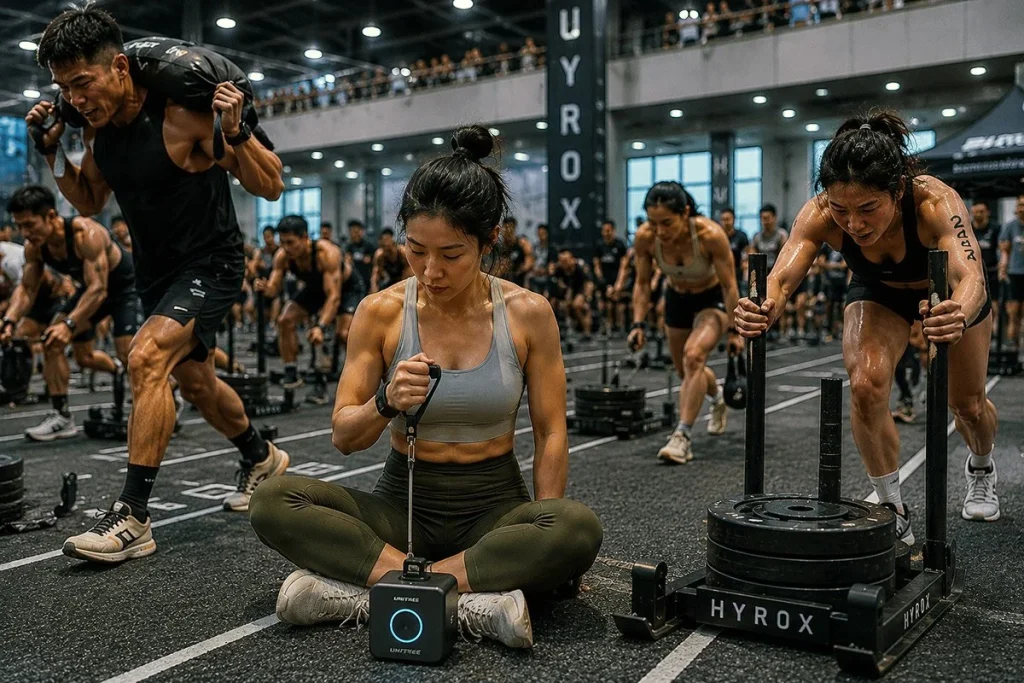
While its hard to have a conversation around China without touching on AI: Robots, OpenClaw and AI agents, AI companions, AI search, AI toys and now AI-powered fitness, another trend is unfolding in parallel: a growing desire for old-school, more physical, more human experiences.
And what a contrast it is!
On one side sits products like the new Unitree x IMBODY “Power Cube,” a 700g portable strength-training device powered by robotics motors, AI algorithms and real-time motion feedback. The product reflects where much of China’s innovation ecosystem is heading: sensors, data loops, gamification, personalised algorithms and “smart” systems designed to optimise human behaviour.
It is a very China story. Rather than simply recreating gym equipment at home, the product aims to solve modern urban pain points: lack of space, low motivation, inconsistent routines and poor feedback. The underlying logic is increasingly becoming “AI decision-making + hardware execution.”
At the same time, another fitness movement exploding across China looks almost entirely opposite philosophically: HYROX.
HYROX is intentionally brutal, physical and primal. Participants push sleds, drag weights, row, run, carry sandbags and collapse exhausted across finish lines while photographers capture their suffering for Xiaohongshu and WeChat Moments. There is very little “smart” about it on the surface. In many ways, it resembles industrial labour repackaged into a premium urban lifestyle sport.
Yet both trends are booming simultaneously.
That contradiction says something important about modern Chinese consumers, and increasingly consumers globally. While technology is becoming more embedded in daily life, people are also craving experiences that feel tangible, physical, emotional and real.
The HYROX craze is case in point. The appeal spans far beyond fitness, to identity, discipline, pain, achievement and social belonging. In an increasingly digital and AI-mediated world, physical exertion itself is becoming a form of authenticity.
This seeming contradiction is appearing across many categories in China.
While AI-powered wellness products, robot companions and algorithmic personalisation surge, traditional tea culture, hiking, camping, pottery, analogue hobbies, board games, childrens’ books, local travel, vintage aesthetics and “slow living” are also thriving. While Chinese consumers are moving toward crazyily-futuristic technology, many are simultaneously moving toward emotional grounding and sensory experiences.
Many companies currently feel pressure to inject AI into everything because China appears obsessed with technological innovation. There’s no disputing that Chinese consumers are extraordinarily open to new technologies compared to most markets. But brands risk misunderstanding the deeper emotional landscape if they assume consumers only want more screens, automation and optimisation.
The success of HYROX reflects a growing desire for struggle, community and visible effort in an age where so much of life feels abstracted behind algorithms and office screens. Even the social media element says a lot: people are not posting screenshots of AI systems; they are posting sweat, pain, muscles, medals and exhaustion.
Ironically, the more digital life becomes, the more valuable “real-world” experiences can feel.
This creates a fascinating balancing act for brands. The winners may not be those who simply become the most technologically advanced, nor the most nostalgic, but those who understand how to combine both worlds.