
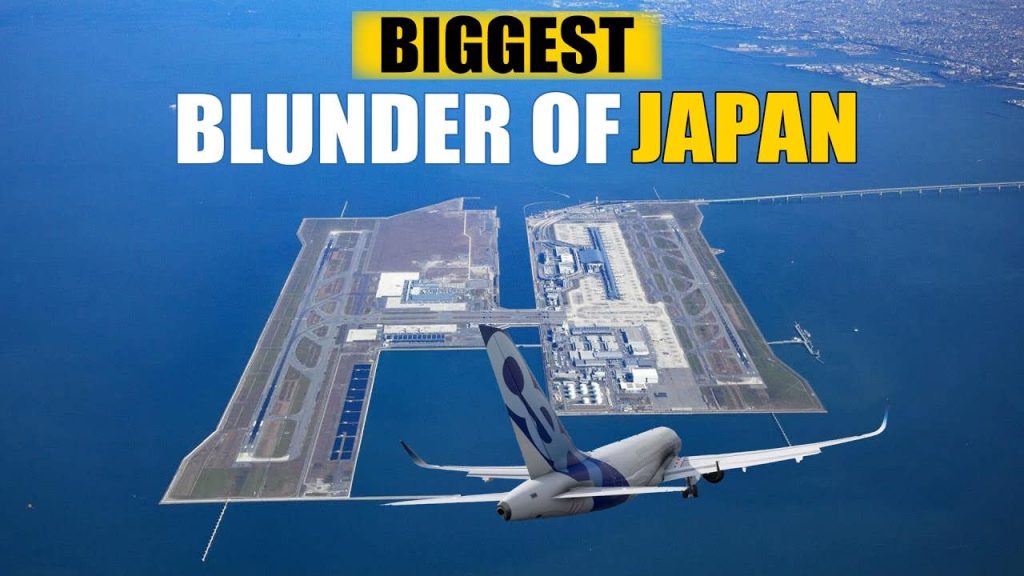
About 4 kilometers off the coast of Japan, there is a massive giant airport floating in the sea. It is so large that it can even be seen from the International Space Station. This is not only the world’s first airport built in the ocean, but the bridge connecting it to land is also one of the longest bridges of its kind.
This airport has a state-of-the-art design and is built on an artificial island, which at the time was the largest man-made island ever created. The project cost around $20 billion. It is considered an engineering masterpiece—but during construction, a critical mistake was made that caused the airport to slowly sink into the sea over time.
Why did Japan take such a risk by building an airport in the ocean instead of on land? And what are engineers doing now to stop it from sinking?
When it comes to futuristic technology and incredible structures, Japan is always at the forefront. Just 18 years after being devastated by nuclear attacks during World War II, Japan introduced the world’s first high-speed train (Shinkansen). While most countries focus on cars, Japan even installs shock absorbers under skyscrapers to protect them from earthquakes.
However, not every engineering project in Japan has been perfect. Mistakes do happen—and one such example is Kansai International Airport.
The airport is located near Osaka, Kobe, and Kyoto—areas that already had three airports within a 50 km radius. However, due to increasing population and economic demands, another airport was needed. Expanding existing airports was not possible because they were surrounded by dense population, and the available land was owned by farmers who refused to sell.
So Japan had only one option: build an airport in the sea.
The water in that area was about 60 feet deep, so engineers first had to create an artificial island. Construction began in 1987. Initially, the cost was estimated at $8 billion, but due to complexity, it rose to $20 billion. If built on land, it would have cost even more due to compensation to landowners.
Engineers designed two islands, one 4 km long and the other 3.5 km long. To build them, about 750 million cubic feet of soil was brought from mountains. However, the seabed mud was very soft, making it risky to support such a massive structure.
Experts estimated the island would sink between 19 to 25 feet. To save costs, officials designed it assuming only 19 feet of sinking—which turned out to be a major mistake.
During construction, the seabed was strengthened using one million vertical pipes to compress the soft soil. A 24 km long seawall was built using 48,000 concrete blocks to protect against waves and storms. The island was raised 65 feet above sea level.
However, even before completion, the island had already sunk 34 feet—far more than expected.
Engineers predicted that after 50 years, the island would stabilize at 13 feet above sea level. But this happened in just 10 years. By the time the second terminal opened, the island had already sunk significantly and reached a dangerously low height.
To prevent flooding, engineers have been continuously raising the seawall, spending millions of dollars. Hydraulic jacks have also been installed under the airport to lift the structure slightly every few years.
Despite all efforts, the airport continues to sink slowly. Japan knows that one day it may become unusable, but by maintaining it, they are buying time to build another airport in the future.
Natural disasters have also caused damage. In 2018, a powerful typhoon flooded the airport, submerging runways and damaging parked airplanes, forcing operations to shut down temporarily.
Even though Kansai Airport is sinking, Japan considers it a success—because they achieved something no other country had dared to attempt.