
By CEO Lisa Singh and Research Fellow Tushar Joshi
Australia’s 2026 National Defence strategy places India front and centre as a “top-tier security partner” and “our most important defence partner in the Northeast Indian Ocean”. It also emphasises that Defence will “strengthen engagement with Bangladesh, Sri Lanka and the Maldives” with a focus on regional security and collective maritime domain awareness.
It is therefore surprising that one of the most consequential developments unfolding in these waters has received little attention in Canberra.
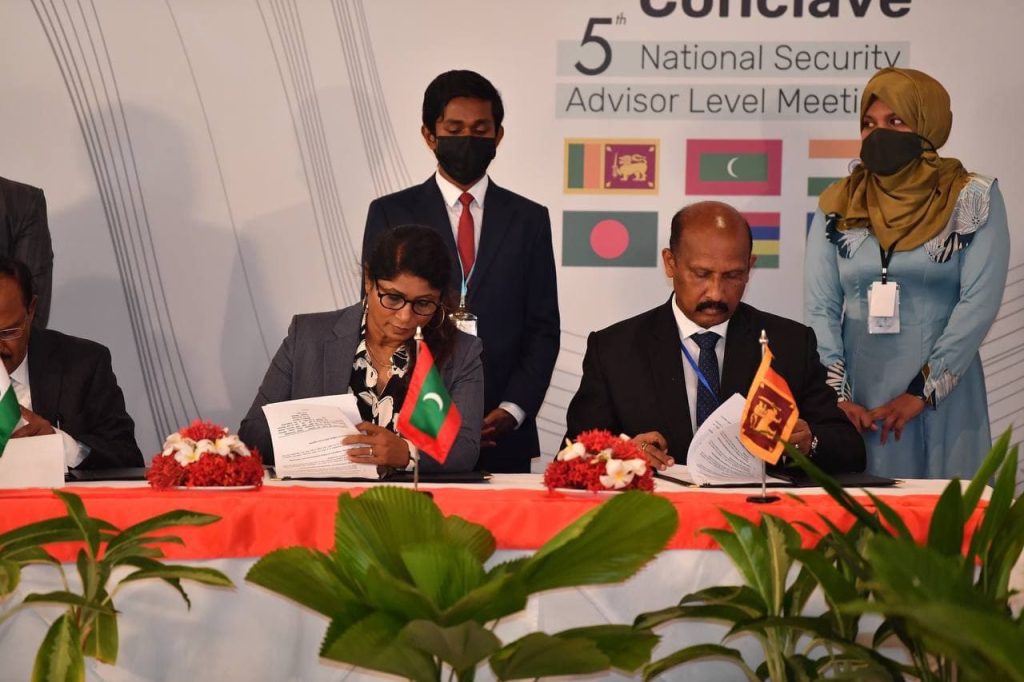
On 19 April, Indian Foreign Secretary Vikram Misri confirmed that the Colombo Security Conclave (CSC) would be upgraded into a formally institutionalised regional security organisation with a permanent secretariat in Colombo and a Secretary-General-led structure. Comprising six Indian Ocean littoral states – India, Sri Lanka, Maldives, Mauritius, Bangladesh, and Seychelles – the revamped organisation is planned to be led by a former Indian Navy vice chief.
This structural transformation marks a genuine shift. Unlike its past iteration as a loose trilateral dialogue between India, Sri Lanka and Maldives that was heavily dependent for its success on navigating the fluctuations of political alignment, this institutionalisation builds bureaucratic durability and continuity that will hopefully survive localised political changes.
The CSC fills this vacuum by being geographically concentrated, security-oriented, and operationally focused.
While agreement to establish the permanent Secretariat was signed in 2024, the Iran war has acted as a strong catalyst for these Indian Ocean states to formalise the regional security group. In essence the CSC will become the premier maritime security forum in the Northeast Indian Ocean.
India’s leadership in the Conclave formalisation represents a significant gain in fostering practical cooperation with littoral states on shared non-traditional threats.
India pushed the revival of the CSC for the past decade as its primary institutional architect. This has been in response to China’s ongoing efforts to limit India’s influence, through controlling sea lines of communication, ports and trade. Regardless, India has long been a driver for building regional structures in the Indian Ocean region, particularly led through its maritime focused SAGAR policy, which has since evolved into the more expansive MAHASAGAR vision (Mutual and Holistic Advancement for Security and Growth Across Regions), reflecting its more integrated approach to maritime cooperation, security, and regional development.
Since its 2011 inception, the CSC has had a rocky history with long bouts of stagnation and domestic political frictions. Starting out as a trilateral between India, Sri Lanka and Maldives, after its 2020 revival its membership expanded to include Mauritius (2022), Bangladesh (2024) and Seychelles (2025).
This uplift of the CSC reflects the changing dynamics of the Indian Ocean region – a trend towards states building smaller, issue-focused and hyper-functional minilateral arrangements. Larger institutional partnerships, such as the South Asian Association for Regional Cooperation (SAARC), remain politically paralysed. The Indian Ocean Rim Association (IORA), of which Australia is a founding member, lacks a hard security mandate. The Indian Ocean Naval Symposium (IONS), with its “consensus-bound regionalism” approach requiring unanimous endorsement of all participants, lacks a permanent operational structure. The CSC fills this vacuum by being geographically concentrated, security-oriented, and operationally focused.
China’s expanding presence through naval deployments, dual-use infrastructure projects and growing political influence in Sri Lanka and the Maldives has also intensified India’s concerns about the strategic balance in its maritime neighbourhood. These include Beijing’s long-term lease of Sri Lanka’s Hambantota Port, the recurring docking of Chinese surveillance vessels like the Shi Yan 6, and the Maldives’ recent bilateral military assistance pact with Beijing.
Beijing may likely view the CSC’s institutionalisation as India consolidating its sphere of influence to limit China. On the other hand, Washington may welcome such regional burden-sharing as aligning with its broader interests in the Indo-Pacific, although the unpredictability of the Trump administration’s foreign policy makes any long-term assessment uncertain.
Roughly two-thirds of Australia’s maritime trade traverses the Indian Ocean, leaving its commercial shipping deeply tied to vulnerable sea lanes and chokepoints such as the Strait of Hormuz and Bab el-Mandeb. Though Canberra is not a participant, the CSC operates within the exact geographic pivot where Australia’s primary trade lines exit Southeast Asian chokepoints.
Beyond the shared interests in maritime security and domain awareness, the non-traditional security threats on the CSC’s agenda such as illegal fishing, cyber threats, transnational narcotics and climate disasters align directly with Australia’s security interests.
Canberra’s acknowledgement of the CSC upgrade to a permanent secretariat would recognise the role India has played in the evolution of the Conclave and signal Australia’s interest as a future observer as the new grouping considers expanding its observer membership.
Expressing support for this formal regional security network would not only align with Australia’s new Defence Strategy, it would also advance Australia’s broader maritime security agenda of practical engagement, diplomacy and defence cooperation with regional partners. The experience and expertise Australia could bring to the formalised CSC would not only complement its existing security initiatives – including through IORA – but also provide practical engagement in the Northeast Indian Ocean region, which India, as the primary security leader in the region, would welcome.
This article was originally published in the Lowy Interpreter. This image is sourced from the The Government of the Republic of Maldives.