
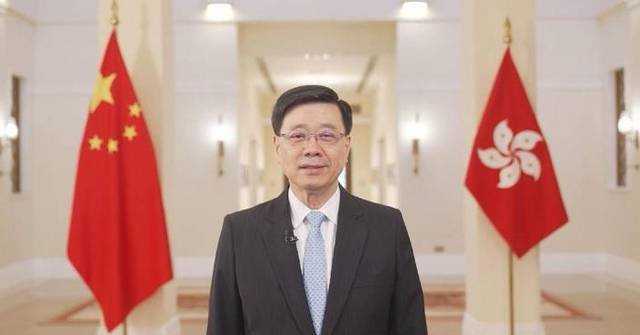
John Lee, chief executive of the Hong Kong Special Administrative Region (HKSAR), on Saturday congratulated Lai Ka-ying on becoming a member of China’s fourth batch of astronauts.
Lee expressed gratitude to the country for its support for and trust in the HKSAR, and wished the Shenzhou-23 crewed spaceflight mission great success.
The spaceship is scheduled to be launched at 23:08 Sunday (Beijing Time) from the Jiuquan Satellite Launch Center in northwest China.
The China Manned Space Agency announced on Saturday that Lai, the first astronaut from Hong Kong, was selected as a payload specialist for the Shenzhou-23 crewed spaceflight mission. She will carry out the mission alongside flight engineer Zhu Yangzhu and spacecraft pilot Zhang Zhiyuan.
Lee said this reflects the care and support the country has given to Hong Kong’s technological development.
Born and raised in Hong Kong, Lai worked for the Hong Kong Police Force before being selected as an astronaut. She holds a doctoral degree in computer forensics.
Her participation in the Shenzhou-23 mission has drawn widespread attention in Hong Kong, symbolizing the country’s recognition of the region’s technological strength and talent reserves, as well as its contribution to China’s space program.
“This is a shared honor for all Hong Kong citizens, and a vivid testament to the unity and close bond between Hong Kong and our country under the framework of ‘one country, two systems.’ The selection of Hong Kong’s female astronaut is no accident. It clearly demonstrates that the country always bears in mind the development of Hong Kong and the growth of its youths. That’s why it’s opening a wide door for Hong Kong people to participate in major national projects and share the glory of national development,” said Woo Kim Kong Michael, a member of the national committee of the Chinese People’s Political Consultative Conference.
“This is a milestone in Hong Kong’s deep involvement in our country’s space program. It’s of extraordinary significance. The fact that a Hong Kong payload specialist is selected and granted the opportunity to go into space fully demonstrates that the advantage of the ‘one country, two systems’ is that Hong Kong is backed by the country. We should cherish this love and trust from our country to Hong Kong. The spaceflight of a Hong Kong astronaut will serve as a vivid model inspiring Hong Kong youths to love our country and Hong Kong and to dedicate themselves to scientific innovation,” said Wong Kam-leung, a deputy from Hong Kong to the National People’s Congress.
Li Mingze, a student at the University of Hong Kong, said Lai’s success will encourage more young people in Hong Kong to engage in scientific study.
“Female astronaut Lai Ka-ying from the HKSAR is also participating in this mission. She also studied at the University of Hong Kong, so she is my senior. Her participation in our country’s space program is not only a personal honor but also a source of great pride for us alumni. Her courage and perseverance will inspire more young people in Hong Kong to dedicate themselves to science and technology,” Li said.
Hong Kong chief executive congratulates Lai Ka-ying on joining China’s 4th batch of astronauts
The 32nd Asia-Pacific Economic Cooperation (APEC) Ministers Responsible for Trade Meeting concluded in east China’s Suzhou on Saturday, yielding fruitful results and laying significant groundwork for the APEC Economic Leaders’ Meeting in November.
The trade ministers’ meeting focused on “building an open and predictable regional and multilateral economic and trade order” and “fostering new engines of innovative and dynamic trade and investment cooperation.”
Chinese Commerce Minister Wang Wentao briefed the media on the meeting’s outcomes at a press conference.
Wang said the meeting issued a joint statement titled the Suzhou Statement, and approved the latest edition of the APEC Roadmap for Innovative, Competitive and Resilient Services.
All parties agreed to advance policy innovation and reform in services trade, build an open and predictable investment environment, improve regional trade facilitation and supply chain resilience, strengthen standards coordination, and enhance intellectual property protection, Wang told the media.
He also said that substantial progress was made on a framework document for regional digital trade cooperation and the ministers emphasized promoting inclusive AI development, strengthening AI-related trade, and bridging the digital divide to ensure shared benefits from digital transformation.
The minister noted that the outcomes of the meeting demonstrated strong cooperation willingness, highlighted an innovation-oriented approach, and reflected inclusiveness and shared benefits. “The fact that Asia-Pacific economies can come together, uphold the original aspiration of promoting trade and investment liberalization and facilitation while supporting economic growth and prosperity, and engage in in-depth discussions on the important issue of ‘where multilateral and regional economic and trade cooperation is headed,’ fully demonstrates that open regionalism and true multilateralism enjoy broad support, and that mutual success and shared development serve the fundamental interests of all economies,” Wang said.
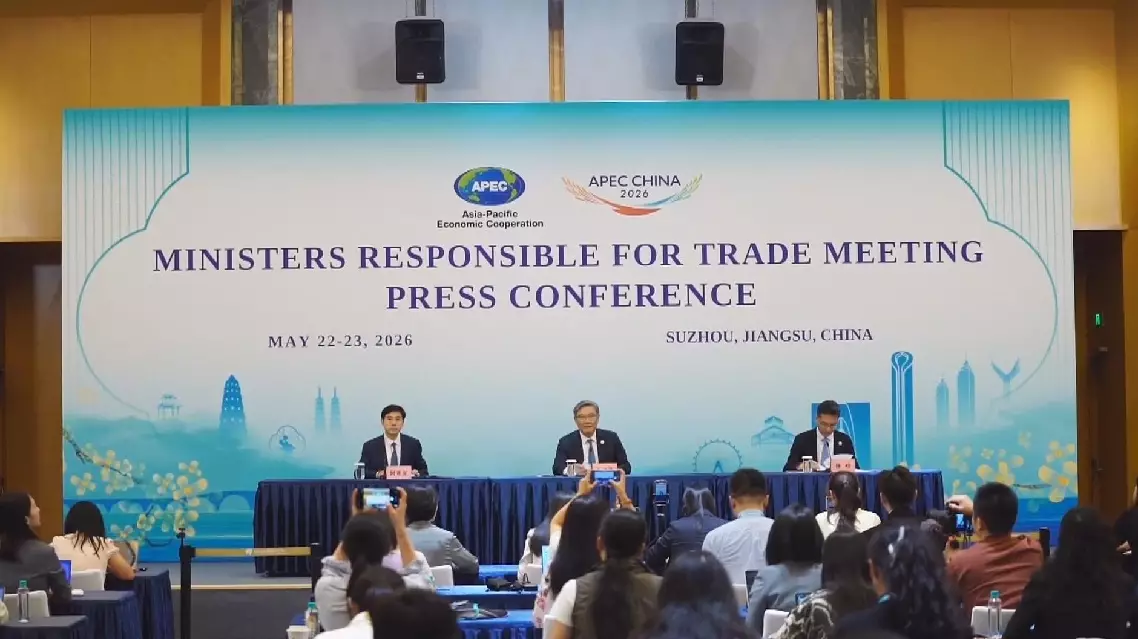
2026 APEC trade ministers’ meeting concludes with fruitful results