
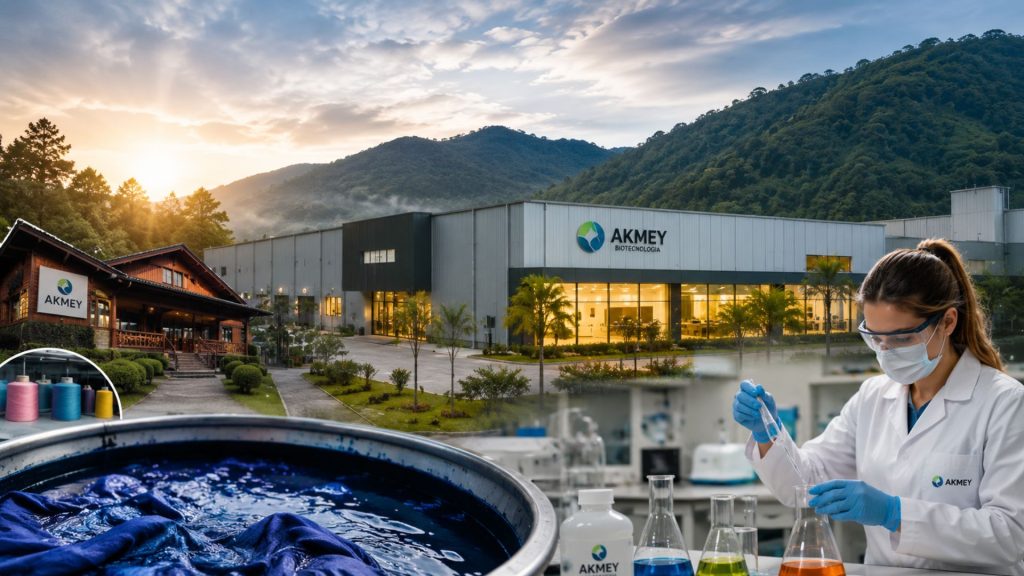
The new factory emerges with 2 thousand square meters and can quintuple in size, with construction starting in the second half of 2026. Behind the expansion is a little-known curiosity: the name Akmey was formed from the Japanese names of the three eldest children of the founders, who started just reselling textile products.
A small family business born in Gaspar, Santa Catarina, has transformed into one of the main references in biotechnology applied to the textile sector, one of the most polluting in the world, and is now preparing for a new leap. Akmey Textile Biotechnology announced, on May 22, 2026, that it will open a new factory in the municipality of Apiúna, in the Itajaí Valley, with an initial structure of about 2 thousand square meters and potential for gradual expansion up to 10 thousand square meters, as operations grow.
The announcement, released by the municipal administration of Apiúna, anticipates that construction will begin in the second half of 2026, with an estimated timeline of about two and a half years for the completion of the new industrial unit. The arrival of the company is seen as strategic for the local economy, due to the expectation of job creation, strengthening of the productive sector, and attraction of new investments. The trajectory of Akmey, which evolved from a family representation business to conquering markets inside and outside Brazil, is at the heart of this story.
From family business in Gaspar to sector reference
The story of Akmey began in 2003, in the city of Gaspar, Santa Catarina, when the founders set up a family business representing products for the textile industry. A curious detail marks this origin: the name Akmey emerged from the combination of the Japanese names of the three eldest children of the founding family. The idea of creating their own company was born from the observation that many industrial textile processes had room for improvement, with significant waste and intensive use of environmentally harmful chemicals.
From this concern, the family began researching cleaner technologies and found in enzymes a solution little known in Brazil at the time. What started as a small family representation business gradually transformed into something bigger. In 2008, the company moved its headquarters to Indaial, also in the Itajaí Valley, and transitioned from being just a representative to becoming a producer of biotechnological solutions, with its own laboratory to develop its product portfolio.
How Biotechnology Cleans One of the Most Polluting Industries
The textile sector is notoriously one of the most polluting in the world, due to the high consumption of water, energy, and chemicals in fabric processing, as well as the generation of effluents. This is precisely where Akmey’s technology comes in, based on the use of enzymes, which are natural proteins capable of accelerating chemical reactions. Being biodegradable and operating at lower temperatures, they reduce the need for heat and aggressive inputs.
In practice, enzymatic processes allow for the preparation, bleaching, and finishing of natural fibers such as cotton while consuming less water, steam, and energy, and replacing aggressive chemicals with sustainable alternatives. This was the differentiator that brought the family business out of anonymity: by offering environmental benefits and, at the same time, cost reduction and quality improvement for textile industries, Akmey found a promising and expanding market niche in Brazil and abroad.
The Turnaround That Transformed the Family Business into a Corporation
The turning point in the family business’s trajectory came in 2015, when Akmey received an investment from the environmental innovation fund FIMA, linked to the manager KPTL. The investment transformed the company into a corporation with various investors and allowed for the restructuring of the entire manufacturing park, consolidating it as a reference in biotechnological solutions and innovations for textile processing.
The expansion also crossed borders. In 2016, the company opened a partner in Honduras, named Rethink, through which part of the founders began serving clients in Central America. Akmey also made its mark in international showcases of the sector, such as the ITMA fair in 2023, in Milan, Italy, one of the largest in the world in textile technology. Thus, what started as a family business began to operate outside Brazil as well, with products aimed at the sustainability of textile processes.
Why Apiúna Was the Chosen City
The choice of Apiúna for the new factory reinforces the industrial vocation of the Itajaí Valley, a historical region of the Santa Catarina textile sector. For the municipality, the arrival of the unit represents a bet on sustainable growth and the attraction of innovative companies, with the expectation of generating jobs and boosting the local economy in the coming years as operations expand.
The project foresees a phased growth, starting with about 2,000 square meters of built area and potentially reaching 10,000 square meters, that is, a potential to quintuple in size as demand increases. With construction expected to begin in the second half of 2026 and completion estimated at about two and a half years, the new factory symbolizes the continuation of the expansion of a family business that has managed to combine innovation and sustainability in one of the most traditional sectors of Santa Catarina.
The Importance of the Itajaí Valley in the Textile Sector
The choice of a city in the Itajaí Valley is no coincidence. The region is one of the largest textile and clothing hubs in Brazil, with cities like Blumenau, Brusque, and Indaial concentrating spinning, weaving, knitting, and garment industries. This industrial density creates a fertile environment for companies like Akmey, which offer technologies to make textile production more efficient and less polluting.
By setting up the new factory in Apiúna, Akmey gets even closer to this productive ecosystem, which can facilitate partnerships, logistics, and customer service in the region. The presence of a family business that has become an international reference in biotechnology also reinforces the image of the Itajaí Valley as a hub not only of traditional textile production but of innovation and sustainability applied to this strategic sector for the economy of Santa Catarina.
Akmey’s journey, from a small family representation business in Gaspar to a biotechnology industry with an international presence, is an example of how innovation and sustainability can go hand in hand. The new factory in Apiúna represents another chapter in this growth story, showing that it is possible to transform one of the world’s most polluting sectors with clean solutions, and that ideas born in small towns in Santa Catarina can reach the global market.
Did you know the story of Akmey or other family businesses from Santa Catarina that became international references? Do you believe that biotechnology is the way to make the textile industry more sustainable? Leave your comment, tell us if you work in the textile sector of the Itajaí Valley, and share the article with those interested in innovation, entrepreneurship, and regional development.