
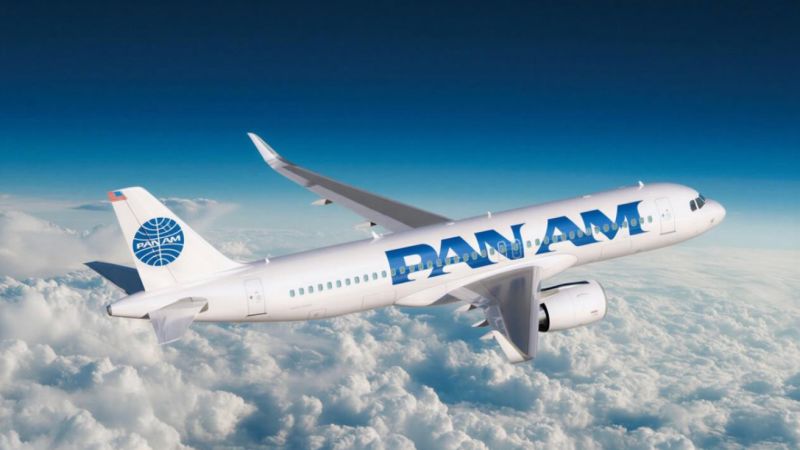
Few brands in aviation have been as influential as Pan Am.
Founded in 1927 as Pan American Airways, this legendary airline had a key role in defining the modern air travel experience. Under the leadership of its energetic and visionary founder Juan Trippe, Pan Am not only pioneered long-haul routes across two oceans and set new standards of service, but was instrumental in the development of some of the most iconic passenger aircraft to ever take to the skies, including the Boeing 707 and the 747 jumbo jet.
For nearly 40 years, Pan Am was the most prominent US carrier internationally and a symbol of American soft power. However, a combination of questionable strategic decisions and external shocks, such as the 1970s oil crisis and the 1988 Lockerbie bombing, led to its closure in 1991.
Nevertheless, the Pan Am brand became so intertwined with the idea of a so-called Golden Era of air travel that its name remains a symbol of cosmopolitan sophistication to this day. The appeal of the Pan Am brand is such that several attempts have since been made to try to resurrect it in one form or another.
And the latest and most ambitious of them all is beginning to take shape.
In February 2024, a group of investors led by Californian entrepreneur Craig Carter bought the Pan Am trademark and its related intellectual property for an undisclosed sum, with the idea of resurrecting the legendary airline as a lifestyle brand.
In the future, we could be staying in Pan Am hotels, or waiting for our flights in Pan Am airport lounges. We could be toting a Pan Am bag as we eat in a Pan Am restaurant. Even better, we could be taking to the skies in a Pan Am plane, delivering a taste of the glory days of flying to frazzled 21st-century travelers.
But that all depends if the new owners can pull it off.

Resurrecting a brand after it has laid dormant for 30 years is not for the fainthearted. But in the case of Pan Am, three decades of dormancy seems to have awakened nostalgia in many aviation fans’ minds.
How else to explain the excitement in June 2025, when a Pan Am-branded airplane set off on a 12-day “air cruise” to historical Pan Am destinations? Bermuda, Lisbon, Marseille, London, and Shannon in Ireland were the stops for the passengers, who had each paid around $60,000 to relive the spirit of Pan Am.
Carter won’t confirm how many paying passengers were on board, but the aircraft — a Boeing 757-200 leased from Icelandair and painted in the classic Pan Am livery — was configured with 50 full lie-flat seats.


The success of the itinerary, which sold out in three days despite its price tag, has been seen by the airline’s backers as proof that the Pan Am brand still holds considerable appeal — even if few of today’s travelers were in the air during the airline’s heyday.
It also suggests that a niche group of Pan Am fanatics are willing to pay considerable amounts of money to relive the airline’s glory days.
But does enthusiasm for a one-off retro itinerary translate into a potential long-term business?
The cornerstone of the new Pan Am project is a full-service airline which plans to take the famous blue and white globe livery back to the skies. Not just as a one-off, but on a regular basis.
Plans are very much in the embryonic stages, however, and have already changed from what was being mooted only recently.
In interviews last year, those behind the new Pan Am said they were planning business class-only cabins. Now, they are planning a three-class service, Ed Wegel, an aviation industry veteran and the new airline’s CEO, tells CNN.
The current obstacle is finding the right aircraft at a time in which the aviation industry is reeling from capacity constraints, he says. But one thing is clear: while the Pan Am of the past was firmly linked to Boeing, its new iteration will jump ship to Airbus.

“We have identified the Airbus A220 as the most suitable choice for our business model, although we may actually start with A320s if these become available,” he says.
Ultimately, they want to acquire widebody aircraft and expand into the long-haul market, he says. Ideally, the new Pan Am would operate a fleet of 25-30 single-aisle aircraft and 10-15 widebodies. But Wegel admits that there is “no specific timeline” for such a bold expansion.
In fact, there’s no timeline for the new airline at all. The much-trumpeted plans to get Pan Am back into the sky so far have no launch date. And in an already tricky economy for airlines, it’s safe to say that it will not be rushing to take off.
Wegel hints that “it may be in less than 12 months,” but that’s a big ask in this economy.

In the meantime, the investors are going ahead with launching Pan Am as a lifestyle brand, rather than an airline.
Pan Am’s brand popularity proved itself in 2014 when “The Pan Am Experience” started offering airline-themed dinners recreating the inflight dining experience of the 1970s.
No regulatory approval or airport slots were needed for that, since the Pan Am Experience did not take place during a real flight, but inside a Boeing 747 mock-up within a film studio located near Los Angeles, California.
The project managed to capture a significant amount of public attention before the Covid pandemic shut it down in 2020. But, says Carter, it will make a comeback at a new venue in September, bar any administrative holdups.
Next up is hospitality. March 2027 will see the opening of the first Pan Am hotel in Commerce, California — southeast of Los Angeles, and a 45-minute drive from LAX.

The hotel — which will be managed by Hilton and aims to embrace guests with travel nostalgia — was originally scheduled to open in late 2026, but faced bureaucratic delays, says Carter.
It might not be an one-off, either. Carter says that the Pan Am holding company is in conversations with a major hospitality brand to open up another 28 Pan Am hotels worldwide, although there are no dates confirmed.
Pan Am-themed dining is on the way, too. The first Pan Am restaurant should open at an undisclosed New York airport in October 2026, says Carter.
Finally, the company is in early discussions about opening branded lounges in the US and internationally, though not before 2028. “We want to touch everything travel-related,” Carter tells CNN.
The company is also licensing the Pan Am brand in order to offer a broad range of products and services, from Swiss watches to LEGO sets, under his umbrella company called Pan American Global Holdings.
He is convinced that people want to wear the brand — but what is that lends it such staying power, more than 30 years since its closure?

“Pan Am was global before globalization,” says Edmund Huot, chief creative officer at the Forward Group, a design studio specializing in airline branding.
“It embodied the idea of possibility. Everything in that brand communicates.”
Huot, who also manages an Instagram account called “The Livery Project,” which explores airline liveries as cultural artifacts, makes no secret of his admiration for the Pan Am brand. Yet he also sounds a word of caution.
“As a brand, it has delivered, but the world has changed,” he says. “You can’t just take the past and try to recreate 1965; you need to redefine the brand in terms of what it means today, of what people expect today. Can they build something that is digital, modern, frictionless? It’s going to be an interesting challenge.”
The plans to resurrect Pan Am as an airline certainly appear challenging — especially in the current climate.
With well-established carriers already canceling flights because of the fuel crisis sparked by the Iran war, there couldn’t be a much more difficult time to introduce a new airline brand. Carter and Wegel declined to comment when asked by CNN if this was the worst time to launch an airline, and if they were revisiting their plans and timeframe in light of the Iran war.
Carter says that they plan to relaunch Pan Am as a charter airline, with flights planned around markets where the Pan Am name still has “resonance” — starting with the East Coast “to maximize access to South and Central American markets.”

When these might take to the skies remains unclear. Last year the company was mooting launching flights to Christmas markets in Europe, but those never came to pass. And Wegel’s talk of a three-class service is already a change from last year when Carter said in an interview that they were considering an all-business-class service.
Even with three classes, though, don’t expect bargain-basement economy. “We don’t see an opportunity in the low-cost market,” says Wegel.
‘There’s no way they can do premium and survive’
That swerve from economy is a good move, says industry analyst Addison Schonland, co-founder of aviation data platform AirInsight. Yet Schonland is also skeptical about the overall feasibility of the project.
“The fact that they have selected Miami as a base makes sense, since this is where the original Pan Am started,” he says. “However they are going to have to start from zero because the brand doesn’t mean much to travelers today. I don’t see any gap in the market and I don’t know what they have to offer that is special.
“There’s simply no space for a new ultra-low-cost or low-cost carrier and there’s no way they can do premium and survive.”

Premium-only airlines have traditionally been a challenging business proposition. Over the past two decades a handful of startup carriers, including Eos, MaxJet and Silverjet, have all tried to grab a slice of the lucrative transatlantic market, only to fold after being unable to compete with the established incumbents.
Some niche players, however, have managed to persevere in specific markets. La Compagnie, which launched in 2014 with all-business flights from Paris to Newark, is still going, and since 2022 it has operated a Milan route too. However, its London-Newark route, which launched in 2015, folded after little more than a year.
BeOnd, which launched in 2024, links four European countries with the Maldives via the Middle East in all-business cabins — although a fifth destination, Munich, has been reduced to seasonal flights.
Meanwhile in the US, private charter companies such as JSX and Aero have also established a new category that sits roughly half-way between commercial and executive aviation.

Resurrecting a prestigious travel brand is rare, though not impossible, says Huot. In 2017, the Orient Express brand was acquired jointly by hospitality giant Accor and luxury conglomerate LVMH, with the aim of creating a premium travel and lifestyle brand comprising hotels, yachts and trains. So far, two ultra-luxury hotels, one upscale sleeper train, and a yacht have been launched. Slated for 2027 is “L’Orient Express”, a sleeper train which will recreate the original 1920s and 1930s experience aboard 17 original carriages.
Nostalgia for another defunct US airline has proved successful for the 1960s-themed TWA Hotel, which opened in 2019 at JFK airport in the former TWA Flight Center, designed by Eero Saarinen.
The Pan Am brand may be all about nostalgia, but the company is looking to the future, too. Wegel — who is also the founder of UrbanLink Air Mobility, a startup investing in electric aircraft for urban and regional flights — suggests that there may be opportunities to collaborate.
Small vertical-takeoff-and-landing electric “flying taxis” operated by UrbanLink could act as a feeder for Pan Am, bringing in people from different locations across state and nearby Caribbean islands to connect with flights out of Miami, he suggests.
UrbanLink has already signed Letters of Intent with several promising aircraft developers in the US. One order for 10 electric seaplanes has gone to Norway-based NOEMI Aerospace, which recently published a rendering of one of its amphibious aircraft emblazoned with the Pan Am livery. And a post briefly appeared on Wegel’s LinkedIn page recently, stating that the new Pan Am plans to use electric Seaglider planes from startup Regent. The post is no longer visible.
If true, it would be a return to the past. Pan Am helped popularize air travel in the 1930s through its pioneering use of seaplanes. At a time when most people still sailed across the oceans, the Pan Am “Clippers,” large long-range seaplanes, became one of the earliest forms of reliable air travel across both the Atlantic and the Pacific and emblazoned the promised of the nascent era of aviation.
It would be remarkable if, one century later, its new incarnation played a similar role in the coming-of-age of electric aviation, forging a direct link between the past and future of aviation.