
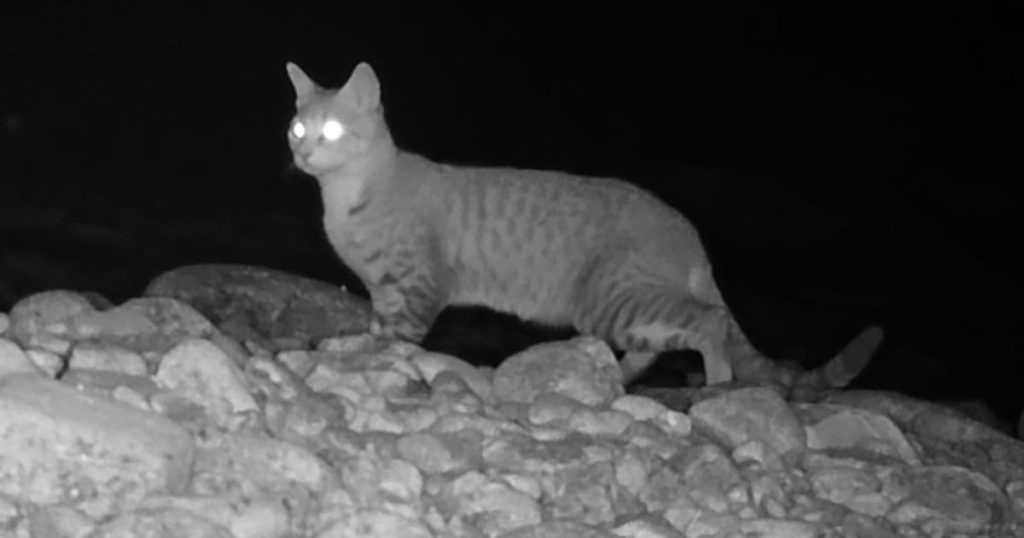
Arabian wildcats have been spotted in Wadi Wurayah National Park in Fujairah for the first time in at least a decade.
Images of the felines have been released by Emirates Nature – WWF after they were caught by cameras installed thanks to an initiative funded by Mashreq and Fujairah Environment Authority.
While the pictures confirm that Arabian wildcats are in the UAE, they face multiple threats, among them development and the risk of hybridisation with domestic cats.
Dr Andrew Gardner, associate director, biodiversity conservation at Emirates Nature – WWF, said it was “genuinely exciting” that the creatures were photographed.
“The Arabian Wildcat is one of the most elusive members of the UAE’s mammal fauna,” he told The National. “It is secretive, largely nocturnal, and easily overlooked even in suitable habitat.
“All records from Wadi Wurayah National Park are significant, both as a data point for range assessment and as a reminder of what the park is protecting.”
Regarded as secretive, mature Arabian wildcats will not allow people to approach them.
Since the cameras were set up in the park two years ago, two Arabian wildcats have been photographed.
‘Rewarding’ discovery
Dr Gardner said the sightings were “particularly rewarding” because they were the result of a wildlife mapping initiative that involved citizen, scientists and volunteers from the Emirates Nature – WWF Leaders of Change programme.
“It demonstrates exactly what structured community-based monitoring can deliver: hard evidence for species that would otherwise remain invisible to conventional surveys,” he said.
Wadi Wurayah National Park is, Dr Gardner said, a “sanctuary” for the animal, known scientifically as Felis lybica, as there have been few confirmed sightings elsewhere in the Emirates.
While he said there have been records of sightings from the broader Hajar Mountains area, peer-reviewed published records are limited.
“Outside the Hajar range, there are anecdotal reports from desert-fringe and rocky wadi habitats in the western UAE, although distinguishing true wildcats from feral domestic cats or hybrids in the field is notoriously difficult without genetic analysis,” Dr Gardner said.
“The honest assessment is that the species’ current UAE distribution is incompletely documented, and systematic camera-trap surveys across mountain and foothill habitats have not been conducted at the national scale needed to resolve this.”
Wadi Wurayah National Park is Fujairah’s only protected land area. It was given formal protection in 2009 and covers 225 square kilometres, more than one-fifth of the emirate.
Hybridisation with feral or domestic cats is the biggest threat to the Arabian wildcat, according to Dr Gardner, and there may be few genetically pure individuals remaining in the wild.
Without genetic testing, he said, it is very difficult to distinguish hybrids from pure wildcats.
Telling them apart
A true wildcat does not have black stripes on its body, but has two to three black bands on its tail, which ends in a black tip. Their body is pale light brown with some darker ginger stripes and spots. They have a cream underbelly and the backs of their ears are ginger.
Animals in remote locations with no domestic tabby markings and the right colouring “are most likely to be pure wildcats”.
“We believe those photographed deep in the Wadi Wurayah National Park are almost certainly pure. However without genetic testing, it cannot be 100 per cent certain,” Dr Gardner said.
“The most pressing conservation priority globally for the species is identifying genetically pure individuals and taking measures to prevent further hybridisation and that applies with particular force to the small, isolated Arabian population.”
The Arabian wildcat, previously called Gordon’s wildcat, is a distinct population of the Afro-Asiatic wildcat, which has a broad range across Africa and Asia.
While globally the species is listed by the International Union for Conservation of Nature as of “least concern”, Dr Gardner said that within the UAE it is endangered and there have been breeding programmes to safeguard the population.
Aside from hybridisation, other threats include habitat loss, because urban expansion, road building, quarrying and uncontrolled off-road driving fragment the mountains and foothills where the species lives.
Another issue is overgrazing by feral goats and donkeys, as this cuts the amount of vegetation available to the small mammals and reptiles that the Arabian wildcat eats. Dr Gardner said Arabian wildcats also eat insects, “which may be a significant part of their nutrient intake”.
Further measures that could conserve the population include undertaking more detailed genetic analysis to determine levels of hybridisation, and expanding camera-trap monitoring.
Wadi Wurayah National Park has, Dr Gardner said, yielded confirmed sightings of four wild carnivores, “making it one of the most important site for carnivore conservation in the UAE”.
As well as the Arabian wildcat, the Arabian caracal, Blanford’s fox and the Arabian leopard have been seen there.