
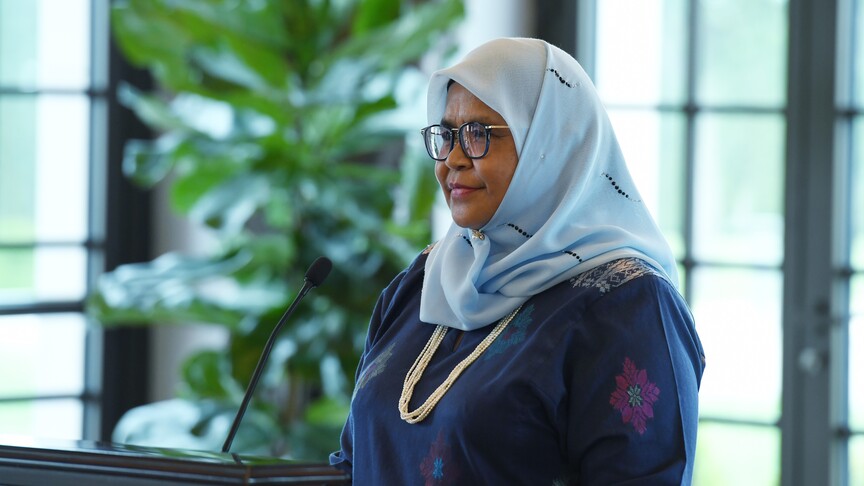
Zero waste should not be viewed solely as an environmental goal or municipal service, but as a practical climate action model that can make cities more efficient, resilient and sustainable, a Malaysian urban policy adviser said Saturday.
Maimunah Mohd Sharif, adviser to the Malaysian government on sustainable urbanization, made the remarks in a keynote speech titled “From Global Agendas to Local Results: Delivering Zero Waste as Climate Action” at the Zero Waste Forum in Istanbul.
Sharif said global climate frameworks and financing commitments have generated momentum, but their success ultimately depends on whether they are translated into tangible local systems.
Referring to the operationalization of climate funding arrangements, including the loss and damage fund agreed at COP28 in Dubai, she said the key question is whether such financing reaches the people and communities most in need.
“These figures are important for one simple reason. This shows that the world is moving in the right direction in terms of policy, in terms of commitment,” she said.
But implementation remains critical, she added, “where infrastructure is built, where services are improved, and systems are delivered to the most needed and the most vulnerable people.”
Sharif said global agreements, partnerships, and financing can only succeed when they produce visible local outcomes, particularly in cities, since zero waste is not simply about managing rubbish, but about how cities plan infrastructure, deliver services, coordinate institutions, engage communities and shape daily habits.
‘School is the most powerful space for system change’
Drawing on her experience as executive director of UN-Habitat and later as mayor of Kuala Lumpur, Sharif said the challenge is not only identifying solutions but making them “practical, scalable and lasting.”
She said zero-waste efforts should begin with the hierarchy of “rethink, reduce, reuse and recycle,” emphasizing that cities must focus on preventing waste before it is generated.
Recalling her time as mayor, Sharif said Kuala Lumpur faced financial and cleanliness challenges, while residents were reluctant to pay local taxes due to a lack of trust in the municipality.
Her administration sought to rebuild that trust through greater transparency, including printing the city’s audited accounts on tax bills to show residents how public funds were spent.
According to Sharif, Kuala Lumpur’s recycling rate rose from 16% to 56% during her tenure, becoming the highest in Malaysia at the time.
She also stressed the role of schools in driving long-term behavioral change, saying student-led zero waste initiatives helped integrate waste separation, composting and reuse into daily routines.
“School is the most powerful space for system change, because it shapes habit, norms and expectation,” she said, adding that children can become ambassadors for zero waste practices within their households and communities.
‘When waste has a cost, people begin to rethink’
Sharif said responsibility must be properly structured within waste systems, arguing that public systems weaken when municipalities are expected to absorb all costs regardless of who generates waste.
“When waste has a cost, people begin to rethink. They rethink what they consume, what they dispose, and how they manage,” she said, adding that the most effective waste management system is “the one that has less waste to manage.”
Sharif further noted that zero waste is linked to resource extraction, production, transport, consumption, and emissions across the value chain, making it a central element of the circular economy.
“Zero waste here is not only about rubbish. It is about better management, smarter design, responsible production, conscious consumption, and going to the circular economy,” she said.
She also called for stronger collaboration among governments, businesses, communities and other stakeholders through what she described as the “four Ps” principle: public, private, people, and partnership.
Governments provide rules, incentives and accountability, while the private sector contributes innovation, logistics and operational expertise, she explained. Communities, meanwhile, play a decisive role in determining whether systems succeed.
‘Innovation without governance is not transformation’
Sharif said governance is essential to turning ambition into results, stressing that leadership, institutional capacity, financing, coordination and continuity are necessary for zero waste systems to endure beyond political cycles.
She cited examples from Kuala Lumpur, including a zero-waste program at Ramadan bazaars that helped recover 11 tons of food worth about 141,000 Malaysian ringgit ($35,000), and prevented more than 21 tons of carbon dioxide emissions.
She also highlighted community recycling centers where residents could exchange recyclable materials for coupons redeemable for goods, public transport tickets or rent payments in affordable housing.
Such programs, she said, demonstrate how waste can be transformed into everyday value when participation is practical and rewarding.
‘Scaling is not about duplication’
Sharif said zero waste cannot succeed as a standalone campaign but must be embedded into city systems through aligned incentives, visible services, institutional coordination and community participation.
“Scaling is not about duplication. It is about adaptation,” she explained, urging cities to “adopt and adapt” successful practices to local realities.
The Zero Waste Forum, held June 5-7, is led by Türkiye’s first lady Emine Erdogan, who chairs the UN High-Level Advisory Board on Zero Waste and serves as honorary president of the Zero Waste Foundation. The event is supported by UN agencies including UNEP and UN-Habitat.