
China displays ambitions which, if realised, will constitute hegemony. Or at least a type of hegemony, one which would be less orderly, given its reluctance to take on responsibility for the global commons.
China’s ambitions are large. No matter what field of endeavour – engineering, science and technology, manufacturing, military capability, AI or space – the regime aims at the commanding heights, combining Stakhanovite determination with Teutonic thoroughness. It has a can-do confidence derived from its recent rapid growth, organisational prowess, the supposed secret sauce of “scientific socialism” blended with “ancient Chinese wisdom”, its economic weight and population size, and the West’s disarray.
China tells the Global South that its experience constitutes an alternative, non-Western path to modernity. Its propaganda speaks of creating a “great miracle in the history of human development” and a “new form of human civilisation”.
Moving beyond the material, China now wants to develop an autonomous knowledge system, a corpus of philosophy and social sciences independent of Western ideas (the irony of Marxism’s European origins is ignored).
In short, wherever possible, China aims to reach the top.
Claims that China is different and will not deploy power like others are not borne out by its behaviour.
All countries seek to maximise their interests but China is unusually exacting in this regard. Its self-proclaimed “core interests” are non-negotiable. It is unembarrassed about exploiting bilateral leverage, linking economic carrots and sticks to political demands. In China’s bilateral dealings it raises the bar ever higher, such as by tightening what it is prepared to tolerate under its “one China” policy umbrella.
In the past, China exerted pressure mainly behind closed doors, but now it is less subtle. Copying the United States, it has developed mechanisms to sanction foreign firms, individuals and governments. During Covid it sought to place political conditions on exports of medical supplies. Now it weaponises its near monopoly on rare earths, with Japan’s defence industrial complex currently a target (Opens in new window).
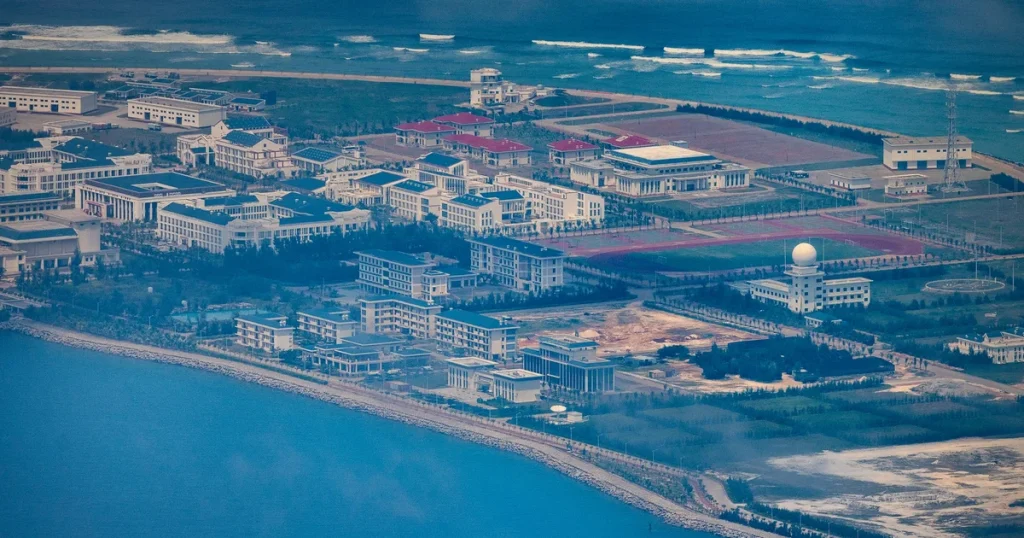
Compromise is seen as the last resort rather than a fair and worthwhile objective. Take the South China Sea. This group of islets and reefs spread between the notional EEZs of several states, claimed in whole or in part by six governments and with no native inhabitants, should be ideal for a negotiated settlement, a big soft power plus for Beijing. But China has resolved that its claims alone will prevail. It is determined to possess these waters come what may: rejecting legitimate international arbitration, investing in massive facilities and deployments to dominate the physical space, and working up legal argumentation that would restrict the application of international law there.