
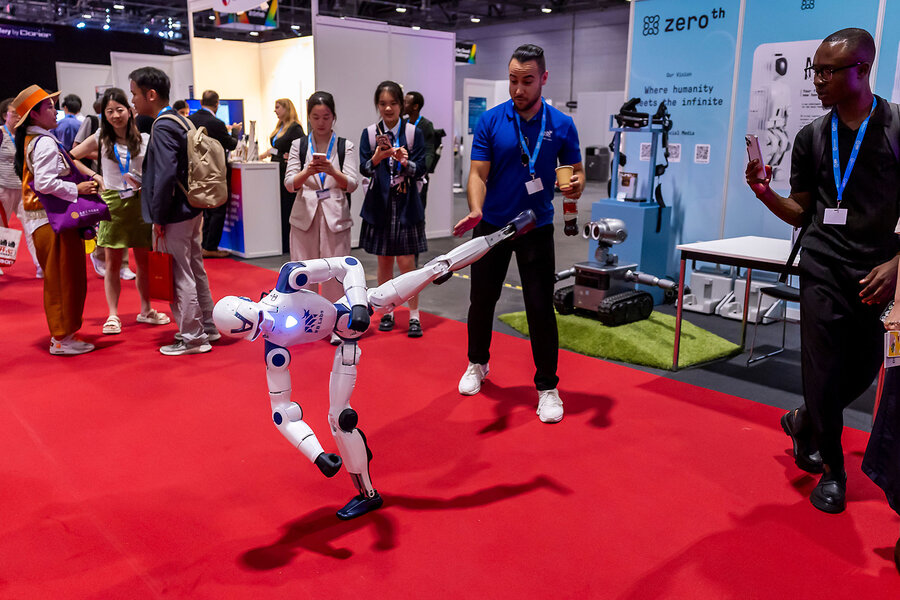
Representatives from more than 190 countries are in Geneva this week to take part in three overlapping summits hosted by the United Nations about the future of artificial intelligence. But there’s one country whose presence is being felt across the range of events: China.
There’s the Chinese-made humanoid robot practicing karate in the hallway, the dog-shaped “human companion” accepting cuddles in the main exhibition hall, and displays for all manner of Chinese-designed cloud-computing and AI tools designed to streamline workflow.
Perhaps more significant than the product demonstrations is the ubiquitous presence of Li Lecheng, China’s minister of industry and information technology.
Why We Wrote This
World leaders and technology executives from around the world are meeting in Geneva this week for a major U.N. summit on the future of AI. U.S. officials are mostly staying away from the proceedings, while China is stepping in to fill the vacuum.
On Monday, the longtime Chinese Communist Party functionary, with wire-rimmed glasses and a high hairline, could be seen on the main stage declaring Beijing’s belief in “AI for Good and AI for All.” On Tuesday, Mr. Li kicked off a session that included leaders from Pakistan, Russia, Zambia, and other African nations to explore ways to extend the reach of AI across the developing world. On Wednesday, he led a series of presentations by the state-run China Academy of Information and Communications Technology on AI-powered prosthetics.
But while the Chinese government has been a constant presence at the proceedings in Geneva, officials from the United States were almost nowhere to be seen.
Several heads of state gave speeches, and most governments – including France, Japan, and India – sent an ambassador or cabinet minister. U.N. Secretary-General António Guterres went to the rostrum on Monday, endorsing his mandate for global collaboration on AI’s use on issues from child safety to “killer robots” used in war.
By contrast, the U.S. delegation was led by a low-level assistant secretary of commerce. No U.S. official was listed as a “featured attendee” on the United Nations’ website, and none spoke Monday after Mr. Guterres, though a State Department spokesperson told the Monitor that a White House official, Katie Strickland, delivered remarks a day later.
“Our hope is that shared efforts to advance the diffusion of the full AI stack across partner countries will become an occasion for bilateral diplomacy, international development, and global economic dynamism,” Ms. Strickland said, according to a transcript provided by the U.S. mission to Geneva. “We are working hard to make sure that the AI future is one of prosperous collaboration and peaceful competition around the world.”
Decline of U.S. importance
In interviews, diplomats, scientists, and civil society advocates from around the world said they had become accustomed to a minimal U.S. engagement in the global AI debate and were proceeding accordingly.
“There used to be a time when there was some prestige associated with the Americans, but now we don’t care,” says Linda Bonyo, founder of Lawyers Hub Africa, a Kenyan nongovernmental organization that works on AI issues.
She adds that governments in Africa and elsewhere are aware that Chinese largesse might come with a catch. News reports have noted that, despite a public commitment to open-source technology, China is considering withholding its most advanced models from other nations. In 2022, the Federal Trade Commission effectively barred the Chinese chipmakers Huawei and ZTE from doing business in the U.S. over national security concerns.
But “the Americans are not perfect either,” says Ms. Bonyo.
The decline of U.S. stature and the rise of China’s prominence were seen even in the prosaic task of scheduling international conference calls.
“It used to be we would have them in the afternoons [East African time] so that the Americans could make it,” she says. “Now, we have them in the morning. Let China attend.”
Critical conversations
Meanwhile, the AI summits in Geneva covered a range of critical issues, often without direct participation by U.S. officials.
On Thursday, the International Telecommunications Union (ITU), a U.N. body that once led discussions on standardized phone numbers, announced it had convened a global working group for discussions around standards for “authentic AI agents” that are capable of reasoning, planning, and executing tasks on their own.
Speaking at the news conference here, representatives from both the Chinese firm Huawei and the French government stressed that global collaboration was necessary to ensure that these bots could be trusted, act safely, and function properly when they interact with each other.
Afterward, Bilel Jamoussi, deputy director of the ITU’s Telecommunications Standardization Bureau, told the Monitor that while no American officials were currently on the panel, the U.S. government had approved its creation.
Mr. Jamoussi says he hopes that the U.S. government and representatives with major U.S. AI firms, such as OpenAI and Anthropic, will consider joining soon.
“I’m optimistic that they will,” he says. “Imagine if you couldn’t pick up the phone in one country and call someone in another. … That’s a benefit of standardization.”