
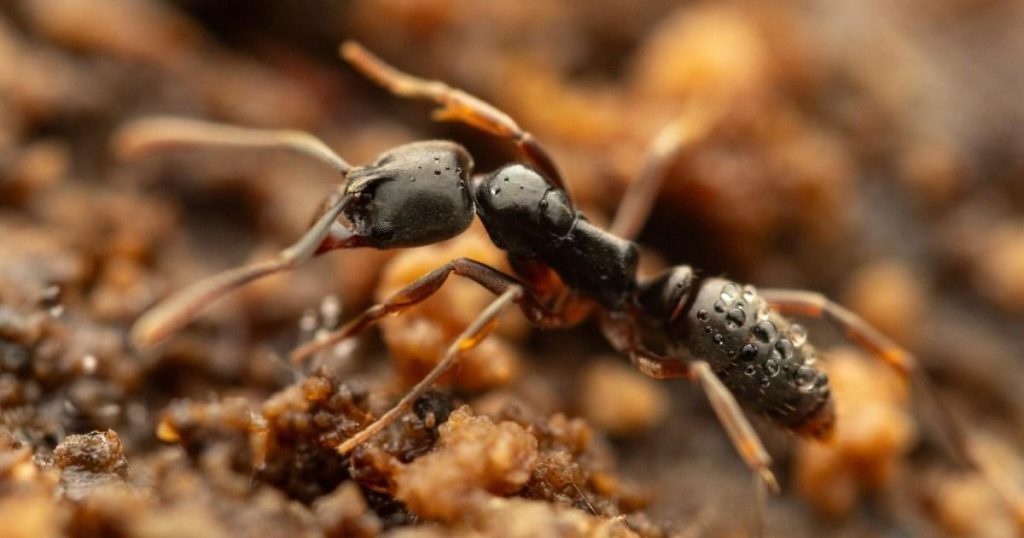

The US is experiencing a venomous ant outbreak with warnings issued across multiple states.
Asian needle ants, native to China, were first reported in the United States over 90 years ago, likely through international trade.
However, officials say they’ve now spread to at least 20 states, reported to be: Massachusetts, Wisconsin, Florida, Georgia, Ohio, New York, Virginia, Alabama, Mississippi, Arkansas, Tennessee, North and South Carolina, Kentucky, Pennsylvania, Maryland, Connecticut, Rhode Island, Washington state, and Texas.
The U.S. Department of Agriculture (USDA) commented on the surge of insects. While the ants were described as ‘not terribly aggressive,’ it revealed that their stings are often painful, and can cause anaphylaxis and, in extreme cases, even death.
Alongside the threat to humans, the department stated that these ants can cause devastating potential ecological impacts.

Asian needle ants ‘displace ant species that are critical seed dispersers,’ it said. ‘Thus, this invasive species could have dramatic, long-term negative effects on forest understory.’
Dan Suiter, an entomologist with the University of Georgia’s extension service, told Georgia Public Broadcasting (GPB) that ‘on a daily basis, you have these multiple species that they’re always competing with one another.’
Suiter explained that Asian needle ants ‘out-compete’ other ant species for food, driving those species to ‘local extinction.’
So, what exactly sets these ants apart from the crowd, and what should US residents look out for?

What is the Asian needle ant?
Asian needle ants are small to medium in size. They have worker and queen variations, and are dark brown to black in colour. Their antennae and legs are a lighter shade of orange-brown.
Despite their small stature, their stings pack a punch — they can trigger severe allergic reactions or, in extreme cases, anaphylaxis and death.
According to the USDA, their sting can cause ‘intense pain’ at the site that ‘comes and goes over the course of several hours.’
However, the department notes that some people can also experience pain from the sting in other areas of the body.
The USDA reports that Asian needle ants can be hard to identify and require an ‘experienced eye.’

There are ways you can detect them other than visually, though.
The ants have a unique habitat, unlike other ants. Rather than building anthills, they prefer nesting in enclosed spaces, such as within logs, debris, under stones, and in leaf litter.
Asian needle ants aren’t fussy about being in nature, either. They have also been found playing house in human homes and businesses, specifically beneath pavers, landscape timbers and mulch.
A 2025 study found the ants thriving in a community mulch pile in Watkinsville, Georgia. The authors claimed that gardeners taking mulch from the pile could be contributing to the ants’ local spread.
How to protect yourself from Asian needle ants
Good news: Asian needle ant infestations can be prevented.
Scott Baker, a Bedford extension agent with the Virginia Cooperative Extension, warned via People that anyone ‘clearing out rotten wood areas’ should ‘be aware’ of a potential nest.
He also stressed it’s important to wear gloves just in case you stumble upon the species.

Suiter backed this up to Georgia Public Broadcasting (GPB). He explained that ‘one of the ways to minimize the numbers of needle ants in your yard would be simply to clean up all that.’
He also added that the species don’t interact the same as ants in long trails might.
‘When you see them in your yard or on the concrete, they’re just kind of meandering around as a single ant, and they don’t really garner your attention,’ he said.
Asian needle ant stings look different to fire ant stings, too, so it’s important to know the difference so you can seek relevant medical help if required.
Needle ant stings produce small, red dots, surrounded by swelling, while fire ants appear like small spots with a white pustule.
Symptoms of anaphylaxis
With the ants bringing risk of anaphylaxis, The Mayo Clinic describes it as a ‘severe, potentially life-threatening allergic reaction.’
It can ‘occur within seconds or minutes of exposure to something you’re allergic to, such as peanuts or bee stings.’
Anaphylaxis causes the immune system to release a flood of chemicals that can send the human body into shock. Blood pressure drops suddenly, and the airways narrow, which blocks breathing.
Symptoms include:
• Rapid, weak pulse
• Skin rash
• Nausea and vomiting
The clinic adds that anaphylaxis requires an injection of epinephrine and a ‘follow-up trip to an emergency room.’ If you don’t have a shot of epinephrine, you must call emergency services for treatment immediately, otherwise it can be fatal.
MORE: Moment fireworks factory explodes and kills 26 people
MORE: You’d never guess it, but Cleveland is a cracking sort of holiday