
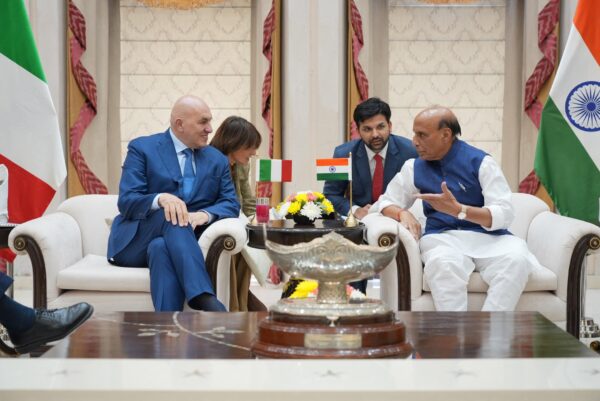
When Italian Defense Minister Guido Crosetto landed in New Delhi in late April, the visit was more than a routine bilateral engagement. It marked another step in a broader strategic recalibration that has seen Italy progressively deepen its political, economic, and security ties with India. Coming on the heels of high-level diplomatic exchanges led by Foreign Minister Antonio Tajani and sustained political dialogue between Prime Ministers Giorgia Meloni and Narendra Modi, Crosetto’s mission signaled that Rome is now investing political capital in the Indo-Pacific generally – and India specifically.
At the core of the visit is a growing defense partnership. During talks with his Indian counterpart, Rajnath Singh, Italy and India agreed on a new bilateral military cooperation plan for 2026–2027 (admittedly a generic, rather than specific, plan), outlining expanded joint activities between their armed forces. This includes training exchanges, general cooperation, and increased industrial collaboration – particularly in the naval sector, where Italian firms such as Fincantieri are seeking a stronger foothold in the Indian market.
Yet focusing solely on defense risks missing the larger picture. Crosetto’s visit should instead be understood as part of a multilayered diplomatic effort that has unfolded over the past year. In December 2025, Tajani (who is also Italy’s deputy prime minister) traveled to India for a number of high-level meetings with Modi and senior members of the Indian government. That visit reaffirmed a shared strategic outlook on key global issues, from Ukraine to the Indo-Pacific, and emphasized the ambition to significantly expand bilateral trade and investment. The two sides also revisited the Italy-India Strategic Action Plan, identifying priority sectors ranging from advanced manufacturing to energy transition.
Crucially, this diplomatic momentum has been reinforced at the highest political level. Meloni and Modi have maintained a steady dialogue, and the Indian prime minister has accepted an invitation to visit Italy in 2026, a move that is expected to further institutionalize the partnership. The symbolism here matters: Italy is positioning itself not merely as a European interlocutor, but as a proactive middle power seeking relevance in the Indo-Pacific.
Italy’s growing engagement with India reflects a broader, even if somewhat belated, Indo-Pacific turn. Compared to France or even Germany, Rome has historically lacked a coherent regional strategy. However, under Meloni’s government, there has been a discernible shift toward a more assertive foreign policy, one that seeks to align Italy with emerging geopolitical realities.
India is central to this recalibration. As a major economic power, a key player in global supply chains, and a strategic counterweight to China, New Delhi offers Italy both opportunities and strategic leverage. For Rome, strengthening ties with India also serves to diversify its partnerships beyond the traditional Euro-Atlantic framework.
Defense cooperation plays a particularly important role in this context. The agreement reached during Crosetto’s visit builds on a shared interest in maritime security, especially in the Indian Ocean, a region increasingly shaped by great power competition. Italy’s naval expertise and India’s regional presence create a natural basis for collaboration, while joint exercises and defense industrial partnerships could further cement this alignment.
Another key dimension of the Italy-India relationship is industrial cooperation. The presence of Italian defense companies in India during Crosetto’s visit underscores the economic logic underpinning the partnership. For Italy, India represents both a vast market and a strategic partner in high-tech sectors, including shipbuilding, aerospace, and defense manufacturing.
This aligns with India’s own priorities. Under Modi’s “Make in India” initiative, New Delhi is actively seeking foreign partners to boost domestic production capabilities. Italian firms, with their strong technological base and experience in niche sectors, are well positioned to contribute to this effort.
At the same time, the partnership reflects a deeper strategic convergence. Both countries share an interest in maintaining a rules-based international order, ensuring maritime security, and managing regional instability. While Italy remains firmly anchored in NATO and the European Union, its engagement with India signals an openness to broader geopolitical alignments.
Despite this positive trajectory, the Italy-India partnership is not without large limitations. Structurally, bilateral trade remains below its potential, and regulatory barriers continue to constrain deeper economic integration. Moreover, Italy’s Indo-Pacific engagement still lacks the institutional depth and strategic clarity seen in other European countries.
There is also the question of sustainability. Italy’s foreign policy has historically been characterized by discontinuity, and it remains to be seen whether the current momentum can be maintained over the long term. Much will depend on whether Rome can translate high-level political engagement into concrete and lasting frameworks of cooperation.
Finally, geopolitical complexities cannot be ignored. India’s strategic autonomy – its ability to maintain relations with both Western countries and actors such as Russia – may at times complicate deeper alignment with European partners. For Italy, navigating this landscape will require a careful balance between ambition and pragmatism.
Crosetto’s visit thus represents more than a diplomatic milestone; it is a test of Italy’s evolving foreign policy. If sustained, the current trajectory could transform Italy into a more consequential actor in the Indo-Pacific, capable of leveraging its industrial strengths and diplomatic flexibility.
The coming months will be critical. Modi’s expected visit to Italy in 2026 could provide an opportunity to formalize the partnership further, potentially elevating it to a comprehensive strategic framework. At the same time, continued engagement at the ministerial and operational levels will be seminal to ensure that the momentum generated by visits such as Crosetto’s translates into tangible outcomes.
In this view, Italy’s approach to India contains a broader shift in its international posture. No longer content with a primarily Euro-centric role, Rome is seeking to position itself within a more interconnected and competitive global order. Whether this ambition will be matched by consistent policy execution remains an open question – but for now, at least the direction of travel is clear.