
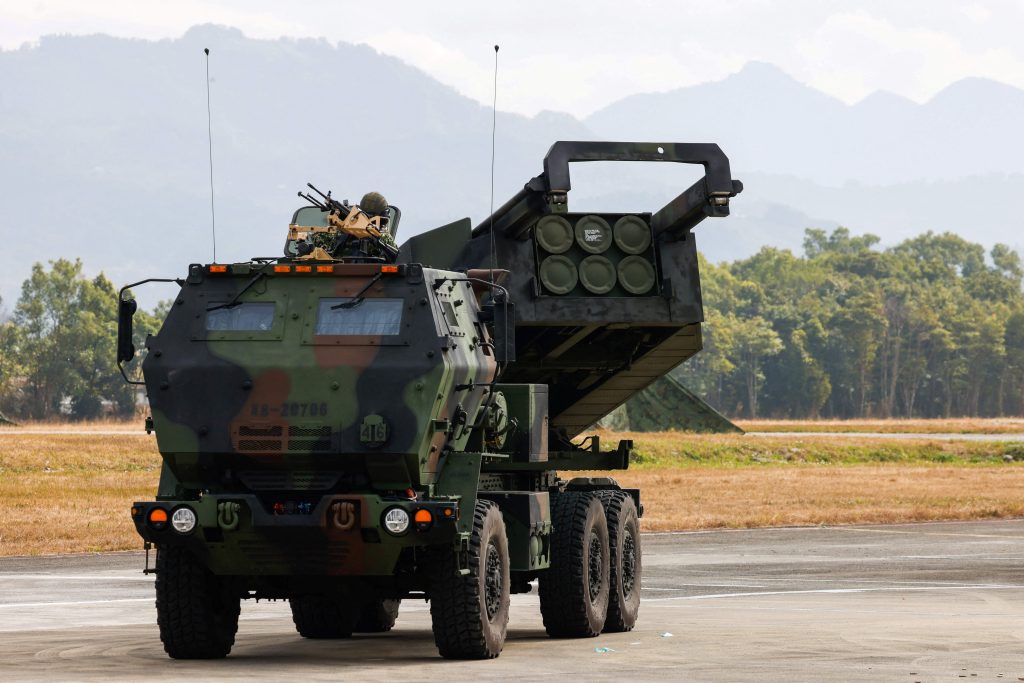
On January 26, the U.S. and Philippine militaries conducted a joint exercise in the South China Sea at the disputed Scarborough Shoal. In a show of force, the Philippines deployed its frigate, the Antonio Luna; a coast guard offshore vessel; a helicopter; and two military planes, while the U.S. Indo-Pacific Command deployed a MH-60R helicopter and an Arleigh Burke-class guided missile destroyer.
Days after the exercise, China conducted air and naval patrols around the Scarborough Shoal. In an unusual move, the PLA Southern Theater Command announced details of the operation, revealing the type of aircraft and naval frigates used, alongside flight paths over the disputed region. Japan also tracked four strategic warships transiting the Miyako Strait. The strait, which is of high strategic importance, is part of Japan’s exclusive economic zone.
Meanwhile, satellite imagery showed that China intends to claim land on Antelope Reef in the Paracel Islands. The images show significant changes, including new infrastructure and access for heavy equipment; if turned into a military base, the island could serve as a helipad, anchorage for Chinese vessels, and a radar station.
China Escalates Pressure on Taiwan
After China launched rockets into Taiwanese waters during military exercises in late December, Taiwanese President Lai Ching-te vowed to bolster national defense and protect Taiwan’s sovereignty. Taiwan’s National Security Bureau, the nation’s top security agency, further characterized the drills as both a campaign to stifle international backing for Taiwan and a tactical diversion from China’s domestic economic issues. The U.S. Department of State also issued a statement urging China to stop its intimidating military actions and to instead facilitate “meaningful dialogue.”
On January 17, a Chinese surveillance drone entered the airspace of Pratas, a Taiwan-controlled island located in the South China Sea. In a statement, Taiwan’s defense ministry stated that the drone left after Taiwan broadcasted warnings using international radio channels and that the move was “provocative and irresponsible.” The drone activity was likely the first violation of Taiwanese airspace by Chinese aircraft in many years and could have resulted in a military response from Taiwan.
Meanwhile, amid reports that General Zhang Youxia, a top ally of Chinese President Xi Jinping, is under investigation, Taiwan’s Defense Minister Wellington Koo stated Taiwan was monitoring “abnormal” shifts in China’s military leadership on January 26. While noting those internal purges, Koo warned that Taiwan will not lower its guard, as China’s persistent daily harassment and refusal to renounce using force indicate a significant threat.
Taiwan also conducted military drills on January 29 to simulate repelling a sea assault by China. The exercise marked the first deployment of domestically produced suicide drones, which Taiwanese officials liken to the American-made Switchblade drones that Ukrainian forces used successfully against Russia. Taiwan used those new assets alongside fast patrol boats and shore-based missiles to intercept an incoming threat.
Continued China-Japan Tensions
A Chinese commerce ministry statement on January 6 announced a ban on dual-use exports to Japan that could be utilized for military purposes. Those items include software and technology with both military and civilian applications, including rare-earth elements that Japan can use to make chips or drones. The next day, Japan denounced the ban as “absolutely unacceptable.” Responding to those supply constraints, a Japanese mining ship departed on January 12 for a remote atoll to conduct the world’s first attempt at extracting rare-earth sludge from a depth of six kilometers (nearly four miles), a key step in Japan’s strategy to reduce its mineral dependence on China. According to a Reuters survey, over two-thirds of Japanese companies believe deteriorating relations with China will damage the economy, with roughly 44 percent already experiencing or expecting a direct hit to their business.
Amid the rising tensions with China, Japan and the Philippines signed a defense pact on January 15 that allows their forces to exchange essential supplies such as fuel and ammunition during joint training. Alongside that resupply deal, Japan pledged a $6 million security assistance package to build naval facilities for Philippine patrol boats, further bolstering the Philippines’ maritime defense capabilities. Beijing accused Tokyo of using Manila to justify “remilitarization,” invoking Tokyo’s wartime “blood debt” to Manila to undermine the coalition.
The diplomatic rift reached a symbolic milestone on January 27, when panda twins Xiao Xiao and Lei Lei were returned to China a month earlier than their loan stipulated. Although their departure marks the end of an era of “panda diplomacy” that began in 1972, officials from both nations expressed hope that such cultural exchanges will continue to foster future friendship.
China and Pakistan Reaffirm Partnership
On January 5, China and Pakistan committed to expanding the China-Pakistan Economic Corridor and deepening cooperation across industry, agriculture, and mining. Both sides also called for stronger action to dismantle terrorist organizations in Afghanistan and pledged to upgrade protections for Chinese personnel working on projects in Pakistan.
Two days later, China’s public security minister met with Pakistan’s interior minister in Beijing to intensify that security commitment, agreeing to establish a quarterly joint security working group and annual ministerial meetings. The two sides pledged to improve counterterrorism response mechanisms, expand police training exchanges, and enhance cybercrime cooperation, with Pakistan welcoming Chinese technology assistance and announcing a dedicated protection unit for Chinese nationals in Pakistan’s capital, Islamabad.
China and India Continue Moving Toward Rapprochement
India’s finance ministry plans to scrap five-year-old restrictions on Chinese firms bidding for government contracts, as India revives commercial ties amid reduced border tensions. The curbs, imposed in 2020 following a deadly military clash, had effectively barred Chinese firms from competing for an estimated $700–750 billion in Indian government contracts.
That thaw was underscored on January 26, when Xi publicly described China and India as “good neighbors, friends and partners” in a message to India on its Republic Day. Xi called the improvement in bilateral relations over the past year significant for global peace and prosperity and expressed hope that both sides would expand cooperation and address each other’s concerns going forward.
China Signals New Nepal Hydropower Investments
A Nepalese official said China has already proposed several hydropower projects and is planning additional investments in the near term, signaling continued expansion of its role in Nepal’s energy sector. The official added that, as Nepal’s largest investor, China is expected to further increase foreign direct investment, particularly to develop hydropower capacity for potential export to India.
Thailand signed a January 12 agreement with China to purchase an additional batch of VN-1 armored vehicles, expanding its existing fleet as part of its 2025 defense modernization plans. The agreement, finalized with state-owned company Norinco in Beijing, reflects Bangkok’s reliance on cost-effective Chinese military hardware to strengthen frontline capabilities.
On January 23, Xi congratulated Vietnam’s To Lam on his reelection as Communist Party general secretary, describing the two nations as a “community with a shared future.” Xi praised Vietnam’s achievements in socialist construction and its growing international standing, using the occasion to reinforce the two countries’ close ideological and diplomatic ties.
On January 27, China’s foreign ministry reported that the Cambodia-Thailand ceasefire is being “gradually” implemented, expressing hope that both sides would ensure a comprehensive and lasting end to hostilities. Thailand returned eighteen soldiers to Cambodia following the second ceasefire agreement reached in late December, which ended weeks of the worst border clashes between the two neighbors in years.
Meanwhile, Indonesia revoked the operating permit of a China-backed hydropower plant on its island Sumatra. The plant was among twenty-eight firms penalized for environmental breaches that worsened deadly floods in November, which killed over a thousand people. China’s consulate general in North Sumatra pushed back, asserting that the Batangtoru plant’s construction complied with Indonesian law and expressing hope that operations could resume.