
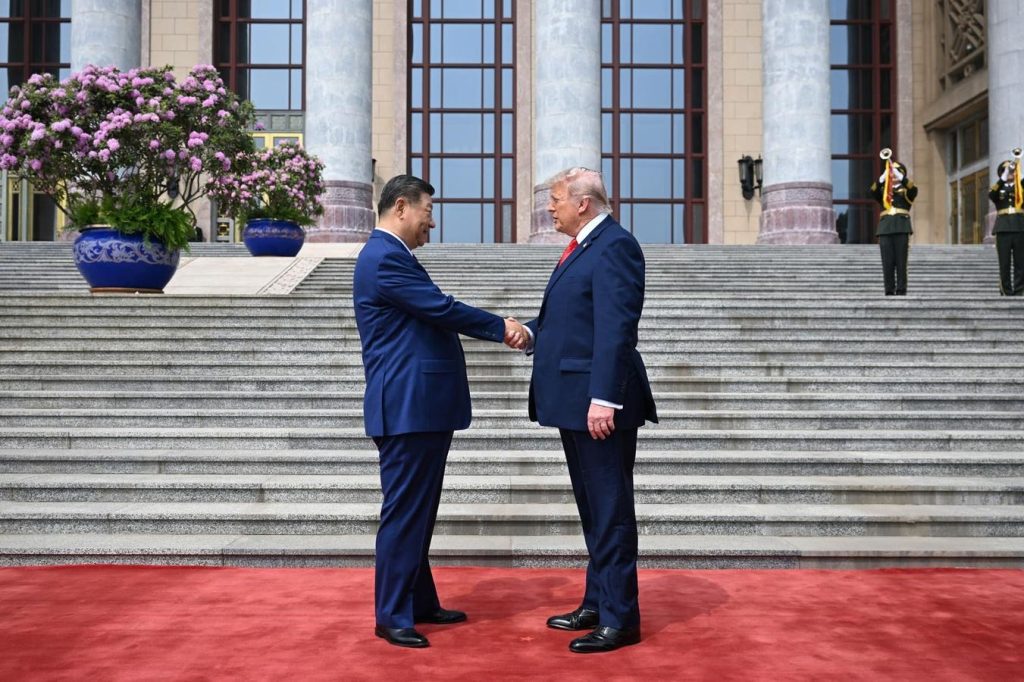

U.S. President Donald Trump (R) is greeted by Chinese President Xi Jinping at the Great Hall of the People on May 14, 2026 in Beijing, China. The trip by Trump is focused on trade, regional security, and strengthening bilateral ties between the world’s two largest economies. (Photo by Kenny Holston-Pool/Getty Images)
Getty Images
The turnout of more than a dozen U.S. corporate heavyweights including Tesla CEO Elon Musk and Apple CEO Tim Cook at this week’s summit between U.S. President Donald Trump and Chinese President Xi Jinping in Beijing underscores the continuing importance of China to the American economy and its key businesses despite years of growing bilateral trade and geopolitical stress, according to a long-time American business expert.
“We’ll see in coming weeks what kind of deals the CEOs came away with, but it’s clear that they all need China, both for the market and production,” particularly involving rare earth minerals, said Ker Gibbs, author of recently published The Fragile Dragon: Trade, Trump, and China’s Vulnerabilities. Formerly chairman of the American Chamber of Commerce in Shanghai, he is currently an executive-in-residence at the University of San Francisco’s Center for Asia Pacific Studies.
“Both Sides Need Each Other”
Trump’s decision to bring “companies worth some $30 trillion in market cap was impressive, but it was also a demonstration of vulnerability. Both sides need each other,” Gibbs said in a written exchange.
Tesla, for instance, reportedly generates as much as a third of its global car sales from China. Apple’s supply chain dependence on the country was detailed in a best-selling book last year, Apple in China: The Capture of the World’s Greatest Company.
“The Fragile Dragon” is the second China-themed book by Ker Gibbs.
Ker Gibbs
Trump’s visit to China, the world’s second-largest economy, was the first by a U.S. president in nine years, yet ended light on formal deals, Gibbs said. “The specific outcomes seem limited, but a deeper relationship between the leaders is a good thing,” he said. The billionaire businessman-turned-politician notably lavished praise on Xi, summed up by one Reuters headline: “Trump leaves Beijing with few wins but warm words for Xi.”
Conservative Supporters Wary
The warm language has attracted warnings of caution from his supporters at home wary of China. China announced after the summit that Xi Jinping agreed to visit the U.S. on a state visit in the autumn; it also announced that Russia President Vladmir Putin will pay a state visit next week.
Trump could use some good news. Inflation is at a three-year high ahead of year-end Congressional elections, and the U.S. war in Iran launched with Israel has bogged down. For its part, China is facing a period of relatively slow economic growth, high youth unemployment and a dramatically aging population.
A general understanding appears to have been reached between Trump and Xi during the summit on at least one key issue – Iran, Gibbs said. “The leaders agreed that the Hormuz Strait should be opened, but Xi’s position was basically ‘you broke it you fix it,’” he said.
On Taiwan, the self-ruled democracy of 23 million over which Beijing claims sovereignty, Xi’s message was “pretty strong,” warning of conflict over differences, he said.
“But it’s still an issue for the future, not now,” Gibbs said. “Right now, China is in no position to attack, and the U.S. is in no position to defend. We have some time, but Xi is clearly stating that a resolution is coming. Finding a peaceful path forward has never been more important or urgent. Everyone should be paying attention to that.”