
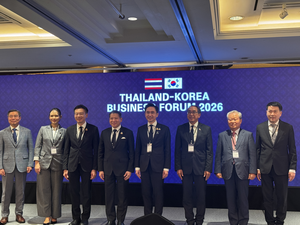
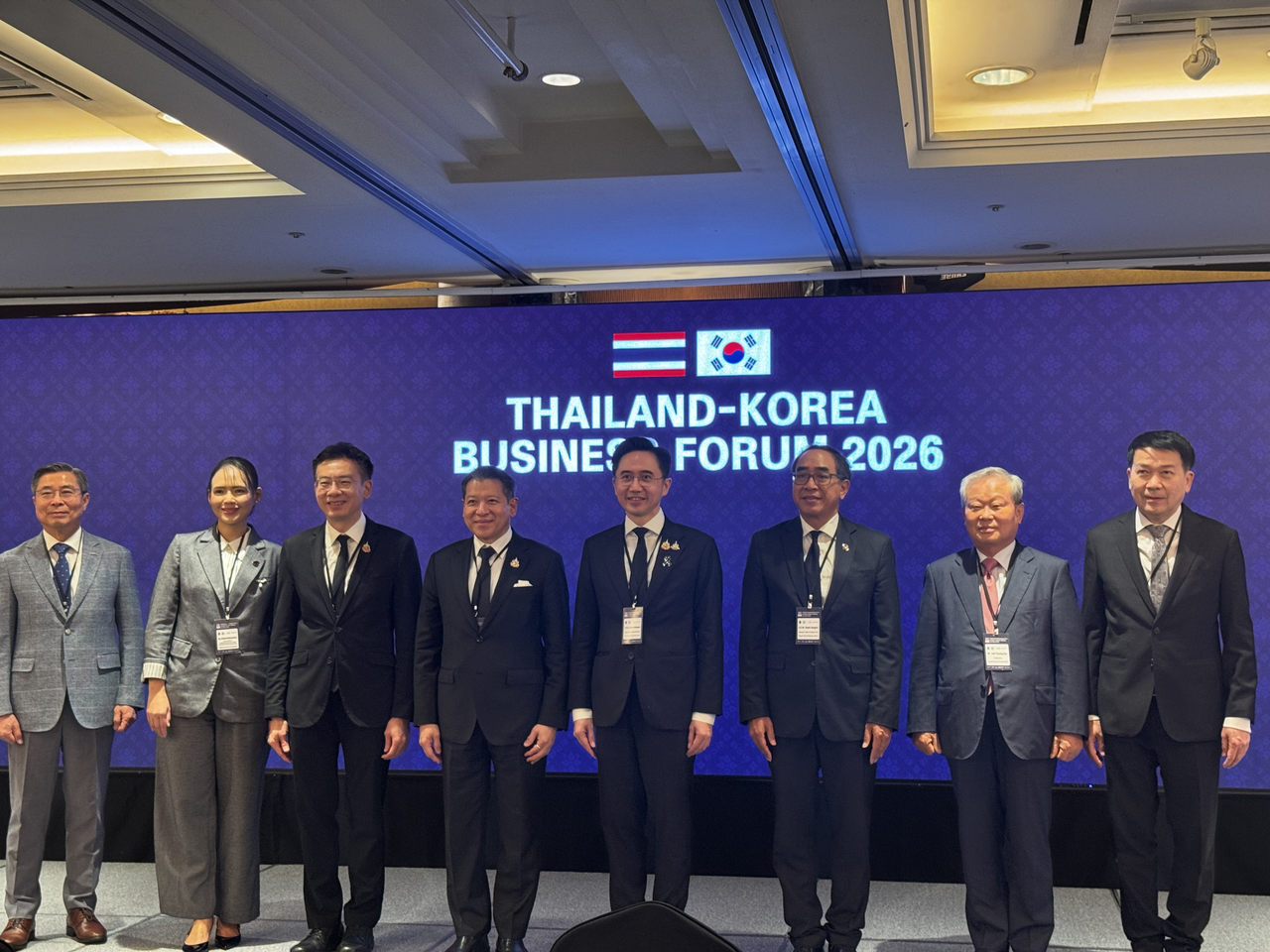
Thailand’s deputy prime minister called for greater Korean investment in biotechnology, healthcare, wellness and future food industries Wednesday as the country seeks to reduce its reliance on agriculture and expand into higher-value sectors.
“We seek to support Thailand’s partners through joint incubation programs, joint investment and business matching in areas such as medical devices, the medical industry and vaccine development,” Deputy Prime Minister and Minister of Higher Education, Science, Research and Innovation Yodchanan Wongsawat said at the Thailand-Korea Business Forum held at a hotel in Jung-gu, central Seoul.
Wongsawat said Thailand was working to develop its medical sector and other high-value-added industries, including vaccines, wellness tourism and cosmeceuticals, as part of efforts to diversify its economy beyond agriculture.
Other Thai government and business officials at the forum presented the country as an investment destination and a base for Korean companies seeking to expand across Southeast Asia.
Sarun Charoensuwan, Thailand’s vice minister for foreign affairs, said the country’s wellness economy reached $42.7 billion in 2024, making it one of the world’s fastest-growing wellness markets.
He also pointed to the growing ties between Korea and Thailand, noting that more than 1.5 million Korean tourists visit Thailand each year.
“Against this backdrop, we must ask the important question: How can we develop this close relationship into greater economic value?” Charoensuwan said.
Uthaiwan Watanasuvakul, a senior executive investment adviser at the Thailand Board of Investment, said Thailand already serves as a regional hub for companies looking to enter the broader Southeast Asian market.
She cited the country’s domestic consumer market of around 70 million people and its status as Southeast Asia’s second-largest financial market.
“Thailand is a central trading country from which companies can branch out into the ASEAN region and eventually the world,” she said, referring to the Association of Southeast Asian Nations.
Watanasuvakul also highlighted Thailand’s infrastructure, skilled workforce, established supply chains, readiness for digital transformation, competitive production costs and range of tax and non-tax incentives as advantages for foreign investors.
Biotechnology industry leaders at the forum said the sector offered particularly strong opportunities for cooperation with Korean companies.
Suthira Taychakhoonavudh, CEO of Thai biopharmaceutical company Baiya Phytopharm, cited the availability of land for production facilities, relatively swift registration and regulatory approval procedures, and the country’s population and medical infrastructure as advantages for conducting clinical trials.
“Thailand has the largest number of clinical trials among ASEAN countries,” she said. “We do not seek to compete with countries such as Korea, but to collaborate and cooperate.”
seungku99@heraldcorp.com