
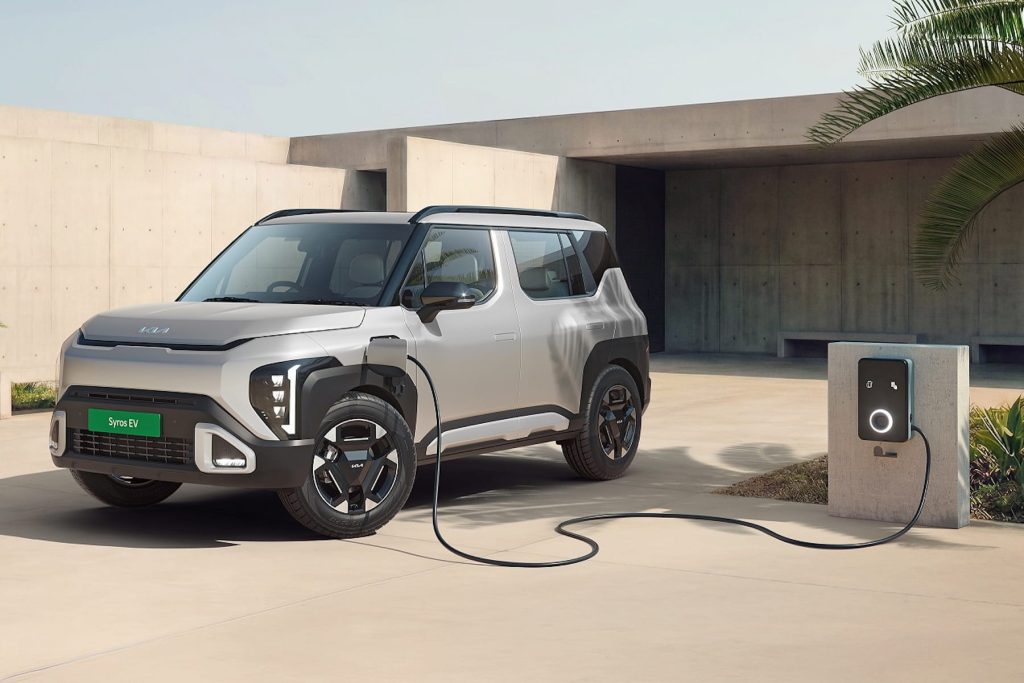
The Syros EV is derived from the ICE-powered Syros, and Kia has kept the design largely unchanged to keep costs in check. It has revised the front bumper and reduced the size of the grille area, possibly to reduce drag. The company has also added a 16-litre frunk and integrated the charging port into the front left quarter panel.
Measuring 3.99 m in length, 1.8 m in width and 1.67 m in height, the Syros EV is just as long and wide as its ICE donor but 10 mm lower. The wheelbase remains unchanged at 2.55 m. The interior is largely unchanged, but Kia offers two EV-specific dual-tone upholstery options: Onyx Black with Off-White and Onyx Black with Hunter Green. The company has also integrated a vehicle-to-load (V2L) charging port below the rear seat.
Kia has introduced the Syros EV in standard-range and extended-range configurations. The company uses the same powertrains and battery packs as the Carens Clavis EV, its electric compact MPV, and the Creta Electric, Hyundai’s sister-brand sub-compact SUV.
The standard-range configuration features a front-mounted motor producing 99 kW and 255 Nm of torque, paired with a 42 kWh NMC battery pack offering a range of 443 kilometres. The extended-range configuration uses a 126 kW/255 Nm version of the same motor and a 51.4 kWh NMC battery pack. Kia claims this setup allows the Syros EV to accelerate from 0 to 100 km/h in 8.1 seconds and achieve a range of 526 kilometres on a single charge.
Both battery packs can be charged from 10 to 80 per cent in 39 minutes using a 100 kW DC charger. Kia offers a lifetime warranty on the battery pack, which the company says is a first for 42 kWh and 51.4 kWh NMC battery packs in India. By comparison, the Carens Clavis EV and Hyundai’s Creta Electric come with battery warranties of eight years or 160,000 kilometres. Kia will also offer a guaranteed buyback programme to boost consumer confidence.
The Syros EV will compete with Tata Motors’ Nexon.ev, one of India’s best-selling electric cars, and Mahindra’s XUV 3XO EV. It is positioned above both rivals in terms of performance and driving range. Kia has yet to announce pricing, which will ultimately determine its competitiveness. The company has confirmed that it will offer the vehicle with a Battery-as-a-Service (BaaS) programme.
Source: Information via e-mail, kia.com (brochure)