
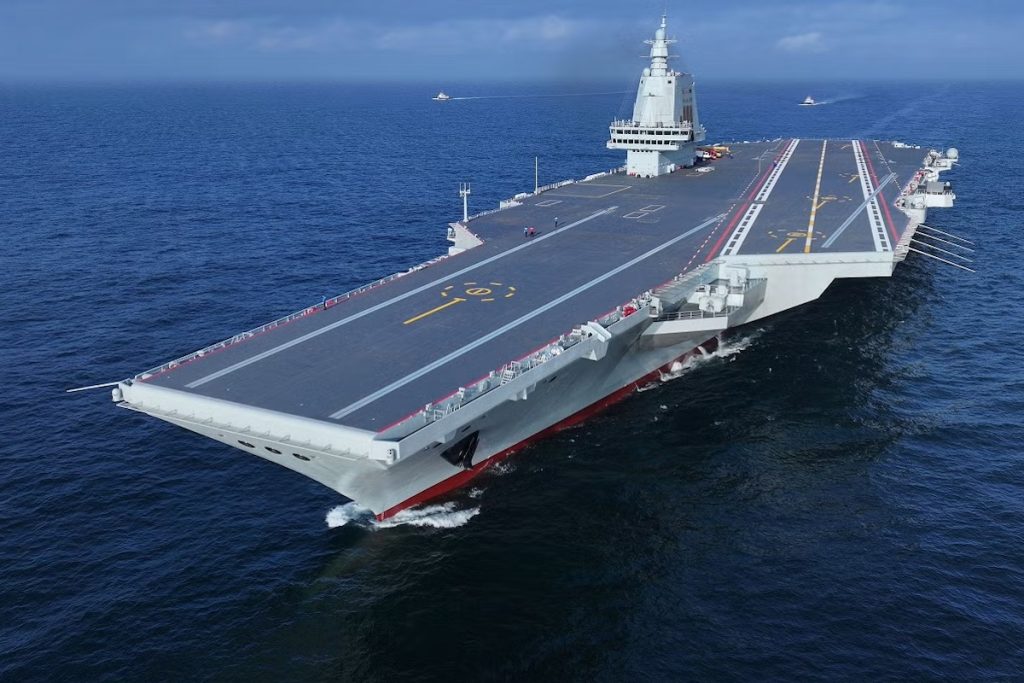
China’s newest aircraft carrier may carry a weapon built to kill incoming torpedoes, a sign that its blue-water ambitions still face their deadliest threat from below.
This month, the South China Morning Post (SCMP) reported that China’s newly commissioned aircraft carrier, the Fujian, is likely to become the world’s first carrier equipped with an active anti-torpedo torpedo (ATT) defense system, giving it a cutting-edge “hard-kill” capability against advanced Western submarines.
The Fujian, China’s third aircraft carrier and its first domestically designed vessel, features a six-tube, 324-millimeter lightweight torpedo launcher that replaces the conventional 12-tube depth charge launchers seen on its predecessors.
The system appears to be designed as a direct response to the “severe threat” posed by the US Navy’s Seawolf-class and next-generation SSN(X) attack submarines, with heavy wire-guided torpedoes capable of inflicting more devastating damage on large warships than anti-ship missiles.
The advanced defensive interceptor uses a broadband sonar array to distinguish real targets from decoys and a high-torque permanent-magnet pump-jet thruster capable of accelerating the weapon to 50 to 60 knots within three seconds to track highly maneuverable torpedoes.
To guarantee single-hit destruction, the ATT deploys directional shaped charges and overpressure shockwaves, with potential supercavitation upgrades enabling defensive velocities of up to 200 knots to counter close-range underwater threats.
China’s development of an active ATT system for the Fujian reflects an effort to compensate for persistent PLAN anti-submarine warfare deficiencies by strengthening the carrier strike group’s organic point-defense layer against advanced US undersea threats.
China’s current carrier doctrine may underscore its deficiencies in anti-submarine warfare (ASW) capabilities.
Steve Balestrieri notes in a February 2026 article for 1945 that China’s carriers were designed to operate relatively close to its shores, under cover of land-based missile networks and aircraft, rather than having comprehensive onboard defenses. Balestrieri points out that the approach stands in contrast to US carriers, which serve as “roaming nerve centers” for a wider network.
Consequently, he says that while China relies on long-range land-based missiles to threaten enemy carriers at range, its carriers remain vulnerable to direct attack. He adds that US Virginia-class submarines, armed with the Mk48 heavyweight torpedo and Maritime Strike Tomahawk (MST) missiles, can threaten Chinese carriers.
Deficiencies in PLAN ASW capabilities, particularly airborne ASW, could compound the vulnerability of China’s carriers to US submarines. Eli Tirk and Daniel Salisbury point out in a May 2024 report for the China Maritime Studies Institute (CMSI) that China’s airborne ASW force has historically been constrained by a shortage of fixed-wing maritime patrol aircraft and has struggled with lagging operator proficiency and training deficiencies.
Tirk and Salisbury say that PLAN airborne ASW training has traditionally lacked realism due to administrative barriers that prevent training in diverse environments. Beyond that, they add that while the PLAN has aggressively fielded newer platforms, qualitative advancements in sensor data processing and weapons remain constrained, leaving the force’s capability to execute complex joint-arms ASW operations largely aspirational.
Highlighting wider systemic vulnerabilities in the PLAN’s ASW capabilities, Andrew Erickson mentions in a March 2026 US-China Economic and Security Review Commission (USCC) testimony that a critical impediment is China’s deficient meteorology and oceanography capabilities, which lag behind the US Navy and leave the PLAN with a comparative ignorance of the ocean battlespace.
He adds that a lack of deployed sensors, limited patrol aviation, and inadequate logistics infrastructure severely constrains out-of-area ASW operations. He also states that the PLAN faces major operational weaknesses in mine countermeasures (MCM) and real-time, time-sensitive data fusion due to complex intra-service coordination hurdles.
While the PLAN has overtaken the US Navy in fleet size, the latter maintains a significant advantage in submarine stealth.
In a report this month for the Korea Institute of Maritime Strategy (KIMS), Erickson points out that acoustic signatures remain a persistent Achilles heel for Chinese submarines, leaving second-generation Type 093 nuclear attack submarine (SSN) and Type 094 nuclear ballistic missile submarine (SSBN) hulls significantly louder at high speeds than their world-class US counterparts due to a lack of advanced pump jet propulsion and natural reactor circulation.
Erickson notes that while China’s initial nuclear platforms suffered from extreme noise deficiencies, the PLAN has worked aggressively to close this acoustic gap. He adds that through lower-vibration machinery and reverse-engineered Russian pneumatic isolation mounts, China has achieved noteworthy breakthroughs, with its forthcoming third-generation Type 095 SSN and Type 096 SSBN projected to finally approach Russian Improved Akula-class stealth standards.
Also, US submarines are actively operating along China’s periphery. The South China Sea Strategic Situation Probing Initiative (SCSPI), a Chinese think tank, released a report in June 2026 stating that in 2025 the US deployed at least 11 nuclear-powered attack submarines (SSNs) and one nuclear-powered guided-missile submarine (SSGN), the USS Ohio, in the South China Sea.
The SCSPI report adds that the US Navy relied on auxiliary submarine tenders, including the USS Emory S. Land and USS Frank Cable, to provide critical logistics support and conduct multinational port visits to sustain these forward-deployed undersea forces.
But as China builds its fourth aircraft carrier, likely nuclear-powered, it may eventually be able to sustain power projection beyond the First Island Chain, which runs through Japan, Taiwan and the Philippines. Consequently, its nuclear-powered carriers and escorts may need to operate more independently of land-based support, placing greater emphasis on all-aspect, organic layered defenses.
In a June 2024 CMSI report, Daniel Rice notes that China’s carrier strike groups employ a multi-layered defensive concept organized into three concentric zones. According to Rice, the Depth Defense Zone, spanning 185 to 400 kilometers out, relies on submarines conducting offensive sweeps and J-15 multirole fighters for long-range air and ship strikes.
He mentions that the Middle Area Defense Zone, spanning 45 to 185 kilometers, is guarded by large surface combatants; Type 052D destroyers provide multi-target tracking and advanced air defense, while Type 054A frigates handle subsurface screening.
Finally, he says the Point Defense Zone extends from 100 meters to 45 kilometers, using terminal defense systems to intercept targets that breach the outer layers.
In view of that layered approach to carrier defense, China’s new ATT may play a role in the Point Defense Zone, providing an additional layer to already formidable carrier defenses.
If China’s carriers are to move from protected regional bastions into sustained blue-water operations, systems such as Fujian’s ATT will matter less as standalone breakthroughs than as tests of whether the PLAN can integrate sensors, escorts, aircraft, submarines and command networks into a genuinely survivable carrier ecosystem.
The next contest, then, will not be over whether China can bolt advanced defenses onto individual capital ships, but whether it can close the wider undersea-warfare gap fast enough to make those ships credible instruments of power projection in waters where US submarines still hold a quiet advantage.