
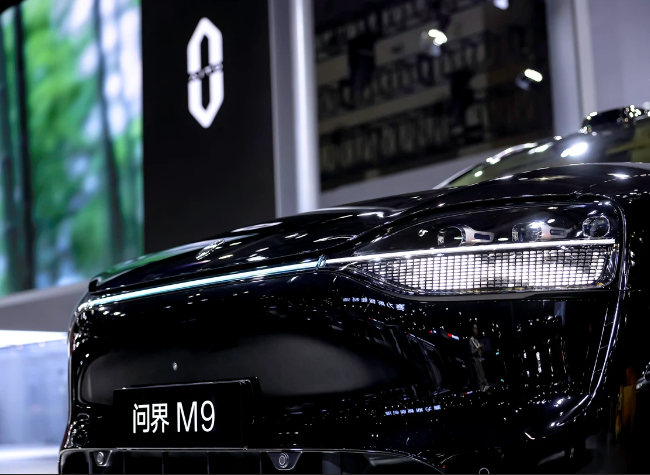

Recently, Landian Technology, a wholly owned subsidiary of Seres, completed a capital increase and share expansion and was renamed Saidou Technology. (Photo/Landian Technology)
Chongqing – Chongqing-based new energy vehicle (NEV) maker Seres has recently restructured its business operations, renaming its subsidiary Landian Technology as Saidou Technology following a shareholding adjustment.
The move has sparked industry interest, with multiple financial media reports suggesting Saidou Technology will partner with ByteDance’s cloud and AI platform, Volcano Engine, to develop a new automotive brand.
In recent years, Seres has risen rapidly in China’s NEV market after launching the AITO brand through a partnership with Huawei. Its models have delivered strong market performance, with the AITO M9 becoming the annual sales champion in China’s 500,000-yuan (approx. 73844 U.S. dollars) luxury vehicle segment in 2025.
Landian Technology, by contrast, has focused on NEVs priced between 100,000 yuan and 150,000 yuan. However, due to limited brand recognition, its market response has fallen short of expectations. Public data show that it sold 34,000 vehicles in 2024, while its sales fell to about 26,000 units in 2025.
Landian Technology had become a burden on Seres’ development. The key change in this shareholding adjustment is that Seres no longer holds the largest stake in Landian Technology, and Seres will exclude Landian Technology from its consolidated financial statements. Its stake has dropped to 32.96%, making it the second-largest shareholder.
On May 26, Seres announced that, as of May 25, Landian Technology had completed a capital increase and share expansion totaling about 6.671 billion yuan. Several investors participated, including state-owned capital from Chongqing Shapingba District and CATL.
After the capital increase, Shaci Zhiyuan, backed by state-owned capital from Chongqing Shapingba District, became Landian Technology’s largest shareholder with an investment of 3.433 billion yuan and a 34.5% stake. Seres became the second-largest shareholder with a 32.96% stake. Landian Technology’s employee shareholding platform holds about 16.48%, while a wholly owned subsidiary of CATL holds about 9.89%.
On May 29, Landian Technology was officially renamed Saidou Technology. Xinhua reports the company will tap into opportunities from the deep integration of the automotive industry and AI, focusing on intelligent connected new energy passenger vehicles and building differentiated competitiveness.
AI is set to be the core focus of Saidou Technology’s future development. Several Chinese financial media outlets, including National Business Daily, LatePost and Lanjinger, reported that the new brand’s models may partner with Volcano Engine on smart cockpit interaction. The brand is expected to target young consumers with a sporty positioning, launch in June, build independent sales channels, and sell in both domestic and overseas markets.
According to Lanjinger, Saidou Technology’s first model may be positioned between an SUV and a sedan, with both battery electric and range-extended powertrain options. It is expected to be produced at Seres’ Phoenix Intelligent Factory in Shapingba, which is currently undergoing production line adjustments.
In fact, Seres and Landian Technology had already begun AI-related cooperation with ByteDance. In October 2025, a Seres-affiliated company signed a framework agreement with Volcano Engine on embodied intelligence cooperation.
In December, Landian Technology launched a new model that deeply integrates the Doubao large language model and features ByteDance’s ecosystem, supporting functions such as watching Douyin, Chinese TikTok videos on the central control screen.