
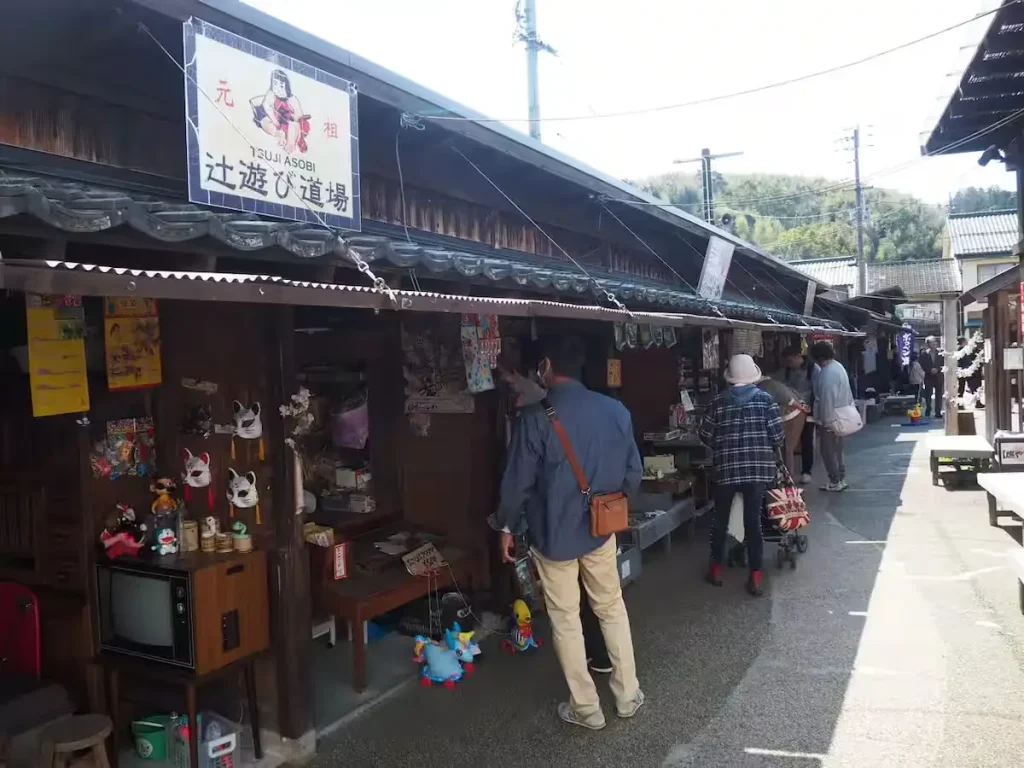
In the Konan district of Ozu City in Ehime Prefecture, streets lined with century-old buildings, including the Ozu Red Brick Hall and traditional townhouses, create a calm, unhurried atmosphere. Walk a little further, and you’ll come to the entrance of a street known as “Pokopen Yokocho.”
There’s just one catch: it only comes to life on Sundays. Around 20 small shop spaces are tucked into a cluster of narrow buildings, drawing both local families and tourists. On weekdays, it disappears entirely, as if it were a dream.
Pokopen Yokocho recreates the feel of a 1950s Japanese streetscape, transporting visitors back in time. The small shops sell nostalgic goods, traditional toys, and street food such as noodles and croquettes. There are also hands-on areas where visitors can try old-fashioned games and pastimes.
Each independently run stall is packed with model racing cars, vintage automobiles, plastic kits, die-cast miniatures, and character figurines like Astro Boy and Tetsujin 28-go. For this reporter, now nearing 60, nearly every shelf holds something familiar from childhood. The entire place is steeped in nostalgia—rounded red postboxes, old cathode-ray tube TVs, and Space Invaders arcade machines all vie for attention.

Play Across Generations
Glancing down a side alley, two young sisters are absorbed in play—tossing rings and spinning tops. The younger one works a hula hoop with fierce concentration, as if determined to prove she’s the better of the two.
At a nearby shooting booth, a fifth-grade boy takes aim with a rubber-band gun, holding his own among the adults. His mother watches with a smile, explaining that she first brought him a few weeks ago, but he enjoyed it so much they’ve been coming back ever since.
The retro atmosphere draws in adults just as much as children. In one corner, six grown-ups huddle over a surprisingly intense spinning top competition, each aiming to claim the title of grand champion.
At one of the stalls, a 63-year-old office worker and member of a local civic group tends to customers. “I hope the children who visit can really soak up the atmosphere of Pokopen Yokocho and have a wonderful time,” she says.

From TV Fame to Preservation Efforts
Ozu City also has a deeper cultural footnote—it served as the setting for the 1966 NHK morning drama series Ohanahan (1966–1967). The surrounding streets, once fondly known as “Ohanahan Street,” were lined with old houses and traditional storehouses. But after about 30 years, the buildings began to show their age, raising concerns about deterioration and the risk of collapse.
According to Shuji Doi, a former official in the city’s tourism division, Ozu decided around 1999 to preserve and revitalize these historic streetscapes.

The effort gained momentum through a series of events showcasing nostalgic items collected by two local enthusiasts. Building on that interest, the prefecture organized an expo in 2004 in collaboration with neighboring municipalities. It was during this period that Pokopen Yokocho was born, carved out of a former furniture company’s offices, factory floor, and warehouses.
Designed to recreate the feel of 1950s Japan, Pokopen Yokocho operates as an open-air event held on Sundays throughout the year. Doi reflects, “The number of visitors coming specifically for the historic streetscape has grown. That said, expectations continue to change, so it may be worth considering how Pokopen Yokocho should adapt and evolve over time.”
Through the end of June, Pokopen Yokocho is generally open every Sunday, except the second Sunday of each month, from 10 AM to 3 PM.

RELATED:
(Read the article in Japanese.)
Author: Motohiro Wada, The Sankei Shimbun