
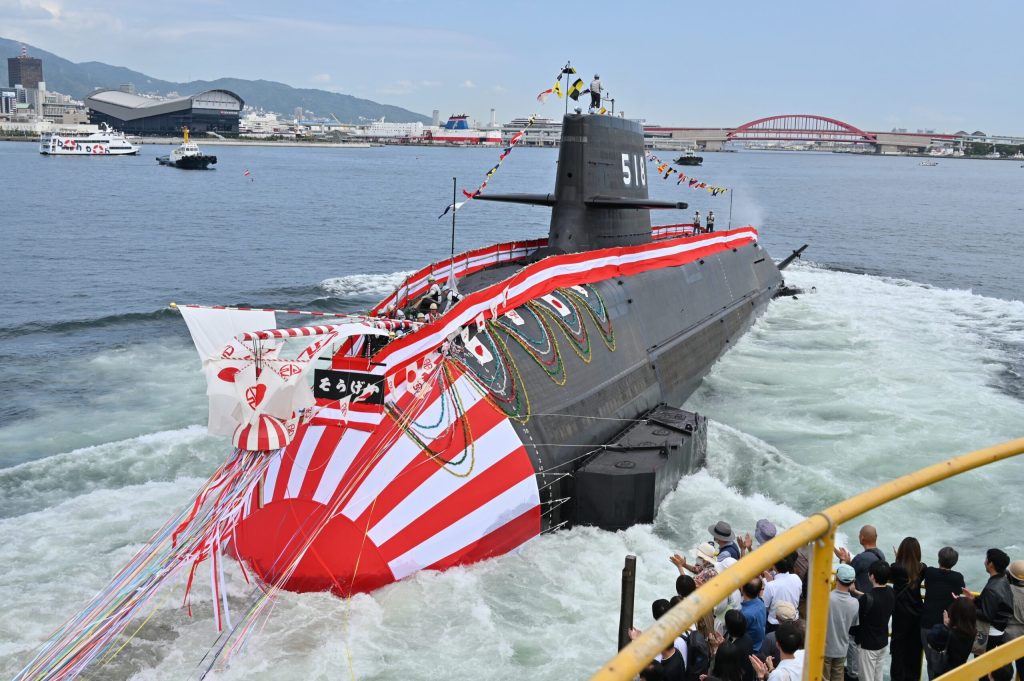

Japan is unlikely to join the submarine component of the AUKUS defence partnership between Australia, Britain and the United States, but it could help mitigate the risks associated with Australia’s acquisition of nuclear-powered submarines. This topic should be on the agenda for Prime Minister Sanae Takaichi’s visit this week.
While AUKUS remains the best mechanism for ensuring partner nations’ future defence, all three governments acknowledge that there are substantial risks already identified in the AUKUS Optimal Pathway. An ASPI report released today makes the case for a Japanese option to cover a submarine capability gap that might emerge from these risks.
Nuclear-powered submarines under government control will give Australia a critical defensive capability while helping all three AUKUS nations deter China. AUKUS naysayers who argue the partnership should be terminated, including on the basis that it reduces Australian sovereignty, rarely provide any realistic alternative. But risks do exist. The challenge is to neither get swept up by concerns around US or British reliability nor sweep known risks under the rug.
To avoid losing a modern, crewed, sovereign submarine capability in the 2030s, Australia needs to start considering ways to mitigate those risks. One option is the leasing of submarines, and cooperation with Japan offers a realistic path forward. As the requirement for these submarines could emerge rapidly, if this is to be a viable option, Australia needs to start pursuing it now.
The risks mainly stem from three demanding, complex enterprises: the extension of the operating life of Australia’s current fleet of six Collins-class submarines; the ability of the US to ensure the timely delivery of between three and five Virginia-class submarines; and the construction of the SSN-AUKUS in Australia and delivery to the Royal Australian Navy from 2040 onwards. Together, these risks could deprive Australia of a modern, sovereign submarine capability for more than a decade – a capability Australia has deemed essential to its defence over what will be a critical decade of heightened challenges. This gap could manifest as early as 2030 and extend into the 2040s.
The likelihood of the government abandoning key components of the Optimal Pathway is remote, unless circumstances force it to. For more than a decade, Australia tried to replace its Collins-class submarines with a similar capability – an effort that proved unsuccessful, costly and politically bruising. As a result, the Australian government has no appetite to embark upon a full acquisition process to purchase a new class of conventional submarines to cover any submarine capability gap. Even if the political will existed, the time, resources and effort required for the full evaluation, competition and acquisition process of a new class of submarines effectively prohibits this as an option.
However, though it would still present obstacles, leasing a modern submarine capability to fill an emerging gap would present far fewer challenges. Leasing or otherwise rapidly acquiring Japanese submarines would require few resources, at least initially, and wouldn’t detract from the Optimal Pathway until that path became obviously unachievable or significantly delayed. As we get closer to key decision points – such as certification to US Congress by the next US administration, likely in 2030 or 2031 – the level of effort required to make leasing a small number of Japanese submarines a reality could be dialled up or down according to the assessed level of risk at the time.
While not the only candidate to approach for leasing, Japan is a particularly attractive partner with which Australia could explore this option. Thanks to its prudent industrial policies and extensive manufacturing capability, it possesses a young, large, modern, highly capable submarine fleet. It is still producing these submarines and continually upgrading their capability and performance, and it likely has excess future production ability and some spare capacity in its existing fleet. Japan and Australia maintain excellent relations across all dimensions of international relations including trade, diplomacy and military-to-military links, as well as having a common perception of the likely threats in the Western Pacific in the foreseeable future.
Given the depth of this request, to make leasing a realistic option Australia will need to begin engagement with Japan immediately. Leaving aside the political and diplomatic dimensions, a significant number of practical matters would need to be put in train as soon as possible, such as determination of costs, funding, industrial production rates and military-to-military discussions.
A sovereign submarine capability is a core requirement for Australia’s defence over the next two decades. Given there are known risks that could prevent that happening, exploring a relatively modest alternative seems prudent. To ensure this alternative is available when we need it to be, Australia should start pursuing it now. There is no better time than Takaichi’s visit to Australia.