
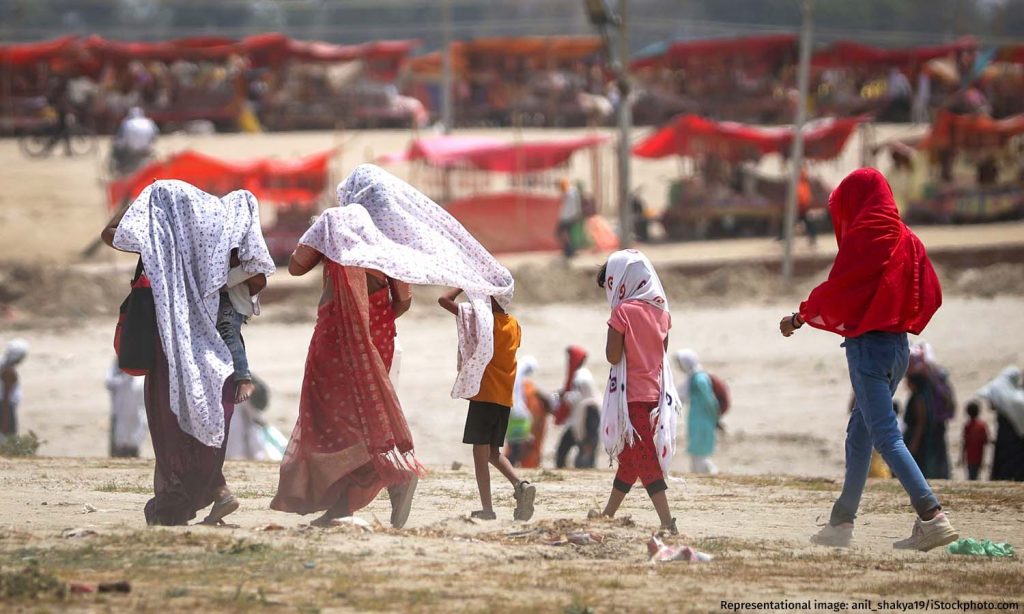
Mumbai: Summer is under way and heat waves are being reported in many parts of the country already. The 16th Finance Commission has recommended that heatwaves be notified as national disasters. The move could unlock central funding to states battling heatwaves and also make way for compensation for people who suffered death or injury due to heat.
If the recommendation is accepted, its implementation could also come with challenges. In India, a heatwave is declared by the India Meteorological Department. If there is a heat stroke death but a ‘heatwave’ is not declared by the IMD in that region on that day, the victims may not get compensation. Compensation may be allotted only to certified heat stroke or heatwave deaths and there are already concerns over heatstroke deaths being under-reported.
Heat is also a slow-onset disaster unlike, say, cyclones. To map the victims of this disaster will be a challenge in itself, given how it affects vast areas over a long period. And once these challenges are addressed, the number of people eligible for compensation may be very high.
Even then, India needs a policy to compensate those suffering from heatwaves and the unlocking of funds will also be crucial for implementation of heat action plans, setting up early warning systems, urban cooling centres, improving awareness, capacity building of health professionals and all those involved in responding to heat stroke victims, experts say.
IndiaSpend wrote to the Union Ministry of Finance to whom the Finance Commission submits its report on how India plans to assess the number of victims of heatwaves, how much compensation will be given and to whom. We will update this story when we receive a response.
Centre:State
In India, all matters related to disaster management are governed by the Disaster Management Act, 2005. There are two kinds of relief funds—the National Disaster Relief Fund (NDRF) and the State Disaster Relief Funds (SDRFs). There are also national and state disaster mitigation funds known as NDMF and SDMF.
“Prior to 2015, the primary responsibility for disaster risk management rested with the state governments. Chhattisgarh, Odisha, Kerala, Rajasthan, Andhra Pradesh, Maharashtra and Karnataka had declared heat waves as a local disaster… Until 2015, the approach of the central and state governments towards heat waves had been response-centric, and due importance to risk reduction was not given,” the National Disaster Management Authority’s (NDMA) booklet notes.
At present, the disasters covered under the SDRF include cyclone, drought, earthquake, fire, flood, tsunami, hailstorm, landslides, avalanche, cloudburst, pest attack, frost and cold waves. Additionally, states can utilise up to 10% of the SDRF allocation for natural disasters not included in this list but locally significant.
Eleven states have already notified heatwaves as a state‑specific disaster.
In 2024, the 15th Finance Commission did not find much merit in the request to expand the scope of disasters eligible for financial assistance and so, extreme heat was not considered to be a natural disaster or calamity eligible for assistance.
The 16th Finance Commission noted that National Crime Records Bureau data show a total of 3,798 deaths were reported due to heat or sunstroke in India between 2018 and 2022. There have been incidents of officials dying on election duty or people who died in a political rally due to extreme heat.
“This classification gap places the financial burden on states, requiring them to declare heatwaves as ‘state-specific disasters’ to access even limited support,” The Energy and Resources Institute noted in an article in 2025. “While national agencies like NDMA, IMD, and the Ministry of Health have pushed for early warnings and mitigation, the scale of intervention remains inadequate.”
The 16th Finance Commission considered the question of expanding the national list of notified disasters and finally, in November 2025, recommended that both heatwaves and lightning be included in it “given their scale and the fact that they often exceed the coping capacity of affected communities”. It recommended a total corpus of Rs 2 lakh crore for SDRF and SDMF together.
“Many states have strongly advocated for the inclusion of heat wave among the notified disasters under the national framework. While the Union Government has allowed States to undertake mitigation efforts related to heat waves through the SDMF and NDMF, it is equally important to enable States to provide immediate relief to the vulnerable population affected by heat waves through the SDRF,” the 16th FC noted in it’s report. The recommendations cover the five-year period from 2026-27 to 2030-31.
The FC, constituted by an Act in 1951, is mandated to review disaster management funding among other things. On February 1, 2026, Union finance minister Nirmala Sitharaman accepted several recommendations of the 16th FC but the expansion of the list of disasters has not been accepted so far.
Nevertheless, the formal recommendation is an important first step which could pave the way for acceptance in the future.
“So far, lightning and heatwave are local disasters and the number of casualties are low, so the states don’t need large-scale resources such as the NDRF,” said Krishna Vatsa member and head of the department at the NDMA, on the FC’s recommendation. “But when it comes to mitigation, which are the long-term measures where we need to set up early warning systems, improve awareness, the resources required may be larger… Besides, it could help in the implementation of heat action plans.”
Who gets compensation and how
India counts among heat stroke deaths only those deaths medically certified as having been caused by direct exposure to the sun, thereby capturing only 10% of the real figure, leaving out deaths due to high ambient temperature. Heat stroke deaths can be classified as direct deaths (due to exertion under direct sunlight) and indirect or non-exertional deaths (people who suffer a heat stroke due to high ambient temperature–such as those trapped inside homes with high room temperatures), as IndiaSpend reported in 2020.
For a long time, there have been concerns that India is undercounting heatstroke deaths. Extreme heat exacerbates comorbidities but may not be captured in the actual cause of death which may be listed, for example, as cardiac arrest.
In India, there are guidelines by the National Centre for Disease Control to deal with heat strokes but a lack of trained personnel from the grassroots up makes treatment and ascertaining cause of death in the case of heat difficult.
Therefore, even if victims of extreme heat may be eligible for compensation, only those where the cause of death is clearly mentioned as ‘heat stroke’ may be eligible and others might be left out. Even Vatsa agreed that attributing a cause of death to a heat stroke will remain a challenge in determining victims eligible for compensation.
“If there is a cyclone, there’s a clear impact that one can trace to it. What happens if there is one day of extreme heat resulting in deaths, but it’s not a declared heatwave day. So, when you say a heatwave should be a notified disaster, what about these odd instances of extreme heat?” asked Nihal Ranjit, senior associate at Indian Institute for Human Settlements.
Ranjit suggested that rather than declaring heatwaves as a notified disaster, extreme heat should be recognised as a continuous risk, with triggers based on cumulative exposure and impacts, and not just a series of isolated events.
Disaster relief gaps
In India, drought is a notified national disaster but despite that, declaration of a drought in a state, assessing its extent, damage and issuing compensation to those affected often becomes a problem and many who suffered losses are not recognised.
In 2023, Karnataka Chief Minister Siddaramaiah had written to the Union government to review the current parameters for a state to declare drought and consider amending them, to establish a more responsive framework that acknowledges the realities of each state and offers timely assistance to farmers.
Drought is one of the known causes of farmer suicides in India. If heatwaves are notified as national disasters, India will have to make sure the same challenges do not recur.
Despite the under-reporting, the number of people dying due to heat waves is quite high and estimates suggest higher mortality risk in the coming years, thus increasing the compensation pressure on the exchequer.
“The indirect nature of heat-related casualties makes attribution inherently challenging,” noted Ranjit from IIHS. “When compensation becomes obligatory under a notified disaster framework, it might deepen the problem of underreporting of heat-related deaths, similar to what was seen during the COVID-19 pandemic. We need to move beyond ex-post compensation toward stronger preventive measures and impact-based financing mechanisms for extreme heat.”
Abhiyant Tiwari, lead of health and climate resilience at NRDC India, believes the move is an important first step.
“Heat is also a geographically widespread disaster as compared to a flood which has a clear spatio-temporal path. Heat can cover the entire state, so there is no clear spatio-temporal scale for it,” said Tiwari.
He believes there is a need for widespread training and sensitisation of officials and staffers who respond to heat and these funds could be useful towards that.
As for the challenges in awarding compensation, Tiwari believes it to be possible.
“There are examples of states who are doing it right now. We can look into that and check what they do right.” he said.
We welcome feedback. Please write to respond@indiaspend.org. We reserve the right to edit responses for language and grammar.