
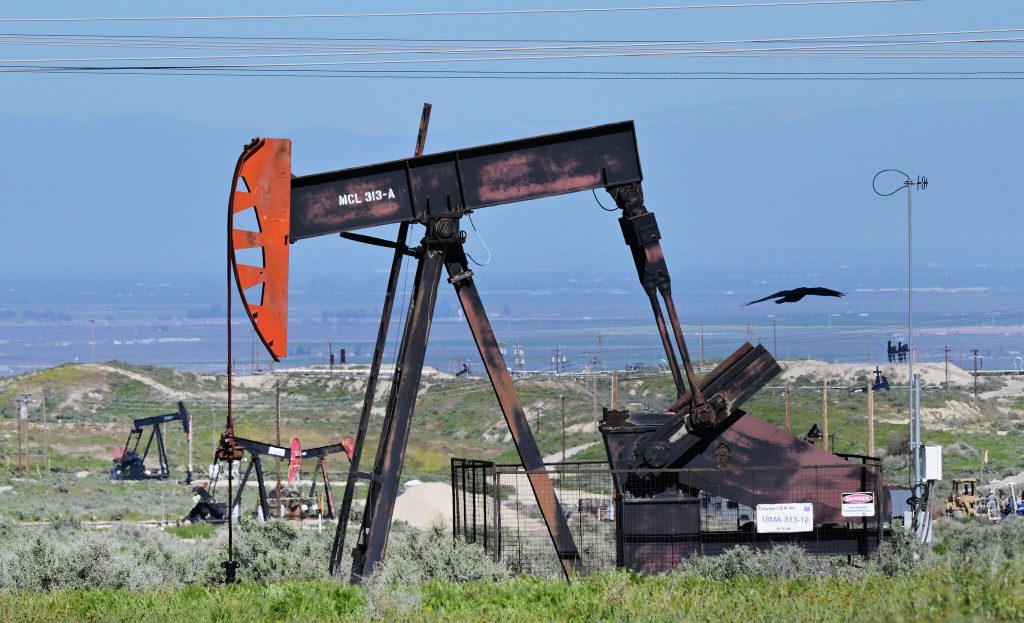

The Trump administration plans to expand oil drilling in Kern County, the state’s petroleum hub (pictured here), as it offers new leases on federal lands. Sites in the Bay Area will also be available for lease.
The Trump administration announced Tuesday that it has met court-ordered requirements for expanding oil and gas drilling in California, clearing the way for more pumpjacks in Kern County, the state’s petroleum hub, as well as potentially other spots, including the Bay Area.
The U.S. Bureau of Land Management has identified 684,000 acres of federal land and 959,000 acres of subsurface federal mineral estate where it could offer new leases to fossil fuel companies for extraction.
The area, within the agency’s Bakersfield and Central Coast regions, is scattered across 18 counties, from Contra Costa County in the north to Ventura County in the south.
Article continues below this ad
It includes land at the edge of Sequoia and Kings Canyon National Parks, parcels not far from Yosemite, a plot in the coastal mountains of San Mateo County and several points in the western hills of Alameda, Santa Clara and Contra Costa counties.

This map shows roughly where oil and gas companies are leasing federal lands for fossil fuel extraction in California and where new leases could be offerred.
While an expansive stretch, industry experts as well as Bureau of Land Management officials say most, if not all, new oil and gas development will likely take place near existing drill sites — not so much isolated pockets in the Bay Area or Central Coast. Extraction in far-flung places is expensive and often invites protest.
In a statement, the Bureau of Land Management said allowing new drilling in California “supports federal direction to expand domestic energy opportunities.” Agency officials have cast the expansion of oil and gas development as a way to bring down fuel prices, notably gasoline.
Article continues below this ad
The agency’s recent completion and approval of two new environmental reviews for drilling fulfills the agency’s obligations for settling a long-running legal spat that essentially halted oil and gas development on new federal lands in the state for more than a decade.
In a series of lawsuits, environmental groups had challenged how well the federal government was addressing the impacts of fossil fuel extraction, particularly fracking, which can be ecologically caustic. The Bureau of Land Management, six months into Trump’s presidency, moved to resolve the issue, citing a nationwide need — and White House directive —to rapidly increase oil and gas production.
The ensuing environmental reviews suggest that the impacts of expanded drilling, including fracking, which employs high-pressure water, sand and chemicals to wring out fossil fuels, are minimal. The Bureau of Land Management’s official approval of the reviews allows seven federal drilling leases in Kern County that were suspended during the legal fray to proceed, and it opens the door for the agency to begin offering new drilling leases elsewhere.
While industry groups have applauded the push to open more lands for drilling, they’ve said new activities will be focused in the oil fields around Bakersfield. Even after obtaining a lease on federal land, oil companies must secure a permit to drill, often meaning further environmental review and more public scrutiny, which makes oil and gas development in new areas far less attractive.
Still, environmentalists say the federal government is moving too quickly, and without proper guardrails, to extract more fossil fuels. Oil and gas drilling disrupts the natural ecology, and the use of the fuels increases pollution and accelerates climate change. California has long pushed to divorce itself from fossil fuels, but many state leaders, including Gov. Newsom, have softened their positions as fuel prices have risen and petro companies have threatened to leave the state.
Article continues below this ad
“The Trump administration is sprinting forward with its eyes closed to hand over a million acres of California’s public lands to Big Oil,” said Cooper Kass, an attorney at the Center for Biological Diversity’s Climate Law Institute, in a statement. “We’ll fight this with everything we’ve got.”
The Center for Biological Diversity was one of the groups that initially sued the Bureau of Land Management last decade for not adequately evaluating the environmental impacts of expanded oil and gas development in California.
With the court-mandated environmental reviews completed, the Bureau of Land Management says it’s now assessing where exactly there is interest in new drilling and where it will offer leases. As it stands, only a small portion of California’s fossil fuels are extracted from federal lands, with most drilling occurring on private property.
In a separate move this week, the Trump administration announced a pair of proposed rules that would make it easier for fossil fuel companies to operate on federal lands nationwide.
The planned changes to the Bureau of Land Management’s oil and gas leasing rule would reduce costs and relax environmental standards on leased lands — for example, cutting lease application fees and lowering the amount of money that companies have to put down to ensure that drilling sites will be cleaned up once the work is done.
Article continues below this ad
The Interior Department, which oversees the Bureau of Land Management, has begun taking public comment on the proposals with the expectation of finalizing them within the next year.
Interior Secretary Doug Burgum said the changes will help cut “red tape.” Critics, meanwhile, denounced them as another bid by the administration to prioritize industry over the environment and make light of the increasing toll of climate change.