
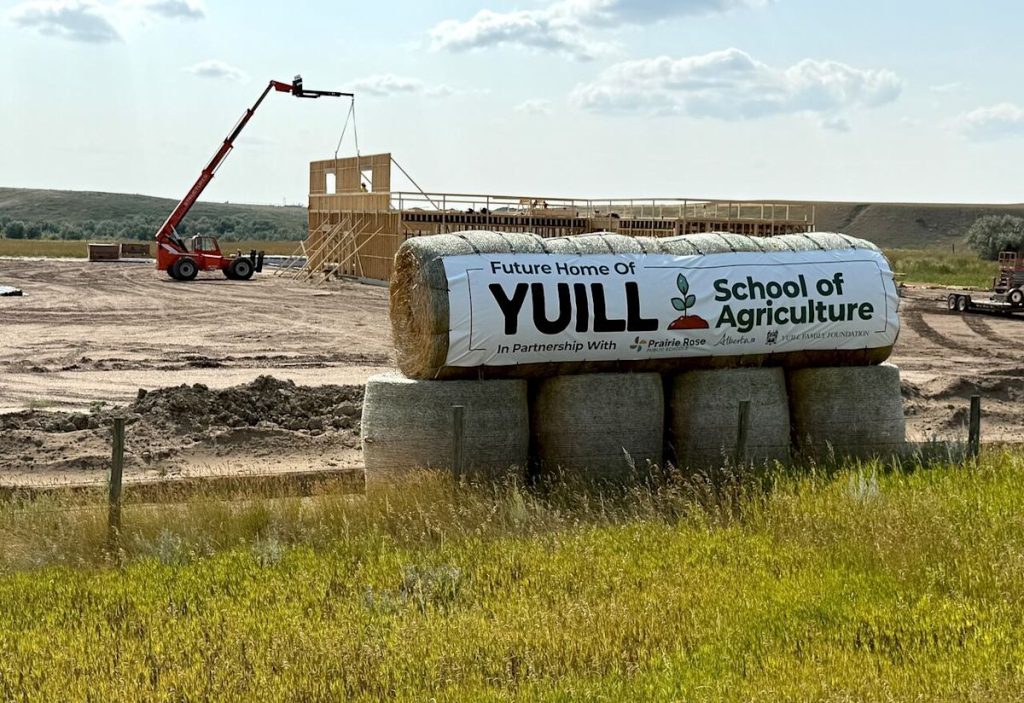
A new barn is being raised just outside Medicine Hat and plans are afoot to buy cattle.
It’s all meant to help grow the next generation of agricultural producers.
“This is basically our living lab for applying agriculture knowledge at a high school level,” said Nichole Neubauer, the Prairie Rose School Division’s director of agriculture education.
“[Students] will engage in hands-on learning, managing a farm.”
The Yuill School of Agriculture is designed to serve as a campus for students at a nearby high school, offering instruction and college credits in 12 subjects related to food production, farming and ranching.
The program is planned to eventually serve 100 students near Dunmore, Alta., roughly 10 km southeast of Medicine Hat.
Ground was broken this month at the school’s 30-hectare site on land donated by its namesake, local businessman Bill Yuill.
A main building for labs, classrooms, an equipment shop and a farmer’s market is being framed. Plans for the next phase of construction include cattle pens, as well as honey, egg and greenhouse vegetable facilities.
High school learners take next step
The school’s scope of study includes agri-business, technology and food processing, and even operating a U-pick or staging food-tourism events. Neubauer said its curriculum is designed to correspond to the evolving food production sector.
Neubauer, who operates a mixed farm operation near Medicine Hat, began a second career as an educator hosting field trips, before eventually helping to create Prairie Rose’s junior high agricultural programs.

Work is ongoing to construct the main building of the Yuill School of Agriculture, a farm facility that will house new programming for the Prairie Rose School Division. (Collin Gallant/CBC)
Grade 9 student Willow Munsch volunteers as chore manager at the Irvine School Agricultural Discovery Centre, located about 30 km east of Medicine Hat. She’s excited to enroll at Yuill when its first classes begin next year.
“It’s probably like just a dream that’s come true,” said Munsch, who is a member of the local 4H club and already raises her own calves on her family’s ranch near Medicine Hat.
“I just love working in agriculture, especially around animals, and it’s been part of my life ever since I was born.”
Workers needed in food production: report
Most students will arrive with a strong foundation of family history in farming and ranching, Neubauer said. But she added that producers must evolve as the sector does and as more workers are needed.

The Alberta Ag for Life program states roughly 79,000 Albertans are employed in the sector, about evenly split between primary agriculture and the food and beverage industry.
This summer, it said 40 per cent of employers have reported trouble in recruiting. Alberta could see a shortfall of 19,000 trained workers by 2030.
Ag community puts shoulders behind the effort
Yuill spoke about the program with the CBC, earlier this year.
“It could be a dandy — the start of something really good.” said Yuill, whose family businesses once included ranching, telecommunications, bus lines and sports ownership.
“It’s just kind of what you do to be a citizen of your town.”

(Prairie Rose School Division)
Along with donating land for the school, Yuill provided $600,000 to get the project underway.
This summer’s fundraising totalled $900,000 overall, said Neubauer, including major contributions from several local ranching families and agricultural firms.
A gala community dinner earlier this summer helped raise another $250,000 where Yuill ceremoniously donated his family’s cattle branding irons to the school.
Neubauer said the province has earmarked $1.9 million as well, which combined with donations and division funds, covers the school’s initial $4.5-million budget.
Model leads to college credits
The new school will become one of 28 “collegiates” in the province. The programs are operated by one or more school boards, offering specialized classes linked to post-secondary institutions and offering program credits for students who enroll at the higher level.
Prairie Rose already operates another career-focused collegiate program in flight training that allows students to earn a pilot’s license.
Many collegiates focus on bolstering careers in the trades, but the Yuill school and another program in central Alberta have joined with agricultural schools, like Olds College and Lethbridge Polytechnic.
“When you ask today’s kids, ‘have you thought of a career in agriculture?’ They look at you and say, well, I don’t own a farm,” said Neubauer.
“But the truth is, there’s so many unfulfilled positions in the industry that nobody really knows about.
“Feeding people is important work. It’s big business…. How we grow food and how we sustain the earth that provides is top priority.”