
A team of researchers led by Professor Richard Kaner has been awarded the Royal Society of Chemistry’s 2026 Materials Chemistry Horizon Prize in recognition of a collaboration between the Kaner group at UCLA and SILQ Technologies,Inc. that translated pioneering zwitterionic polymer surface-coating technology into FDA-cleared medical devices designed to help prevent infections in patients.
The Materials Chemistry Horizon Prize (also known as Stephanie L. Kwolek Prize) recognizes significant recent novel discoveries or advances made in the area of materials chemistry.
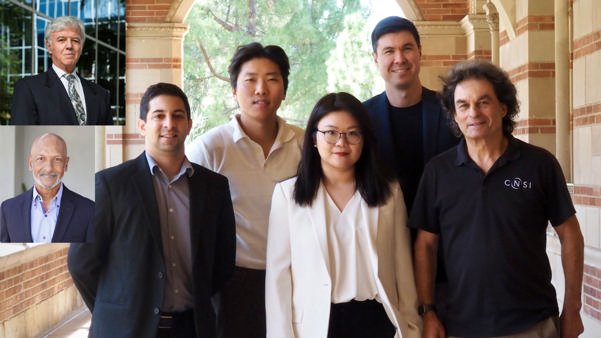
The Kaner Group at UCLA and SILQ Technologies Team – Dr. Jack Kavanaugh, Verne Sharma, Ethan Rao, Min Kyu Lee, Na He, Dr. Brian T. McVerry, and Professor Richard Kaner. Photo by Isabella Luo.
Catheter-associated urinary tract infections (CAUTIs) are one of the most common hospital-acquired infections in the world, and the standard response is antibiotics, which are becoming less and less effective as resistance grows.
“What is exciting about zwitterionic coatings is that they address infection through a completely different mechanism by preventing bacteria from attaching in the first place,” said Kaner, the UCLA Dr. Myung Ki Hong Endowed Chair in Materials Innovation. “There is no drug, no killing, no resistance pathway. It is a solution to what has historically been treated as a pharmacological problem, and that opens up a different way of thinking about medical device design.”
Countless patients have reported that their lives have improved significantly as a result of using catheters treated with the Silq coating.
“Hearing these personal stories has been both profoundly moving and incredibly rewarding,” Kaner said. “They provide powerful motivation to continue our work, expand the use of our technology beyond urinary catheters, and bring this critical improvement to a wide range of infection-prone medical implants.”
The team includes, from UCLA: Richard B. Kaner, Distinguished Professor of Chemistry, and Distinguished Professor of Materials Science and Engineering; and Min Kyu Lee, Ph.D. student. From SILQ Technologies, Inc.: Jack Kavanaugh, Chairman; Verne Sharma, Chief Executive Officer; Dr. Brian T. McVerry, Ph.D. ‘16, Chief Technology Officer; Ethan Rao, ‘16, Director of R&D, Quality Assurance, and Regulatory Affairs; and Na He, Research Scientist.
“Receiving the Horizon Prize is genuinely humbling,” Kaner said. “Our team hoped that the work we were contributing to might one day improve the quality of life for patients and our community. Seeing zwitterionic chemistry go from a bench-scale experiment to an FDA-cleared device that actually reaches patients, and is now being recognized by the RSC, is more than we could have hoped for. Our team both at UCLA and SILQ, is incredibly grateful for the honor. The prize really belongs to a group of incredible team members who each pushed the technology forward.”
“This project is a case study in why academic-industry collaborations matter,” Kaner said. “The fundamental chemistry emerged from years of materials research in my group at UCLA, but transforming that chemistry into something hospitals can actually use required engineering, regulatory, manufacturing, and clinical expertise. SILQ Technologies provided those capabilities. Neither side could have accomplished this alone.”
Penny Jennings, UCLA Department of Chemistry & Biochemistry, penjen@g.ucla.edu.