
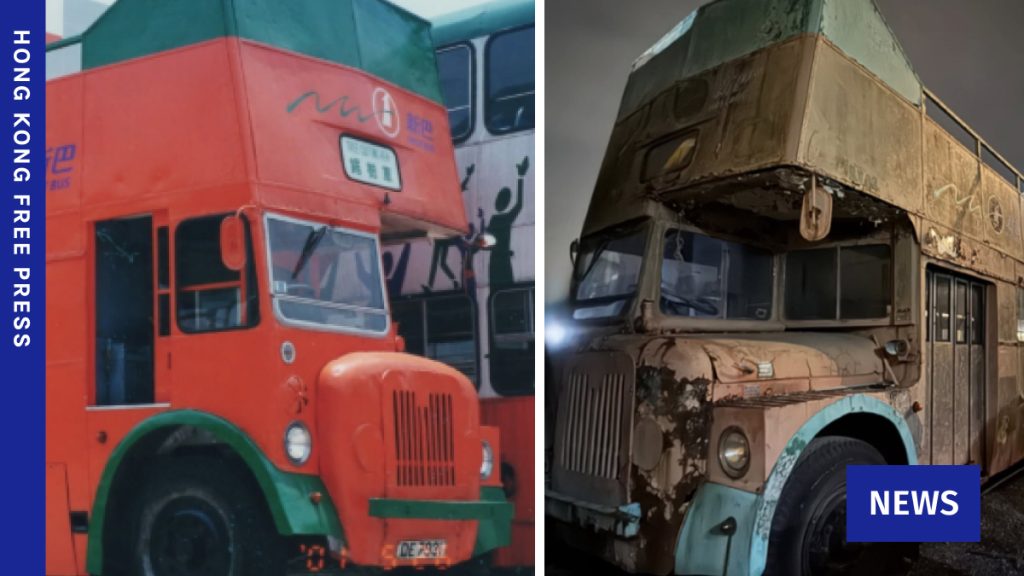
Two friends who restore classic buses in Hong Kong are being forced to abandon their HK$1 million plans to resurrect a vintage double-decker.

Terrence, along with his blacksmith friend Chung, who works in the automotive industry, had hoped to restore an antique China Motor Bus Company (CMB) vehicle at their facility in the New Territories’ northwest.
“The previous owner bought it from a scrapyard when it was retired by New World First Bus around 20 years ago – we took it over in 2019,” Terrence, who only gave his first name, told HKFP last week. “The engine and gearbox still work, but the body is really rotten.”
“It is a pity, but no choice – I need to minimise expenses on hobbies as I get older. Also, we need to save our resources on bus restorations.”
In a Facebook post, they said that “the bus will treat[ed] as recycling if no-one [is] interested before [the] end of this month.”
Transport revolution
CMB upgraded its fleet in the 1960s to include the Guy Arab, a modern vehicle built in Wolverhampton, UK.

According to Terrence, a local company converted some of the fleet from single- to double-decker models. They were then deployed to meet the city’s growing population.
CMB was the first company to introduce double-deckers to Hong Kong. However, its bus operations collapsed in 1998, and it shifted to property development.
The bus franchise was taken over by New World First Bus.
New World First Bus put the Guy Arab in question to work transporting tree-cutting staff around the city. Until its retirement in 1998, workers would use its open deck to cut overgrown roadside trees.
“The bus was also on duty in Victoria Park as a police watch tower every Lunar New Year,” Terrence told HKFP.

According to a 2022 academic paper by the Education University of Hong Kong’s Chiu Chuk-yin, the fate of CMB was sealed in 1981 when Paliburg Investments attempted a hostile takeover of the firm.
“Since then, CMB has become more conservative in bus operation, and its weaknesses were thoroughly revealed in a fatal crash in 1982. When the bus drivers’ strike occurred in 1989, CMB was meant to be written off the list of public bus companies because the Hong Kong government no longer treated CMB as a reliable bus service provider,” the paper said.
The reduction in the “number of bus routes in 1993 and 1995 was the prelude to the end of CMB’s service.”


