
Much of the Western debate about artificial intelligence centers on the machine itself. Will AI become conscious? Will it surpass human intelligence? Could it acquire goals of its own and escape human control?
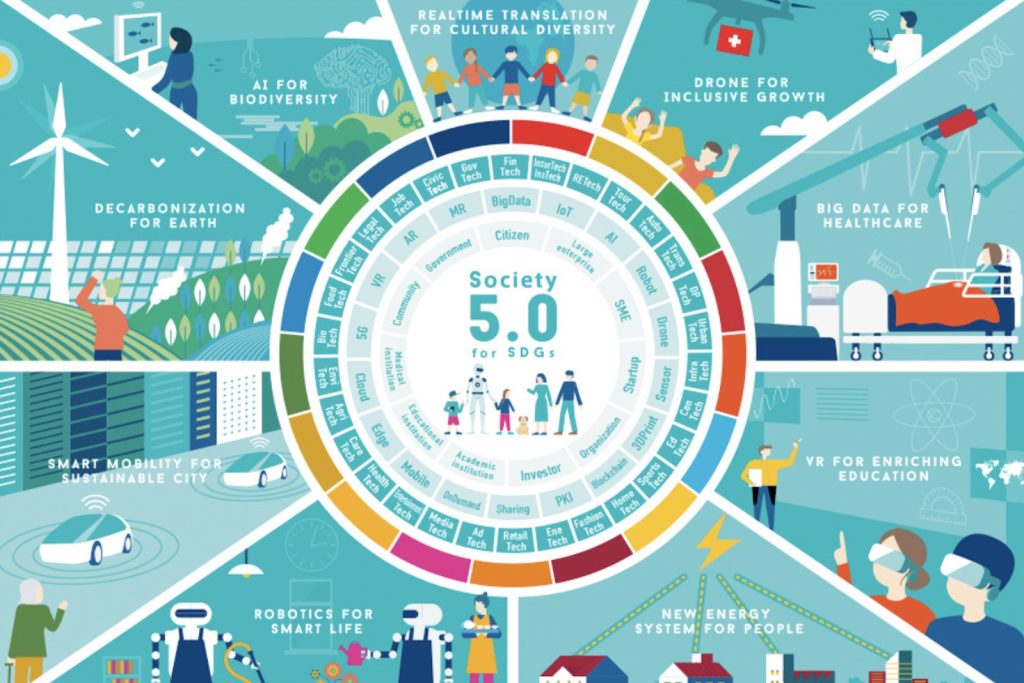
Japan’s Society 5.0 begins from a different premise. Rather than imagining AI as an autonomous mind, it places AI inside a larger social and technological system. Sensors collect information from the physical world; digital networks carry that information into cyberspace; AI analyzes it; and the resulting knowledge is returned to people, organizations, machines and public services.
Intelligence resides less in a single machine than in the circulation of information through the system as a whole. In this respect, Society 5.0 is best understood as a cybernetic vision of society. AI is a service within the feedback loop, not the sovereign agent directing it.
Beyond the information society
Society 5.0 was introduced in Japan’s Fifth Science and Technology Basic Plan, adopted in 2016. The name places the program within a sequence of historical social forms: the hunting society, the agricultural society, the industrial society, the information society, and finally Society 5.0.
Japan describes it as a human-centered society created through the close integration of cyberspace and physical space. Its objective is not technological development for its own sake, but the reconciliation of economic growth with the solution of social problems.
Those problems are particularly acute in Japan. The country has an aging and declining population, rural depopulation, labor shortages, rising healthcare needs, deteriorating infrastructure, vulnerability to natural disasters, and growing energy and environmental pressures.
Society 5.0 proposes to coordinate data, AI, robotics, communications networks and public institutions to respond to these interconnected challenges.
A cybernetic society
Japan’s foundational Society 5.0 documents generally speak of “cyber-physical systems” rather than relying heavily on the classical term “cybernetics.” Yet the architecture they describe is unmistakably cybernetic.
Cybernetics studies how systems use communication, feedback and control to adapt their behavior. A thermostat provides the simplest example: it measures a room, compares the result with a desired temperature, and adjusts the heating.
More complex cybernetic systems continually collect information about their environment, evaluate it against objectives, act, and then measure the consequences.
Society 5.0 applies this pattern on a societal scale. Physical activity generates data through sensors and connected devices. That data moves into cyberspace, where it is combined and analyzed. The resulting recommendations or decisions return to the physical world, producing new conditions and new data. The cycle then begins again.
The cybernetic connection becomes explicit in later Society 5.0-related programs. Japan’s Moonshot research program, for example, includes a goal devoted to “cybernetic avatar infrastructure.”
It envisions people using networked robots and digital avatars to extend their physical, cognitive, and perceptual capabilities. The stated purpose is not to replace humans with autonomous machine agents but to expand what people can do while preserving inclusion and social participation.
Society 5.0 can therefore be understood as a modern form of social cybernetics: data circulates among people, machines, institutions, and environments, enabling the wider system to respond more effectively.
AI as a service
Artificial intelligence occupies an important but carefully delimited place within this architecture. It processes information; it does not define society’s purposes.
In a 2017 speech explaining Society 5.0, then-prime minister and now deceased Shinzo Abe described how sensors connected through the Internet of Things would accumulate large quantities of data. AI would analyze that data, he said, producing “new wisdom.”
The examples he gave were practical: finding patterns in medical data, improving factory maintenance, and helping automated vehicles respond to road conditions.
This formulation is revealing. AI is treated as a service and tool that turns data into useful knowledge, enhancing human capabilities rather than establishing its own goals. The system’s objectives — health, mobility, safety, sustainability and well-being — remain socially determined.
That does not mean every decision must be made manually. Automated systems may control vehicles, balance energy demand, coordinate logistics, or detect medical abnormalities. But their agency is functional and delegated. They operate inside architectures established by people and institutions.
In other words, AI may optimize the means, but it does not determine the ends.
AI industrial roadmap
Japan’s Artificial Intelligence Technology Strategy translated this philosophy into an industrialization roadmap.
Rather than organizing policy around the creation of a single general-purpose artificial intelligence, the strategy concentrated on three domains: productivity, health, medical care and long-term care, and mobility. Information security supported all three.
The roadmap anticipated a phased development. In the first phase, data-driven AI would be introduced into individual industries and services. In the second, AI and data use would spread across public domains. In the third, formerly separate fields would become interconnected, producing a broader ecosystem.
The underlying logic was cumulative. AI applied to healthcare could reduce the burden on medical workers and help people remain healthy longer. AI applied to mobility could improve transport for older people and residents of depopulated regions.
AI applied to manufacturing and logistics could compensate for labor shortages. Once these systems exchanged information, their value would exceed that of isolated applications.
This is another cybernetic characteristic of Society 5.0. The intelligence of the whole emerges from coordination among specialized components. No single AI needs to become generally intelligent because capability is distributed across the system.
Model-centered to system-centered
This distinguishes Society 5.0 from model-centered visions of AI that dominate much contemporary discussion. In a model-centered approach, progress is measured primarily by the intelligence of the model: how well it reasons, writes, codes, plans, or competes with humans.
Society 5.0 instead asks how many elements can be coordinated around a social purpose. The important questions are whether healthcare data can improve treatment, whether transport systems can respond to changing demand, whether infrastructure failures can be predicted, and whether services can reach people regardless of age, location, or disability.
AI is not absent from this picture. It is ubiquitous. But it becomes ubiquitous by disappearing into infrastructure.
Society 5.0 is not simply an AI strategy. It is an attempt to define the social system within which AI should operate. Its central question is not whether a machine can become an independent intelligence, but whether networks of people and machines can make society more adaptive, inclusive, and resilient.
The distinction is fundamental. In Society 5.0, AI is not an artificial person waiting to awaken. It is a component of a larger cybernetic system, a tool for converting data into new wisdom, while human beings retain responsibility for deciding how that wisdom should be used.