
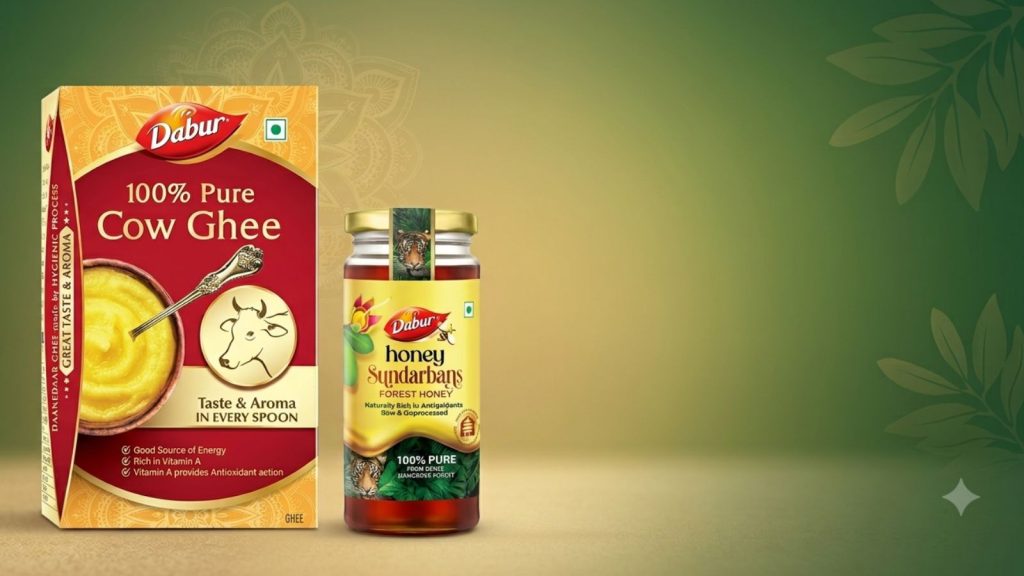
The Food Safety and Standards Authority of India (FSSAI) has directed Dabur to discontinue “100 per cent” claims on products including honey, coconut milk and cow ghee. The move has attracted considerable attention but it is important to understand what it actually means.
FSSAI has not declared these products unsafe, adulterated or of poor quality. Instead, its concern is with absolute claims such as “100% natural, 100% pure, 100% purity guaranteed and 100% organic”, which can create an impression of complete purity or nutritional superiority that current regulations neither define nor support. This is not an issue unique to one company. In May 2025, FSSAI issued an industry-wide advisory asking food businesses to avoid “100 per cent” claims because the term is not defined under Indian food regulations and may mislead consumers. Food labels should accurately describe products rather than exaggerate their qualities.

There is no universal scientific definition of “100% natural”
Consumers often associate words such as “natural,” “pure” and “fresh” with healthier food. Scientifically, however, these are broad marketing terms rather than precisely defined categories. In fact, there is no universally accepted scientific definition of “100% natural” for packaged foods.
Very few packaged foods remain exactly as they existed in nature. Even products made from a single ingredient undergo multiple processing steps before reaching supermarket shelves. Washing, filtration, pasteurisation, homogenisation, concentration, drying, deodorisation, packaging and transport all modify food to improve safety, quality or shelf life.
Food processing exists on a spectrum. Washing and pasteurisation are examples of minimal processing that improve safety, while other foods undergo more extensive processing to improve consistency, quality or shelf life. Processing itself is not undesirable. However, once a product has undergone multiple manufacturing steps, an absolute claim such as “100% natural” becomes difficult to define or justify scientifically.
Purity is often engineered
Consumers usually imagine purity as something untouched by technology. Modern food production works differently. Manufacturers aim to deliver products that taste, smell and look exactly the same every time a consumer buys them. Achieving this consistency requires food science.
Many aroma compounds are lost during processing. Food scientists restore these characteristics using approved flavouring substances. Emulsifiers help prevent separation of oil and water, stabilisers maintain texture, antioxidants delay spoilage and acidity regulators preserve flavour. None of these ingredients automatically makes a food unhealthy. In fact, many are essential for product stability and safety.
Story continues below this ad
Flavour is chemistry
One reason consumers misunderstand processed foods is that flavour appears mysterious when it is actually chemistry. The familiar aroma of vanilla comes largely from vanillin, citrus fruits owe much of their smell to limonene, while roasted coffee contains hundreds of volatile compounds generated during roasting. Scientists can isolate these molecules from natural sources or produce chemically identical versions under controlled conditions.
When two flavour molecules are chemically identical, the body responds to them according to their chemical structure rather than whether they came directly from a plant or were produced under controlled conditions. Labels mentioning “natural flavouring substances” therefore do not necessarily mean that large amounts of fresh fruit or spices have been added. Often, the characteristic flavour is recreated using carefully selected compounds found in nature.
“Natural” does not always mean healthy
Perhaps the greatest misconception is that natural automatically means healthy.
Honey is a good example. It contains small amounts of antioxidants and bioactive compounds, but these are present in relatively low quantities. Nutritionally, honey remains predominantly a source of fructose and glucose. For people living with diabetes, obesity or metabolic dysfunction-associated steatotic liver disease (fatty liver), excessive honey raises blood glucose and contributes calories much like other forms of sugar. The word “natural” does not change its metabolic effects.
Story continues below this ad
The same applies to ghee. It has been part of Indian diets for centuries and can certainly be consumed as part of a balanced diet. However, it remains an energy-dense food rich in saturated fat. Calling it “100% pure” does not alter its nutritional profile or eliminate the need for moderation. Coconut milk is another example. Although plant-based, it is naturally rich in saturated fat. Many consumers interpret “natural” as meaning heart healthy, but its health effects depend on the amount consumed, the overall diet and an individual’s health status—not the marketing language on the package.
Natural does not mean safer
Consumers also tend to equate natural with safe and synthetic with harmful. Science does not support this assumption. In toxicology, the dose largely determines risk. Many naturally occurring substances can be harmful at high levels, while food additives approved by FSSAI undergo rigorous safety evaluation and are permitted only within defined safety limits.
The real issue is transparency. Consumers have the right to know what is present in a product, but they should not assume that every processed ingredient is harmful or that every natural ingredient is automatically beneficial.
Why the FSSAI action matters
Absolute claims such as “100%” leave little room for nuance and imply a level of certainty that science and regulation cannot uniformly support. By discouraging these claims, FSSAI is encouraging manufacturers to communicate more accurately and helping consumers make decisions based on evidence rather than marketing.
Story continues below this ad
This has implications beyond honey, ghee or coconut milk. Similar concerns apply to terms such as “chemical-free, toxin-free, immune boosting and superfood.” These expressions sound persuasive but often lack precise regulatory definitions and can create unrealistic expectations.
Read the back of the pack
The ingredient list and nutrition facts panel provide a far more accurate picture of what consumers are buying. Added sugars, sodium, types of fat and flavouring substances reveal much more about nutritional quality.
No single food determines health. What matters is the quality of the overall diet maintained over months and years. Choosing more minimally processed foods, eating adequate fruits, vegetables, legumes, whole grains and nuts, and limiting excess sugar, salt and saturated fat remain the cornerstones of healthy eating. Science — not marketing — should guide our food choices.
(Dr Bhattacharya is senior consultant, endocrinology, Apollo Hospital, Delhi)