
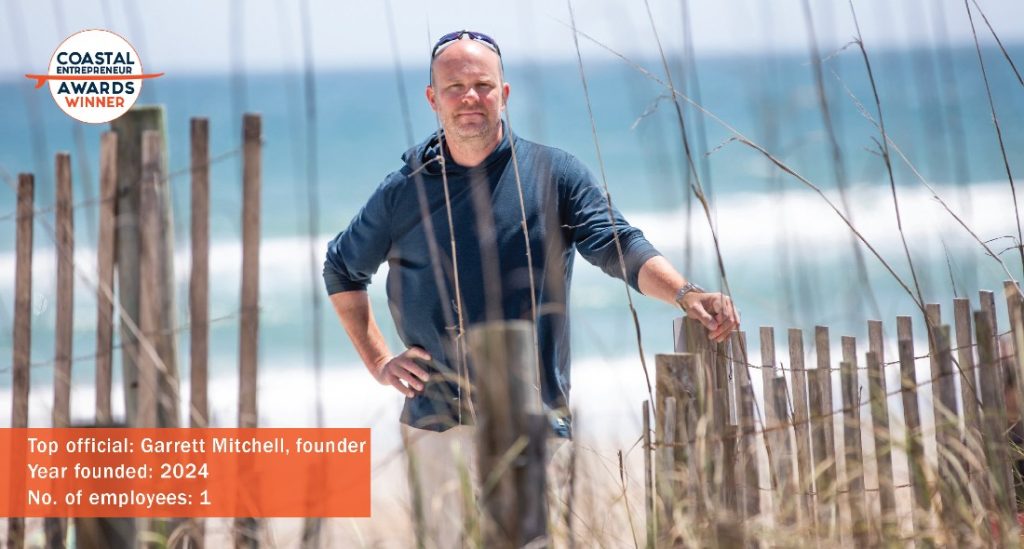
Garrett Mitchell knows that his startup has been called a “moonshot.”
Mitchell founded his research and development company, Nautigen, in 2024, and the firm is still finding its footing. But Mitchell has never lost sight of his goal: to discover novel bioactive marine molecules in deep-sea ecosystems on the seafloor using noninvasive remote sensing and biomolecular technologies.
In his own words, he’s trying to create a bridge from the deep sea to the laboratory.
In a few years’ time, Mitchell hopes to create a digital catalog of biomolecular data – categorized and analyzed with extensive metadata – available to pharmaceutical companies, academic institutions or others seeking new genetic resources. There’s still a way to go to reach that goal; currently, Mitchell is exploring ways to reach the seafloor, though he’s certainly no stranger to its mysteries.
Before founding Nautigen, Mitchell worked as a marine geodata specialist for a Dutch surveying company called Fugro. He spent over a decade locating hydrocarbon seeps for oil and gas companies using sonar technology – becoming an expert in mapping gas bubbles on the seafloor.
After being invited to join a deep-sea mineral survey expedition as an acoustic geophysicist, Mitchell was intrigued by the prospect of discovering new biomolecules for developing pharmaceuticals.
“The biomolecules of interest within these microbial bacteria in the seafloor that could be used for any number of things,” Mitchell said. “New medicines, viral remediation, dissolving oil, carbon capture. There’s a number of these different, pretty exciting applications.”
Exploring the seafloor for novel bioactive marine molecules is not a new body of research in the scientific community, Mitchell said; it’s just very, very difficult. Deep-sea exploration is gaining momentum, especially as interest in alternative sources of rare earth minerals for battery production grows.
“There’s these reservoirs of genetic material in the deep seafloor, but the issue is it’s very difficult to get to,” Mitchell said. “And I was like, you know, we’re already going out there, already sampling, but for different reasons.”
Of course, exploring the deep sea to collect biomolecules can be dangerous (and expensive) without the right equipment and preparation – not to mention the geopolitics of surveying in international waters.
As a solution to this, Mitchell is pursuing partnerships with companies like Fugro. He plans to accompany planned deep-sea expeditions, using his technology to collect sediment samples during surveying as noninvasively as possible.
“We’re trying to facilitate some of the known pathways to existing oil and gas and deep-sea mineral exploration (to find) new genetic resources for medicines,” he said.
Deep-sea mineral sampling is regulated by the International Seabed Authority (ISA), established by the United Nations, for spaces beyond national jurisdiction. Since regulatory approval can be slow-moving, Mitchell is starting within national jurisdiction, specifically within the United States’ exclusive economic zone.
Mitchell plans to analyze the samples using genomics and environmental DNA and to create digital sequence data to build a catalog for potential customers, helping narrow down the biomolecules of interest while being as transparent as possible.
“There’s a technology called eDNA. We can use these pieces of genetic material and actually analyze what’s going on in the environment. … The technology is able to sequence it back (to) what animals, organisms have been there. And I want to apply that to bacteria,” Mitchell said.
“Without that transparency … a lot of biopharma companies probably won’t touch your genetic material,” he added. “They want to verify exactly where it was collected.”
As drug discovery is expensive and can take decades, and AI-driven drug discovery depends on larger biomolecular datasets, Mitchell is hopeful that further exploration of the deep sea will broaden biodiscovery and lead to more affordable pharmaceuticals.
“My biggest passion is the public benefit part of it,” he said. “It’s been called a ‘moonshot,’ but that kind of gives me motivation, actually.”