
by ZHANG Xilong
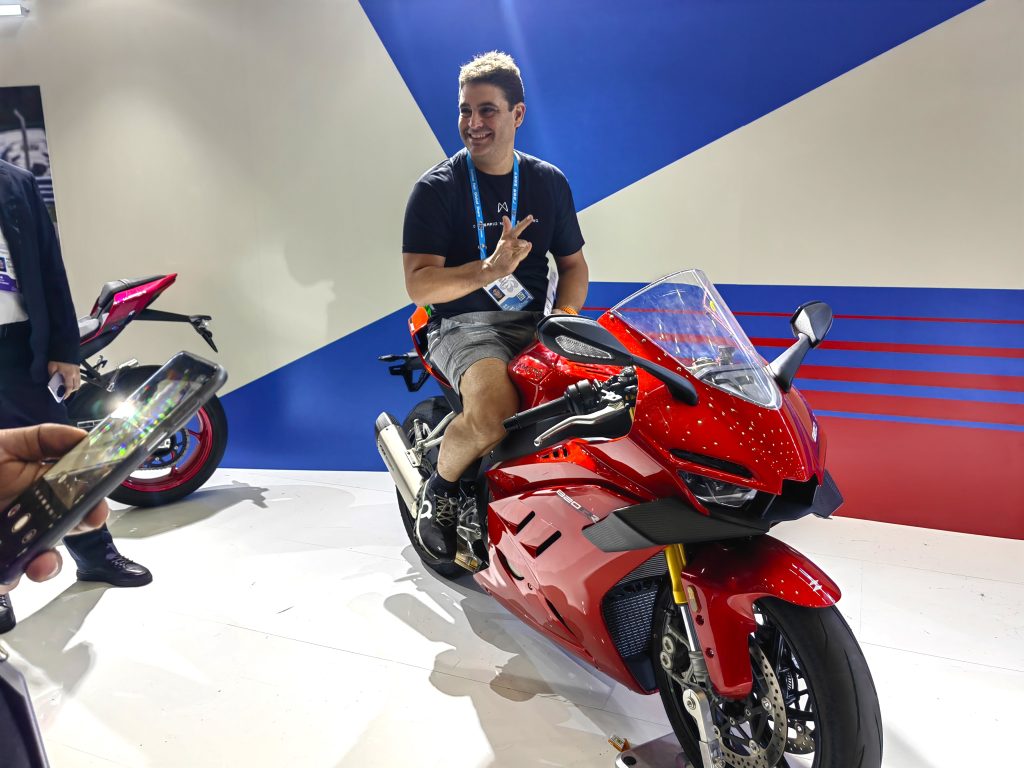
At the Canton Fair in Guangzhou, Lao motorcycle dealer Khamphay Sihavong climbed onto a flame-red sport bike, struck a racing pose and snapped a photo—skipping brochures and sales pitches altogether.
The model, the 820RR from Chinese brand ZXMOTO, has become one of the most talked-about exhibits after gaining attention following a recent win in the Superbike World Championship (WSBK). It has also turned the company’s booth into one of the busiest at the fair, drawing crowds of buyers who stop to take photos before asking about orders.
“I saw this bike on TV after the race,” said Sihavong, a Vientiane-based motorcycle dealer who currently distributes Honda motorcycles. With margins on entry-level commuter bikes squeezed to about US$20 per unit, he is now looking for higher-end models priced around US$1,500, compared with sub-US$1,000 commuter bikes.
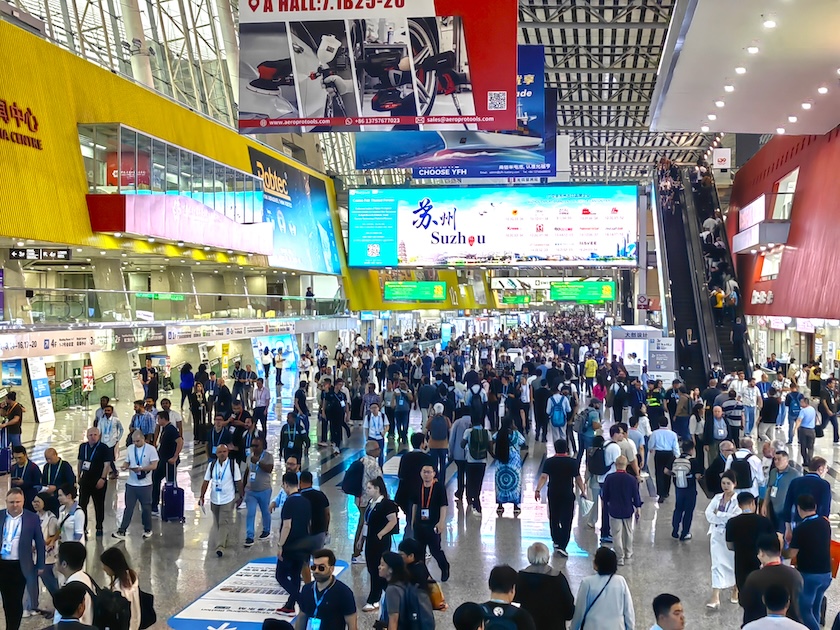
The Canton Fair, which opened on April 15, is the largest on record, with exhibition space of 1.55 million square meters, more than 32,000 exhibitors, and over 210,000 pre-registered overseas buyers, underscoring a rebound in global trade activity.
ZXMOTO, founded in 2024, was not initially expected to qualify for the fair due to a lack of export track record. Its breakthrough came earlier this month after its WSBK victory, which helped secure a late entry with support from local authorities.
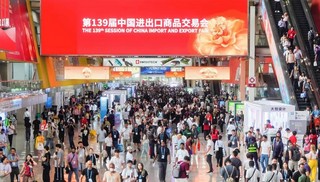
Since then, the company has seen a surge in overseas interest. Its foreign trade head HUANG Qin said the booth received 5,000–6,000 visitors in the first two days and generated “thousands” of intended orders. The company has signed 20 exclusive overseas distributors, with another 40–50 under negotiation, with inquiries from Europe, Southeast Asia and Latin America, including Mexico, Brazil and Peru.
The strong interest reflects a broader shift in demand. Data released during the fair shows emerging markets in Africa, Latin America and Southeast Asia are driving China’s export growth, with demand increasingly shifting towards higher-value products rather than low-end goods.
A report by Chinese cross-border payments platform XTransfer showed export order indices in Africa and Latin America above 56, pointing to strong demand for machinery, equipment and other capital goods. As industrialization gathers pace, buyers in these regions are increasingly seeking higher-quality components, complete equipment and more advanced products.
Sihavong said Chinese motorcycle makers had long competed on price in overseas markets, particularly in Southeast Asia, a strategy that helped them gain share in the 1990s but also led to quality concerns and a loss of ground to Japanese brands such as Honda and Yamaha.
Today, buyers say the picture has changed. “Chinese brands now have strong quality and design,” said Sihavong, who is seeking distribution rights for higher-performance models.
Manufacturers are also upgrading their technology. The 820RR is powered by an 819cc inline three-cylinder liquid-cooled engine, combining high output with reduced weight, bringing race-derived technology into mass-produced models. Huang said Chinese manufacturers can now match Japanese and European quality standards while keeping prices at about 70–80% of comparable products.
Other companies are making similar moves. Daye Motorcycle, based in Jiangmen—a production hub that accounts for roughly one-fifth of China’s motorcycle exports—has developed its own three-cylinder engine and introduced an aluminium twin-spar frame through its ZONTES brand.
Many Chinese brands are using Europe as a testing ground for global expansion. ZXMOTO plans to ship its first batch of bikes to Europe by mid-year, targeting overseas sales of 5,000 units this year before expanding into Southeast Asia and South America.
This approach mirrors that of established players such as Daye, which has already entered markets including Spain, Italy, France, Germany, Switzerland and Austria. “Europe has high certification barriers, so entering that market is a sign of technical capability,” said sales director CHEN Feiyan, adding that inquiries at this year’s fair rose 20–30% from a year earlier.
One sign of that shift is the growing involvement of European partners in product development. Rather than simply exporting finished products, some are moving into co-development models, with European partners handling design while Chinese firms take on engineering and manufacturing.
At the fair, Zhufeng Motorcycle (JMZF Motor), another manufacturer based in Jiangmen, showcased large-displacement models co-developed with Italian brand Mondial. A retro-style model from Jinan Qingqi, jointly designed with British and French partners, has sold more than 25,000 units in overseas markets since 2016, before being introduced back into China—an uncommon reversal that highlights improving product competitiveness.
At the same time, demand is becoming more segmented. Large-displacement, recreational models are gaining traction in Europe, while smaller commuter bikes continue to dominate in Africa and Latin America, with buyers from countries such as Tanzania, Somalia, Ecuador and Argentina driving volume demand.
Payments platform PingPong said transaction volumes linked to exports to Belt and Road markets rose 110% as of the end of 2025, with Africa up 113% and the Middle East and Latin America up 180%, reflecting both rising trade flows and deeper integration into local markets.
At the Canton Fair, the crowds gathering around a red sport bike offer a glimpse of that shift. For many overseas buyers, Chinese motorcycles are no longer just a low-cost option, but a product worth considering on performance, design and brand.