
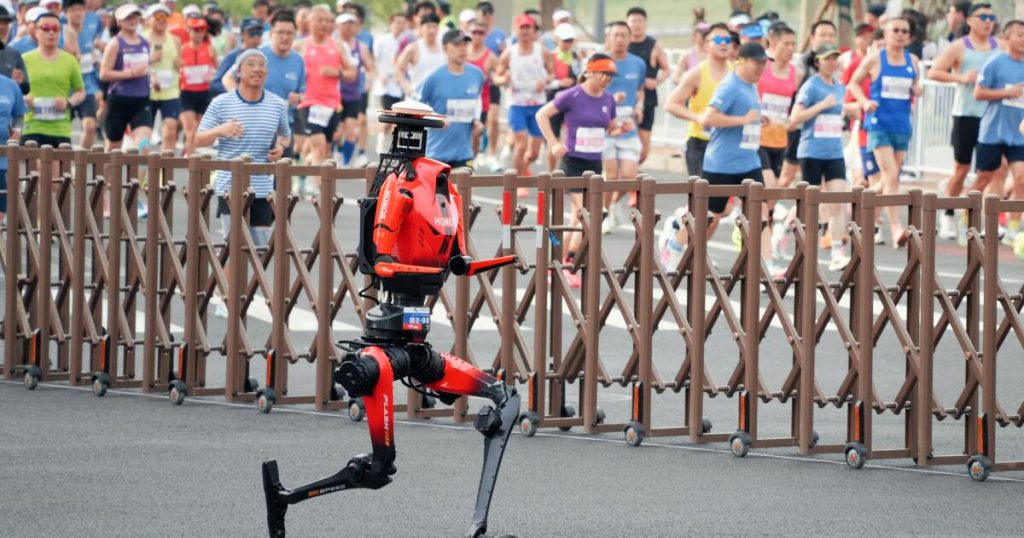
Slide over, Jacob Kiplimo. The world’s fastest human in the half-marathon is still just that, but the Ugandan’s record time of 57 minutes, 20 seconds, was obliterated Sunday in Beijing by a 5-foot-5 humanoid robot named Lightning.
Lightning was one of more than 100 robots running the 13.1-mile race in the Beijing Economic-Technological Development Area (a.k.a Beijing E-Town). Although many crashed or collided with robot brethren, Lightning avoided a serious mishap and crossed the finish line in 50 minutes, 26 seconds.
That’s 6 minutes, 54 seconds faster than Kiplimo’s mark set last month in Lisbon, or about the time it takes to soft boil an egg to custard-like perfection. It also was more than 10 minutes faster than any of the 12,000 men and women who ran the Beijing race in separate, parallel lanes.
Lightning — bright red and designed by Chinese smartphone brand Honor — slammed into a barricade and toppled down the stretch, but the robot helped itself back up with human assistance and propelled its three-foot-long legs to victory.
This was the race’s second year. In 2025 many mechanical competitors overheated and fell. Only six of 21 completed the course. Lightning was nearly three times faster than last year’s winner that finished in 2 hours, 40 minutes and 42 seconds.
This year, rules were “optimized,” according to the Beijing Town website, with entries running either by autonomous navigation or remote control. Lightning was propelled by autonomous navigation.
Awards were added for Best Endurance, Best Gait, Best Design and Best Perception.
The race was also far more impressive than the world’s first Humanoid Robot Games in Beijing. The three-day August event included almost 300 teams from 16 countries competing in soccer and kickboxing in addition to track.
The New York Times reported that during soccer matches “child-size robots tripped over each other, falling down like dominoes” and that one robot knocked over a human staff member during a running event.
A year later, the city of Beijing called Sunday’s race “a major step forward for the robotics industry — accelerating the transition of humanoid robots from lab to large-scale, real-world application.”
Zhao Haijie, 29, ran the fastest time among humans, finishing in 1 hour, 7 minutes and 47 seconds. He said the robots in an adjacent lane were really scooting.
“I felt it was going quite fast,” Zhao said in an interview with NBC News. “It just went whoosh right past me.”
With all due respect to the latest generation of Tesla’s Optimus humanoid robot, China appears to be the world leader in robotics. The nonprofit trade group International Federation of Robotics says more robots function in China than the rest of the world combined. At least 80 humanoid robot companies operate in the country, five times that of the United States.
One of China’s leading robotics companies, Unitree Robotics, already has a humanoid robot on the market that can walk, dance and perform basic tasks. Its least expensive version costs around $6,000.
“The U.S. leads in technological innovation, while China excels in speed of implementation,” P.K. Tseng, an analyst at the tech consulting firm TrendForce, told The Times. “The real turning point will arrive when humanoid robots move beyond R&D prototypes to large-scale deployment.”
Does creating the world’s fastest bipedal humanoid in a half-marathon stretch China’s lead in the overall robotics race?
The most practical innovation that Lightning brought to the race was joints equipped with a liquid-cooling system adapted from Honor’s smartphones.