
Japan’s US-led security path is politically safe but strategically costly
A Taiwan war would turn Japan’s alliance posture into a major economic risk
Japan needs deterrence with diplomacy, not automatic escalation
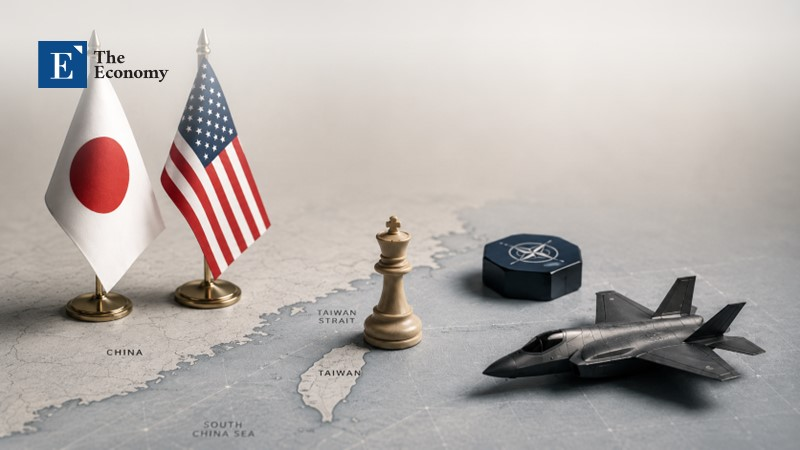
A conflict in the Taiwan Strait would cost the world about US$10 trillion, close to 10 percent of global output. This figure should modify the criteria by which Japanese security policy is evaluated. The question is no longer whether Japan remains a loyal ally of the US, restrained toward China, or responsive enough to protect the sea routes around its islands. Now it is: can Japan minimize the risk of a crisis that would hobble its own economy, divide its region and divert public resources that should be supporting growth and welfare? While the more hawkish path may look safe at home. It appeals to a public that has lost faith in Beijing and it gives Tokyo more room in Washington on trade, technology and defense. But it also carries a hidden cost. It helps make the bonds of alliances more manageable today but security in the region more unstable tomorrow.
Japan’s Security Policy Is Now a Cost Question
Fundamentally, the re-framing is straightforward. Japan’s security policy should not be read merely as a tit-for-tat policy of deterrence. It should be read as a security policy of fiscal and social risk management. A prime minister who gets closer to a U.S.-led security consensus receives tangible returns. Japan is still the central eastern Asian pillar of U.S. power. Japan benefits from diplomatic cover, sharing advanced technology and enjoying broader public acceptance when Japan-related security strategies that had spent years being ‘politically unfathomable.’ Under the Sanae Takaichi administration, the logic becomes even more stark: by working through the Quad, by deepening security relations with Australia and by pursuing technologies related to the AUKUS project, Japan can demonstrate to the world that it remains inextricably under the alliance shield, while normalizing militarization as statecraft in a perilous neighborhood.
That logic makes sense, politically. But it is not free. Japan has already tested the old Zen of keeping defense expenditure in check at about one percent of GDP. The country does not follow this principle anymore. Its planned build-up is linked to a much heavier burden, with major outlays for stand-off missiles, drones, cyber, space and more resilient bases. That case can be made. Supporters point to China’s naval build-up, tensions over Taiwan and the behavior near Japan’s southwestern islands. They say Tokyo has no alternative but to modernize seriously. Perhaps. But the consequence is that Japan’s security policy can become a one-way street. Every step meant to reassure Washington and deter Beijing can also help Beijing justify its own military expansion.
The Taiwan Strait Turns Strategy Into Exposure
And this is where the spiral becomes very dangerous. A war in the Taiwan Strait would not be a distant conflict observed from Tokyo, but would cut through Japan’s geography, its bases, its sea lanes, its ports, its chip supply, its flow of energy and its budget. War games often assume that in defending Taiwan, US forces would need access to Japanese installations, that is, that Japan could be embroiled in the conflict even if no Japanese leader sought a wider war. The point is not that war is certain. It is that Japan’s maneuvering room to stay out of the fire is narrower than the slogans make it out to be.
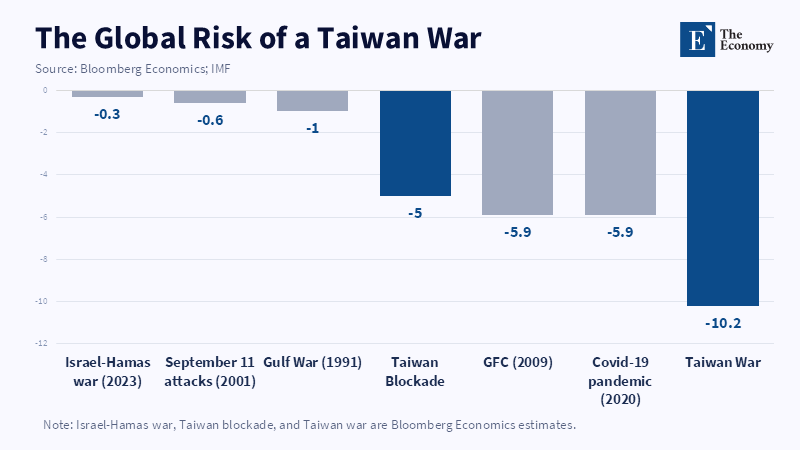
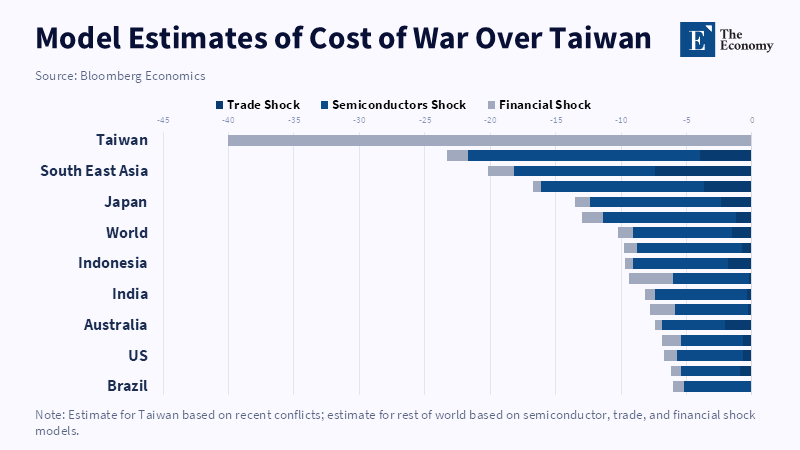
The economic liability is even more stark. Bloomberg Economics has forecast that an all-out war over Taiwan could shave global output by roughly 10.2 percent in that initial year; a blockade of the island could cost roughly 5 percent of global GDP. Rhodium Group estimates at least $2 trillion in economic activity that could be lost in a blockade, in addition to sanctions or military retaliation. These figures are not predictions. These are modeled scenarios. But they show the scale.
Taiwan produces virtually all the world’s advanced chips. The Taiwan Strait sits across one of Asia’s most important trade and technology corridors. Total Japan-China trade reached ¥44.2 trillion (about US$292 billion) in 2024. More than 31,000 Japanese company bases were recorded in China. A stance where China is merely a military threat misses the massive Japanese prosperity that can be lost if such a relationship collapses.
Deterrence Without Diplomacy Feeds the Arms Race
There are some powerful arguments for Japanese deterrence. No sound policy can expect Tokyo to dismiss China’s military advances or North Korea’s missile arsenals. A feeble Japan would not add stability to the region, but attract tests of will and erode the incentives for Taiwan, the Philippines, South Korea and Australia to hedge. But deterrence without diplomacy is a means, not a strategy. It is an engine. It keeps consuming fuel because at each point it cannot envisage an acceptable destination. Once Japan opens up long-range strike assets, unmanned vehicles, defense exports and extensive alliance-making, China will do likewise with its missile stocks, naval patrols, grey-zone operations and economic sanctions. Each move then justifies the other side’s warning.
This is why it is so expensive. Global military expenditure reached about $2.7 trillion in 2024 after the steepest annual rise since the end of the Cold War. East Asia was not immune. It was among the central regions of the crisis. Japan’s own resources behind the strategic shift are not huge in comparison with China’s overall military endowment; yet the signals count. Symbols as well as line-item data resonate in the region. For the restive Japanese right, especially those who see an expanded SDF as eroding the islands’ postwar constraints, it would do so in a sense; for China and the two main Koreas, in a memory of Japanese militarism that they have not fully shaken. But there is no wishing this away in policy either. Japan can position itself to be a restrained internationalist, a restrained democracy in how it conducts international relations; its neighbors can still think of it as a resurgent imperial power under U.S. protection. Both perceptions coexist and must coexist in a practical Japanese security policy.
Domestic Politics Makes the Safer Path Harder
The most difficult challenge is that it is difficult to implement in practice a more stable Japan security policy, while a stabilized approach is easier to gain more support for ideology. It is undeniable that Japanese distrust of China is already deep. A recent opinion survey conducted by a major nightly news demonstrated that the proportion of Japanese having positive views of China is diminishing. Confidence in Xi has also fallen sharply. It takes deep roots of negative feelings earned from years of territorial spats, military activities by Beijing, economic intimidation, historical concerns and anxiety about Taiwan. A leader who appears to adopt a tolerant attitude toward Beijing can be severely punished by rivals within the party, the press and voters, who prefer to see the confrontational faction prevail.
So it’s not going to be a dramatic turn to China any time soon. No Japanese prime minister can walk away from Washington and towards Beijing without risking a crisis at home. Washington has been Japan’s security lynchpin since the 1960s. China cannot fill that role and would not be very popular in Japan if it tried. Which is not to say Japan does not have a stark choice that is more limited. It can maintain the US-Japan alliance and try to rebuild a direct channel for stabilising relations with China, or it can allow alliance loyalties to eat up all other diplomacy. The first is a difficult sell politically, the second is a dangerous one strategically. It might look good at home, but it increases the likelihood of Japan being wedged between an unmanageable US-China crisis and a home life that cannot explore the need for international reassurance without undermining itself.
Diplomacy Is Not Appeasement
Another common criticism is that diplomacy with Beijing pays for coercion. That charge packs a punch when diplomacy means silence, concession, or denial. But a stabilizing China channel needn’t have Japan buying into China’s claims, withdrawing support for Taiwan’s peaceful status quo, or slow-walking each and every defense program. It just has to have Japan deter without provoking, keep crisis management distinct from giving in be prepared to develop missiles for the time being without jeopardising military hotlines, agree to work with the Quad, while continuing to seek regular economic dialogue with China, oppose an implied forced change to the status of Taiwan, while reaffirming that Japan does not want to see a new Cold War breakout in Asia. They sound like narrow distinctions, but hair-splitting distinctions can save lives during a crisis.
Another criticism is more pessimistic. It claims that the arms race has already gone beyond control; it is beyond Japan’s power to alter Chinese ambitions, US-China competition, or Taiwan politics. In which case, diplomacy is merely a pleasant formality before inevitable war. That fatalism is persuasive but short-sighted. War-preparedness thinking discourages the creation of firewalls between power centers, which prevent mistakes from becoming the conscious act of war. Few wars are started because each participant wants the full cost. They are caused by communication breaks, domestic pride and by each side interpreting the other’s war scare as an act of war. Japan can’t influence Beijing’s calculations. It can decide whether its own strategy will leave entry points open.
The challenge for policy is, therefore, not to induce neutrality; neutrality is not only unwarranted but also implausible. The challenge is to deny Japan the automaticity that Washington so relishes and to which hawks are so deeply committed. Japan would cease to be just another variable in someone else’s escalation ladder; a more mature Japanese security policy would entail the adoption of explicit rules regarding the employment of Japanese territory, bases and forces during a Taiwan crisis. It would require public discussion of fiscal compromises prior to the permanent inflation of the Japanese welfare state by the needs of defense and would mainstream the notion that Chinese trade dependence is a national security fact rather than a shameful handicap. Japan would begin to invest in regional diplomacy with South Korea, ASEAN, Australia and Europe so that it does not have to choose between the pressure of the U.S. and the retaliation of China whenever the situation gets hot.
This should be no less true in regard to domestic conditions than it is in regard to international policy. Japan is aging. Its workforce is shrinking. Its social security bill is mounting. Every yen spent on long-term military build-up is a yen that cannot be allocated on similar terms towards family services, pensions, educational programs, community rejuvenation, or the clean tech industry. That is not to suggest that military investment is not prudent. It is simply to highlight that military investment has opportunity costs-in this day and age, the trade-off must be clear. When the threat is imminent, it may be a cost well incurred. When the threat is seemingly self-perpetuated by ineffective diplomatic endeavors, however, the citizens deserve a clearer explanation. A strategy of procuring additional long-range missiles while allowing the regional political climate to worsen may be both a defensive gain and a strategic trap.
The dangerous scenario is not for Japan to be too close to the U.S. It will be close to the U.S. and a significant part of Asia will prefer that to an uncontrolled power vacuum. The dangerous scenario is that Japan will lose the capacity to think beyond the alliance box. If all China matters became U.S. Alliance matters, Tokyo would abandon the only role it still needs to play: that of a front-line middle power that can both deter and work with others while talking, as well as maintaining its interdependence, at the same time. That narrow, difficult role is not comfortable. Doing it involves alienating hawks, frustrating some U.S. Strategists and meeting Chinese pressure without staging. But that alternative is worse; it leaves Japan better armed and worse off.
Japan’s security policy now faces an awkward test. Japan can continue to judge its strength as a state by the size of its budget, the room to operate its long-range missiles and Washington’s approval that Tokyo is “on-side”. Or it can judge itself by whether Japan reduces the risk of the $10 trillion catastrophe that now looms over the Taiwan Strait. Judging all in the second sense will be harder, since it will require political leaders to make diplomacy credible again in a polity that construes engagement with China as weakness. Such is the challenge that lies ahead. Japan should not seek to serve China’s interests, but focus on staying out of a Chinese policy trap. Japan’s next twenty-five years of security should be based on a simple principle: to arm enough to deter war, talk enough to make war less likely and to do both while spending public money as if Japan’s future were as urgent as the approaching crisis.
The views expressed in this article are those of the author(s) and do not necessarily reflect the official position of The Economy or its affiliates.
References
Akimoto, D. (2026) ‘The JAUKUS Option Revisited: Will Japan Join AUKUS under the Takaichi Administration?’, Institute for Security & Development Policy, 18 February.
Cancian, M.F., Cancian, M. and Heginbotham, E. (2023) The First Battle of the Next War: Wargaming a Chinese Invasion of Taiwan. Washington, DC: Center for Strategic and International Studies.
Internal Revenue Service (2025) Yearly Average Currency Exchange Rates. Washington, DC: Internal Revenue Service.
Liang, X., Tian, N., Lopes da Silva, D., Scarazzato, L., Karim, Z.A. and Ricard, J.G. (2025) Trends in World Military Expenditure, 2024. Stockholm: Stockholm International Peace Research Institute.
Ministry of Defense, Japan (2025) Overview of FY2026 Budget. Tokyo: Ministry of Defense.
Ministry of Foreign Affairs of Japan (2025) China’s Economy and Japan-China Economic Relations. Tokyo: Ministry of Foreign Affairs of Japan.
Mochizuki, M. (2026) ‘Japan Can’t Hedge Against Trump Without Stabilising Relations with China’, East Asia Forum, 3 June.
Silver, L., Clancy, L., Schulman, J., Miner, W. and Huang, C. (2025) International Views of China Turn Slightly More Positive. Washington, DC: Pew Research Center.
Vest, C., Kratz, A. and Goujon, R. (2022) The Global Economic Disruptions from a Taiwan Conflict. New York: Rhodium Group.
Welch, J., Leonard, J., Cousin, M., DiPippo, G. and Orlik, T. (2024) ‘Xi, Biden and the $10 Trillion Cost of War Over Taiwan’, Bloomberg Economics, 9 January. Republished as ‘If China Invades Taiwan, It Would Cost World Economy $10 Trillion’, Times of India, 9 January.