
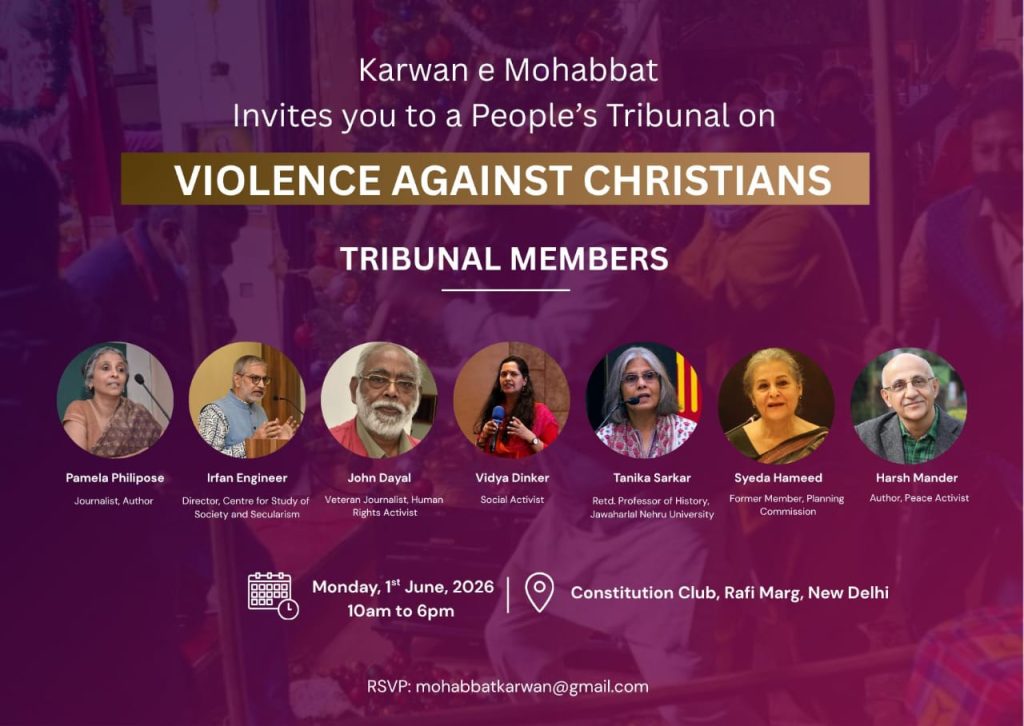
A People’s Tribunal on Violence Against Christians in India this week heard chilling testimony of violence and discrimination across several Indian states.
The hearing was jointly convened by Karwan-e-Mohabbat – the “Caravan of Love” – a civil society advocacy founded in 2017 in solidarity with victims of religiously motivated mob violence, and a collective of concerned citizens.
Survivors, community representatives, researchers, lawyers and human rights defenders gathered to give and to hear extensive testimonies documenting an alarming escalation of intimidation, aggression, and brutality.
At the Constitution Club in New Delhi on June 1, 2026, The People’s Tribunal examined reports that participants said point to growing challenges to the constitutional principles of equality and religious freedom.
The hearing followed fact-finding visits and public hearings in Chhattisgarh in April 2026 and Odisha in May 2026. during which tribunal members met with numerous individuals who reported being affected by religiously motivated discrimination and conflict.
Survivors, lawyers, researchers, and human rights advocates presented testimonies describing hostility toward Christian communities, particularly among Adivasi and Dalit populations.
Father Ajay Singh from Odisha was part of fact finding and testified before the Tribunal. He spoke exclusively to Crux Now, saying the overall situation has not improved in the country.
“The large-scale attacks on Christians in Odisha in 2007–08 were among the worst episodes of anti-Christian violence in India’s recent history,” Singh said.
“Their impact was like a tsunami,” he said. “Since then,” he said, “there has been no let-up in anti-Christian violence across the country.”
Singh presented evidence of systematic denial of burial rights and what he described as one of the gravest forms of humiliation inflicted upon Christian communities.
He recounted cases in which funeral processions were obstructed, burial in village graveyards was denied, and even the bodies of deceased Christians were allegedly removed and buried against the wishes of their families.
He also highlighted the misuse of local institutions and laws to deny Christians from India’s many ancient tribal and ethnic minority groups – collectively known as Adivasis, literally “ancient inhabitants” – access to burial grounds and other rights.
Although India is constitutionally a secular republic, increasing incidents by anti-Christian groups continue to violate fundamental constitutional rights by intruding into private and public spaces.
The incidents include a range of disturbances, from disrupting birthday celebrations in homes and hotels, to vandalizing churches and workplaces, interfering with burials, and stopping Christians while travelling.
These acts are often carried out in the name of stopping alleged religious conversion.
At the Delhi hearing, the Tribunal heard testimonies from survivors and representatives from Uttar Pradesh, Rajasthan, Madhya Pradesh, Chhattisgarh, Gujarat and Odisha.
Evidence presented before the panel detailed attacks on churches and prayer meetings, violence against pastors and priests, social and economic boycotts, denial of burial rights, forced displacement from villages, and the alleged role of Hindu nationalist organizations as well as the response of political leaders, police and judicial institutions.
The June 1 gathering was the second People’s Tribunal after the National People’s Tribunal on Kandhamal held at the Constitutional Club, New Delhi, in 2010.
In India, the People’s Tribunals are unofficial bodies often led by retired judges or guided by legal professionals, who conduct public enquiries into various abuses.
The People’s Tribunal is an alternative outlet for the victims faced with official obstruction and delays.
People’s Tribunals have investigated matters ranging from environmental destruction to forced or coerced relocation, corruption, and communal or state-sponsored violence.
John Dayal: Constitutional guarantees under threat
Opening the Tribunal, veteran journalist and human rights leader John Dayal rehearsed the long and gruesome history of sometimes murderous violence against Christians, and warned that constitutional guarantees of freedom of conscience, religious liberty and equal citizenship are facing unprecedented challenges in the present day.
Documentary screening
The Tribunal also screened a documentary film produced by Karwan-e-Mohabbat documenting violence against Christians in Madhya Pradesh.
The film was based on a fact-finding visit conducted in mid-May 2026 across six districts – Jhabua, Burhanpur, Indore, Dhar, Khandwa and Sehore – during which the team met approximately fifteen survivors and affected families.
Through first-hand testimonies, the film documented attacks on prayer meetings, intimidation of pastors and worshippers, arrests under anti-conversion laws, social ostracisation and the pervasive climate of fear affecting Christian communities in the state.
The film situated these incidents within a broader pattern of increasing hostility towards religious minorities and highlighted the everyday consequences of violence on the lives, livelihoods and dignity of affected families.
Chouhan: Violence under-reported
Lawyer and rights advocate Degree Prasad Chouhan from Chhattisgarh described a significant gap between the scale of violence and the official response.
He pointed to the low number of incident reports filed with police when compared with the hundreds of incidents reported annually, and raised concerns regarding delayed investigations, police inaction and the failure of institutions to provide justice to survivors.
He argued that the central issue was not only the violence itself but the inability or unwillingness of state institutions to respond effectively.
The Tribunal also heard survivor testimonies describing attacks on prayer meetings, arbitrary arrests under anti-conversion laws, threats, social boycott, forced displacement, closure of places of worship, economic deprivation and intimidation by organised groups.
Several testimonies highlighted the targeting of house churches and small congregations, particularly in rural and tribal areas.
Concerns over official complicity and abuse of law
A recurring concern throughout the proceedings was the alleged role of state institutions.
Participants described instances in which police officers failed to protect victims, registered cases against those who had been attacked, delayed investigations, or pressured communities into so-called compromise agreements.
Speakers also raised concerns about the operation of anti-conversion laws and the difficulties faced by victims seeking legal remedies.
In their closing observations, members of the Tribunal reflected on both the testimonies presented and their broader implications for India’s constitutional democracy.
Concluding the proceedings, Karwan-e-Mohabbat founder Harsh Mander said the incidents documented before the Tribunal could not be understood as isolated acts of prejudice or spontaneous expressions of hostility.
He argued that they revealed a systematic campaign of exclusion that threatened the constitutional promise of equal citizenship.
Mander warned that fundamental freedoms guaranteed by the Constitution were being steadily eroded.
He called upon citizens, institutions and governments to act urgently to defend them.