
Lebanese officials on Saturday launched the redevelopment of the Rene Mouawad Airport in Qlayaat, marking a step towards reopening the long-dormant northern facility as the country’s second civilian airport and reducing reliance on Beirut’s sole international gateway.
The move also comes as Lebanon continues to face security threats from the war between Israel and Iran-backed militant group Hezbollah. While bombardment has largely stopped in Beirut, the security situation remains fragile.
Lebanon, on the Mediterranean and on the doorstep of Europe, has long struggled to keep its only airport in Beirut fully operational because of political instability and its proximity to areas prone to unrest. It is located next to the capital’s southern suburbs, a Hezbollah stronghold that has been subjected to heavy Israeli bombardment during successive wars.
A second airport could help it regain some of the status it enjoyed before the civil war began in 1975.
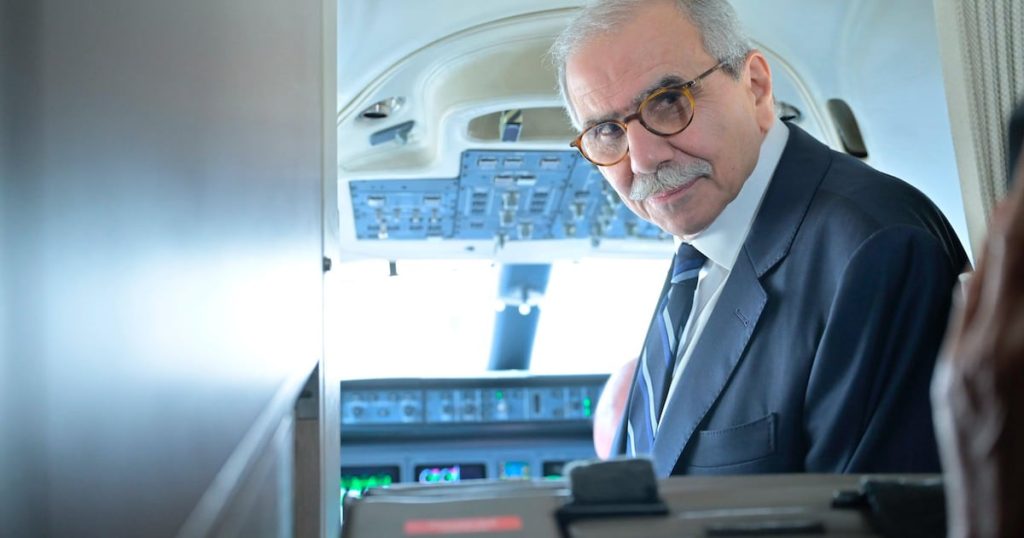
Prime Minister Nawaf Salam attended the launch event at the airport in Akkar, where Lebanese government social media accounts showed video of him arriving by aircraft as officials formally kicked off rehabilitation efforts.
The aircraft carrying Mr Salam and Public Works and Transport Minister Fayez Rasamny was the first plane to land on the runway as part of the launch ceremony, while Interior Minister Ahmad Hajjar and Defence Minister Michel Menassa arrived separately aboard a military helicopter.
Mr Salam said that the airport is not intended to replace Beirut’s Rafic Hariri International Airport, adding that Lebanon needs a modern and integrated aviation infrastructure, as well as stronger links between its areas and the national economy.
Located in northern Lebanon near the Syrian border, the airport – formerly known as Qlayaat Airport and renamed after former president Rene Mouawad − has largely functioned as a military facility for decades, despite repeated proposals to reopen it for civilian use. It was used for domestic civilian flights during parts of Lebanon’s civil war.
Growth in Akkar
Officials and supporters of the project say reopening the airport could boost economic activity in Akkar and northern Lebanon, create jobs and attract investment to one of the country’s most deprived regions. The facility is also expected to ease pressure on Rafic Hariri International Airport, Lebanon’s only commercial airport, which handles all scheduled passenger traffic.
“Akkar governorate recorded the highest poverty rate among Lebanon’s governorates, reaching 62 per cent, compared with 33 per cent nationally,” said Mr Salam.
“It also recorded the lowest labour force participation rate, with no more than 35 per cent of residents engaged in economic activity or the labour market, compared with 43 per cent nationwide. Indicators also show that about a quarter of the governorate’s population is unemployed.”
The contract for the rehabilitation and relaunch of Rene Mouawad Airport was awarded in May to Sky Lounge Services, a Beirut-based private and business aviation services company.
In a speech during the opening ceremony, the company’s chairman, Ziad Munla, said, the passenger terminal will be completed “within 90 days after completing the required approvals and licenses”.The airport will be able to handle about 114,000 passengers in its first year, rising to more than 600,000 by its fourth year, he said.
For his part, Mr Rasamny said that Lebanon’s second airport is not “only for Akkar or northern Lebanon, but for the whole country”, adding that it demonstrates that the state is capable of turning long-delayed projects into tangible achievements “when there is political will”.
“We faced many challenges and circumstances that were not easy for the country, but we believe deprivation is not destiny and development is not a favour – it is a right of citizens,” said Mr Rasamny.
The government has increasingly framed the airport as both an economic and strategic necessity. Discussions have included positioning the facility for low-cost carriers, cargo operations and additional passenger capacity.