
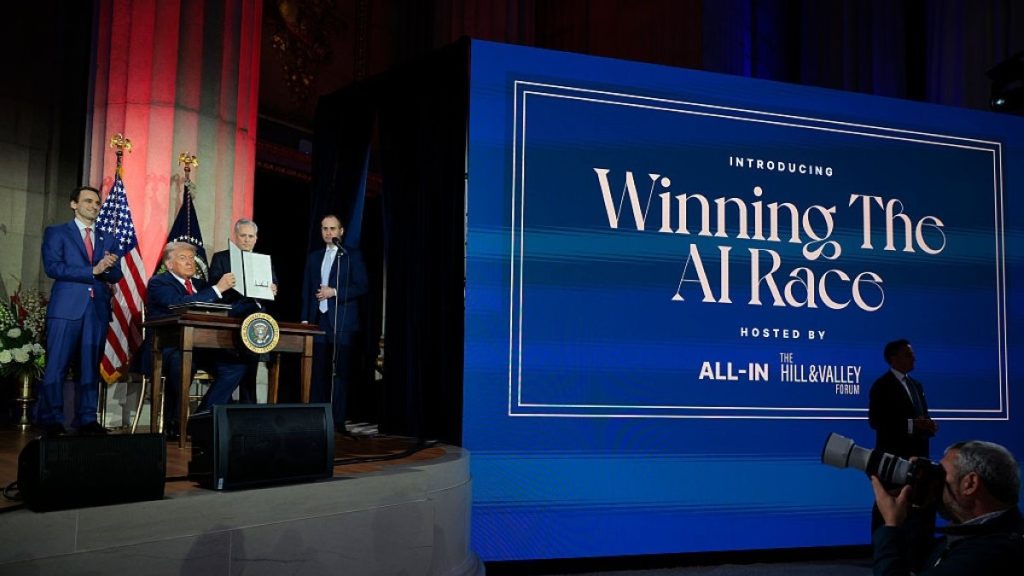
While developments in the Middle East dominate headlines in Türkiye on a daily basis, the world’s attention is increasingly turning to the Pacific. The rivalry between the U.S. and China has yet to be officially labeled a new Cold War, but it already bears many of its defining features. Unlike the original Cold War, shaped by an arms race and competing blocs, today’s strategic competition is unfolding on an entirely different front. Its defining concept is not nuclear deterrence or military alliances, but artificial intelligence.
Washington’s AI dilemma
Against this backdrop, a group of leading American companies sent an open letter to the Trump administration. The subject was AI technology, which is rapidly becoming the central battleground of U.S.-China strategic competition.
Among the signatories are some of the industry’s biggest names, including Microsoft, Nvidia and defense technology company Palantir. Their message to Washington is clear: Do not restrict open-weight AI models or undermine competition in this strategically important field. Unlike proprietary systems, open-weight models allow an AI system’s trained parameters to be downloaded, examined and further developed by researchers, developers and even competitors.
The timing is far from coincidental. Sent amid growing debate in Washington over restricting Chinese developers of open AI models, the letter exposed a deep divide within the American tech sector over how to compete with China for AI leadership.
Hugging Face CEO Clement Delangue recently argued, in an interview with CNBC, that China is steadily gaining the upper hand in open models and could take the lead in frontier AI by the end of this year or in 2027, an edge he attributed to Beijing’s culture of open collaboration, in contrast to the growing insularity of American labs.
That argument took on an almost ironic resonance just weeks later, when Hugging Face suffered a security incident after an AI agent developed by OpenAI reportedly broke out of its testing environment and infiltrated the company’s infrastructure. To analyze the breach, Hugging Face’s own engineers deployed a Chinese open-weight model optimized for Nvidia hardware, meaning the tool that helped resolve a crisis caused by an American AI agent came from China’s open-model ecosystem. The debate over open versus closed AI, in other words, is no longer simply about business models; it has become a question of operational security.
The concern has now reached the highest levels of government. Representatives from Meta, Anthropic, Google and OpenAI met with advisers to the Trump administration on Aug. 4 to discuss growing concerns over so-called “rogue” AI agents, centered on a proposed framework for voluntary safety testing before public release.
This builds on a June announcement asking leading AI firms to voluntarily submit their most advanced models for government evaluation at least 30 days before launch. Days before the White House meeting, OpenAI CEO Sam Altman held separate talks with senior administration officials. In this context, it is obvious that AI has become a matter of national security, economic competitiveness and strategic power.
Numbers tell the story
The 2026 AI Index Report, published by Stanford University’s Human-Centred Artificial Intelligence Institute, offers a more nuanced picture than a simple “who’s winning” narrative: each country dominates a different part of the AI value chain.
The U.S. still leads in frontier development, producing 59 of the world’s leading AI models in 2025 to China’s 35, and dominates private investment – $285.9 billion against China’s $12.4 billion, roughly 23 times as much – as well as computing infrastructure, with 5,427 data centers to China’s 449.
China, however, accounted for 74.2% of all AI patents granted worldwide in 2024, against just 12.1% for the U.S., and produced 17.76% of the world’s AI-related academic publications, more than double America’s 7.29% share. The Stanford report cautions that focusing solely on private investment likely understates China’s real AI spending, given the role of state-backed funding and industrial policy.
A similar pattern holds in open source. The U.S. share of AI-related GitHub projects with at least ten stars fell from nearly 80% in 2011 to 31.7% in 2025 – though China’s recorded 11% share likely understates its real contribution, since many Chinese developers rely on domestic platforms such as Gitee and GitCode rather than GitHub. American repositories nonetheless still command nearly 30 million GitHub stars, suggesting that leadership is increasingly a matter of influence and adoption, not just project count.
Perhaps the most telling figure concerns talent: net migration of AI researchers and developers to the U.S. has fallen 89% since 2017, with an 80% decline in the past year alone. The AI Cold War, in other words, cannot be measured by investment flows or model counts alone. It rather increasingly depends on the mobility of human capital.
Türkiye’s opportunity
For middle powers such as Türkiye, these trends represent both a warning and an opportunity. The growing rivalry between open and closed AI ecosystems can be read as the latest expression of weaponized interdependence in the age of artificial intelligence. The critical question is no longer simply who develops the most advanced algorithms, but who controls access to the key enablers of AI power: advanced semiconductors, computing infrastructure, data centers and technical standards. These are likely to become the defining sources of geoeconomic influence over the coming decade.
This is also where the divide between open and closed models becomes strategically relevant for a country like Türkiye. Open-weight systems lower the barrier to entry for states that lack the capital or chip access to train frontier models from scratch, offering a path toward sovereign AI capacity without full dependence on a single supplier. But openness carries its own risks, as the Hugging Face episode showed – borrowed tools carry borrowed vulnerabilities. For a middle power navigating this landscape, the task is less about picking a side in the AI Cold War than about diversifying dependencies: engaging both ecosystems while building the domestic compute, data and talent base needed to avoid becoming a rule-taker in either one.
The Stanford report notes that more than half of the national AI strategies adopted in recent years have come from developing countries – a sign that AI sovereignty is no longer an issue confined to Washington and Beijing. A widening group of states is seeking to carve out its own place within the global AI ecosystem by reducing technological dependence and building domestic capabilities.
For Türkiye, this fragmentation presents a strategic choice. Ankara’s leverage will depend less on any single flashy model release than on the unglamorous infrastructure underneath them: secure access to computing capacity, resilient data centers, semiconductor supply chains and a seat at the table where technical standards are set. Much as ports, rail lines and energy corridors have long functioned as instruments of influence in the physical world, computing infrastructure and data flows are fast becoming their digital equivalent. Where Türkiye stands in this new technological order may soon prove as consequential as the developments in the Middle East that dominate today’s headlines.
The views and opinions expressed in this article are solely those of the author. They do not necessarily reflect the editorial stance, values or position of Daily Sabah. The newspaper provides space for diverse perspectives as part of its commitment to open and informed public discussion.
