
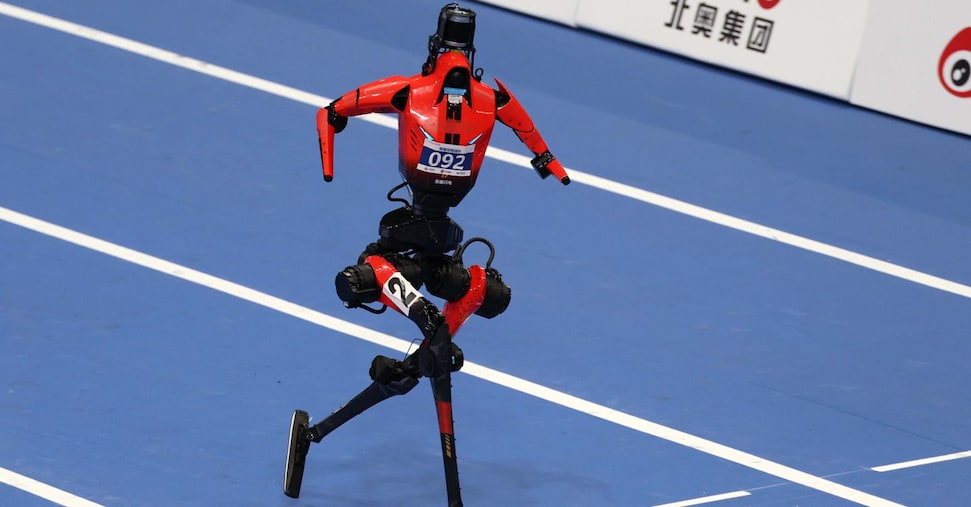
He runs faster than Bolt and snatches the 100-metre record from him. The humanoid robot developed by the Chinese smartphone manufacturer Honor ran the 100 metres in 9.32 seconds, smashing the human world record set by the great Jamaican sprinter and beating it by 26 hundredths of a second. A true Lightning who reached a top speed of 14.5 metres per second during trials for the second edition of the World Humanoid Robotics Games in Beijing.
That it was a direct challenge to the world’s fastest man was perhaps already evident from the name, ‘Lightning’, which echoes that flesh-and-blood ‘Bolt’ who still captures the imagination of athletics fans. But the Jamaican champion, who remains unbeaten to this day, would be left behind if he were to run the 100 metres against his new rival today. All this took place on Saturday 22 August at the second edition of the ‘Android Olympics», where Usain’s legendary 9.58 – set at the 2009 World Championships in Berlin – went up in smoke.
The record was set at a test event. The news was broadcast by Chinese state television, with understandable fanfare. It is no secret that China is increasingly focusing on robotics, and news such as this can only act as a catalyst for the entire sector. In the first half of 2026 , China exported 97 per cent of the world’s total humanoid robots, a total of 40,000 units, and last Wednesday the giant Unitree Robotics made a splash on its debut on the Shanghai Stock Exchange, soaring by 629 per cent. The company – backed by a consortium of major private and public investors – had unveiled its ‘Superman’ a few days earlier, a humanoid robot which, they claim, is capable of jumping 2 metres in height from a standing start and reaching a speed of 12.66 metres per second – compared to the 12.42 metres per second achieved by Usain Bolt in that legendary race in Berlin.
However, these records were smashed by Lightning. The red, headless android – it doesn’t need a head to run – reached a top speed of 14.5 metres per second, crossing the finish line 26 hundredths of a second behind the fastest human ever, with a time of 9.32. To put this into perspective: just a year ago, at the first edition of the World Humanoid Robot Games, the gold medal went to ‘Tiangong Ultra’ from the Beijing Humanoid Robot Innovation Centre, which won with an official time of 21.50 seconds. At a glance, this is unlikely to be the only record to be broken. The second edition of the Games, currently taking place at the National Speed Skating Oval in Beijing, is bringing together over 2,000 robot athletes from all over the world for an expanded programme of sporting and practical challenges, according to Chinese television. The five-day event features 51 events and a total of 1,301 competitions on the programme, divided into nine sessions, compared to the three days and six sessions of the first edition.
This year’s programme will combine sporting competitions, artistic performances and practical activities. The 51 events will include 30 competitive sports – including, alongside athletics, football, tennis, table tennis, as well as weightlifting and martial arts – and 21 challenges based on real-life scenarios. Lightning is apparently set to run the 100 metres, as well as the 400 and 1,500 metres. Because, in its own way, the Chinese robot is also an all-round athlete: a sprinter, middle-distance runner and even a long-distance runner. Last April, it won the Beijing half-marathon in 50’26”, a time better than the men’s world record. At the time, it stood just 1.69 metres tall, with legs measuring 95 centimetres: a bit too short for sprinting on the track, they must have thought at Honor. No big deal: after analysing the situation, the engineers fitted it with two new legs, ten centimetres longer. A trick that – at least so far – human sprinters cannot resort to.