
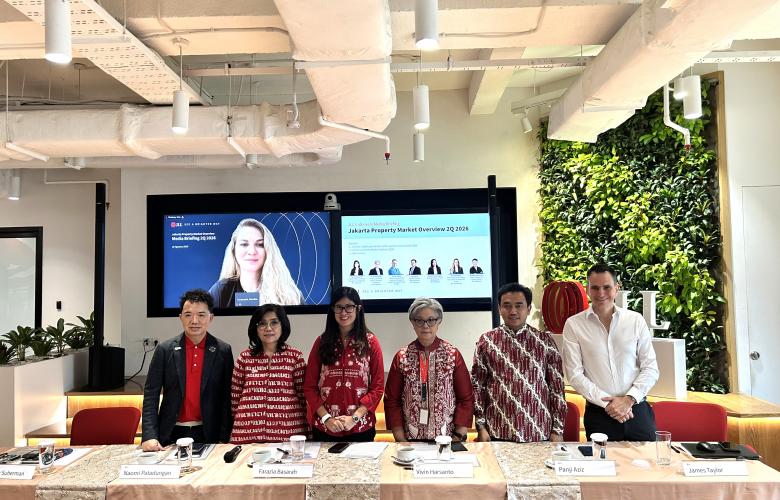
Jakarta’s property market continued its recovery trajectory in the second quarter of 2026, with improvements across office, retail, and logistics sectors.
Office Market Shows Consistent Recovery
The Central Business District (CBD) office market extended its recovery trend in Q2 2026, with occupancy rates climbing to 72.8%. Net absorption remained positive throughout the first half of the year, supported by the absence of new supply in the CBD which continued to benefit existing buildings.
“Jakarta’s CBD office market continued its recovery trend in the second quarter of 2026, with occupancy rates reaching 72.8%,” James Taylor, Head of Research at JLL Indonesia told RETalk Asia. “Net demand remained positive throughout the first semester, although economic conditions and political uncertainty impacted the speed of recovery. The absence of new supply in the CBD continues to support absorption of existing inventory. Rental rates for Premium and Grade A buildings showed moderate increases, while Grade B and C properties began showing signs of stabilization after experiencing declines in previous quarters.”
The non-CBD market recorded its highest absorption figures since 2019, with approximately 23,000 square meters leased during the quarter. This was driven by the completion of two new buildings in North and West Jakarta, adding approximately 67,000 square meters of space, with oil and gas sector companies leading leasing activity.
Panji Aziz, Head of Tenant Representation at JLL Indonesia, told RETalk Asia strong activity in premium locations: “Grade A offices in the CBD recorded consistent absorption in the second quarter, with the financial services sector leading leasing activity. Sudirman and SCBD were the most active locations this quarter, driven by relocation activities by companies seeking to upgrade the quality of their office buildings. The trend for furnished office spaces that began in previous quarters continues, with several property owners retaining furniture from previous tenants or offering newly furnished spaces and fit-out contributions to attract prospective tenants.”
Panji added that rental dynamics reflect a cautious but optimistic market: “Grade A office rental rates in the CBD increased by 0.05% compared to the previous quarter, though slower than first quarter growth. A number of property owners are taking a more cautious approach to rent increases, prioritizing occupancy stability over aggressive pricing. Nevertheless, the absence of new supply until 2029 continues to support property owners’ positions in the Grade A building segment.”
Retail Market Maintains Positive Performance
Jakarta’s shopping center market maintained positive performance in Q2 2026, with net demand reaching approximately 16,500 square meters despite no new supply additions. Leasing activity was driven by expansion of premium food and beverage tenants, specialty beverage outlets, and experiential retail concepts increasingly active in Jakarta’s major shopping centers.
James Taylor, Head of Research at JLL Indonesia says: “The luxury retail segment also showed growth through openings and expansions of international luxury fashion, beauty, fragrance, and jewelry stores in several premium shopping centers. These conditions helped push Jakarta’s shopping center occupancy rate to approximately 86%. Meanwhile, two new shopping center projects are still planned for completion by the end of 2026.”
Residential Markets Show Mixed Performance
The condominium market recorded moderate demand increases in Q2 2026, though transaction volumes remained relatively low compared to historical trends. Increased demand was primarily driven by transactions in new projects by developers with established buyer bases, with end-users continuing to dominate purchasing activity.
“There was one new launch in South Jakarta offering units after project completion,” James noted. “This supply addition contributed to a slight decrease in the sales rate to 82%. With two new launches throughout 2026, total supply addition this year is recorded as the highest since 2020.”
The landed housing market in Greater Jakarta showed growth in the first semester of 2026 compared to the same period last year. Vivin Harsanto, Head of Growth and Head of Strategic Consulting at JLL Indonesia, told RETalk Asia a shift in buyer preferences: “Four-bedroom homes are dominating sales, with prices starting from IDR 600 million. This trend reflects developers’ strategy of offering homes with more optimal space within an affordable price range. The IDR 600 million to 1.3 billion segment continues to dominate the market, offering various unit types from two to four bedrooms.”
Vivin added: “Homes priced below IDR 600 million have increased, as have homes above IDR 3.0 billion. Meanwhile, homes priced between IDR 1.3 billion and 3.0 billion have slightly slowed, showing diverse demand patterns across different price levels. The market also recorded joint venture collaborations between local and foreign developers, demonstrating confidence in the landed housing sector. Developers continue to offer flexible payment schemes and various incentives to maintain sales momentum.”
Hospitality Sector Benefits from Tourism Growth
Tourist arrivals to Jakarta have grown year-over-year since January 2026, with both domestic and international segments surpassing previous year levels, though domestic tourists dominate the market.
Irina Chadsey, Vice President, Investment Sales, Hotels & Hospitality Group, JLL Asia Pacific, told RETalk Asia favorable market conditions: “The weakening Rupiah has enabled hotels in Bali to register notable improvement in RevPAR, driven by significantly higher ADR.”
Investment Market Remains Active Across Multiple Sectors
Indonesia maintained its position as a preferred destination for property investment among foreign and domestic investors entering 2026. Herully Suherman, Senior Director, Capital Markets at JLL Indonesia told RETalk Asia: “The logistics, industrial, and data center sectors continue to lead investment activity, supported by stable GDP growth, a strong manufacturing base, and healthy foreign and domestic capital flows. Investors are actively pursuing income-producing assets offering double-digit yields, with particular focus on office, hotel, serviced apartment, education, and healthcare sectors.”
Herully highlighted growing interest in hospitality assets: “Hotel investment is increasingly favored by investor groups from North Asia, the Middle East, and domestic sources who view Indonesia, particularly Bali for international tourists and Jakarta for business travelers, as an attractive destination with consistent tourism demand. However, market liquidity remains sensitive to currency fluctuations and political conditions, so investors need to continue monitoring market developments carefully.”
Logistics Sector Posts Strongest Performance
The modern warehousing sector in Greater Jakarta recorded positive performance with stable occupancy at 95% in Q2 2026, representing one of the most stable segments in Indonesia’s property market. Farazia Basarah, Country Head and Head of Logistics & Industrial at JLL Indonesia, told RETalk Asia robust market dynamics: “Demand is diverse, from last-mile delivery operators, third-party logistics, e-commerce, manufacturing, FMCG, as well as electrical and electronic equipment companies. Tenants seeking large-scale warehousing face challenges due to limited availability. The entry of new international brands, particularly Chinese companies, continues to drive demand.”
Farazia told RETalk Asia emerging opportunities in adjacent sectors: “The data center sector is also active and attractive, especially related to Artificial Intelligence, with opportunities supported by adequate infrastructure including sufficient electricity supply, clean water availability, efficient cooling systems, and high-quality industrial estates. Rental and land prices continue to rise, with transaction values depending on negotiations. Tenants prioritize locations close to target markets with access to toll roads, airports, and ports. The logistics and industrial sector represents a segment with healthy performance and is monitored as stable in Indonesia’s property market.”