
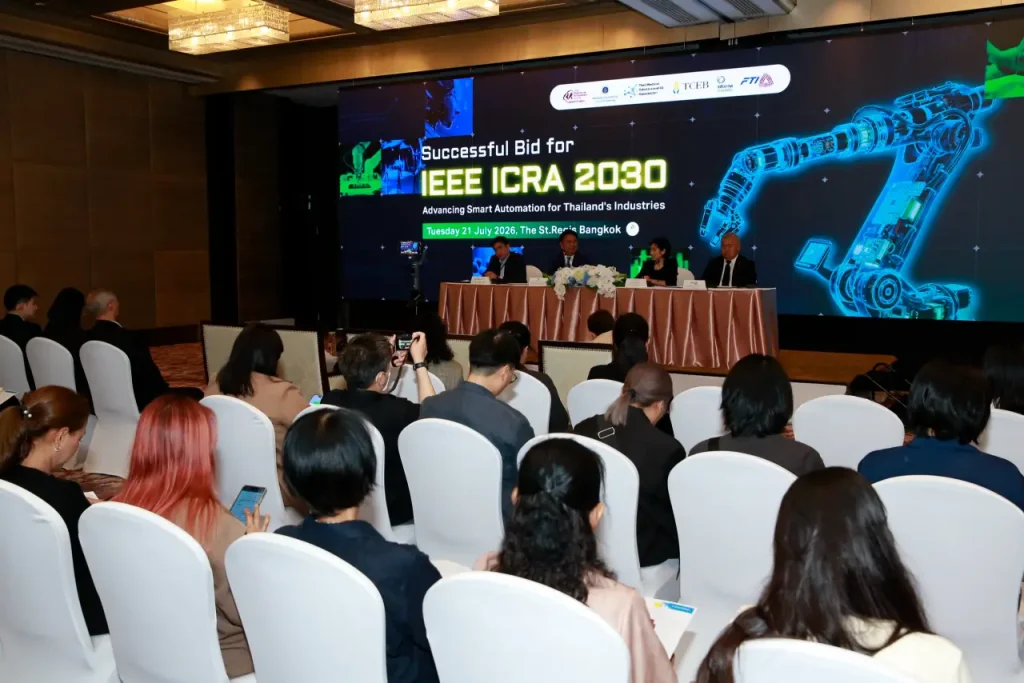
Thailand has secured the right to host the 2030 IEEE International Conference on Robotics and Automation (IEEE ICRA 2030), marking the first time the world’s premier conference on robotics, artificial intelligence (AI) and automation will be held in the country.
Scheduled between 13 and 17 June 2030 at the Queen Sirikit National Convention Center (QSNCC) in Bangkok, the conference is expected to attract approximately 10,000 delegates, including 8,000 international participants.
The event is projected to generate more than 1.06 billion Thai baht (about US$31.6 million) in direct economic circulation, contribute approximately 590.6 million Thai baht (US$17.6 million) in value added to the Thai economy, creating around 745 jobs.
Beyond its direct economic contribution, IEEE ICRA 2030 is expected to become a strategic platform for accelerating Thailand’s adoption of robotics and automation technologies, attracting investment in AI, robotics, and advanced manufacturing, while reinforcing the country’s ambition to become Southeast Asia’s leading Advanced Manufacturing and Innovation Hub.

Jittanun Techasarin, Director of Conventions Department of the Thailand Convention and Exhibition Bureau (TCEB), said winning the bid represents far more than securing another international convention. It reflects TCEB’s strategic approach to positioning business events as national economic platforms capable of driving long-term industrial transformation.
“As global economic competition increasingly revolves around innovation and new value creation, Thailand must leverage international business events as catalysts for investment, technology transfer, and industrial development,” she said.
“Aligned with the government’s national agenda to promote future industries, TCEB is committed to attracting events that serve as Strategic Economic Platforms such as events capable of generating collaboration, trade, investment, and innovation in high-growth sectors. IEEE ICRA 2030 exemplifies this vision by bringing together the world’s leading researchers, innovators, technology developers, investors, and industry leaders in robotics and automation.”
Dr. Supawan (TCEB) added that Thailand’s MICE industry must evolve beyond measuring success by attendance figures or event delivery alone.
“Thai MICE should serve as a platform that connects global talent with opportunities for research collaboration, knowledge exchange, business partnerships, investment, and innovation. The ultimate goal is not simply event success but creating high-impact national value and a lasting legacy that drives economic integration and industry growth.
“Business events should connect the entire economic ecosystem from investment, manufacturing, trade, research, and supply chains to entrepreneurship and the creation of new industries. This creates sustainable economic growth rather than short-term revenue.
IEEE ICRA 2030 will play an important role in accelerating the adoption of robotics and automation across Thailand’s industries while strengthening the country’s existing leadership in automotive, healthcare, and food manufacturing, paving the way toward becoming a regional Advanced Manufacturing Hub.”
Associate Professor Dr. Jackrit Suthakorn, Founder and Executive Director, Center for Biomedical and Robotics Technology (BART LAB), Faculty of Engineering, Mahidol University, said, “Every year, the conference enables businesses to engage directly with leading researchers, technology developers, and end users from around the world. It attracts the world’s top companies in robotics, AI, automation, sensors, semiconductors, and software, while providing startups with a global stage to launch breakthrough technologies,” he said.
“The conference is therefore an important platform for technology showcases, research collaboration, business matchmaking, and investment opportunities in future industries.”