
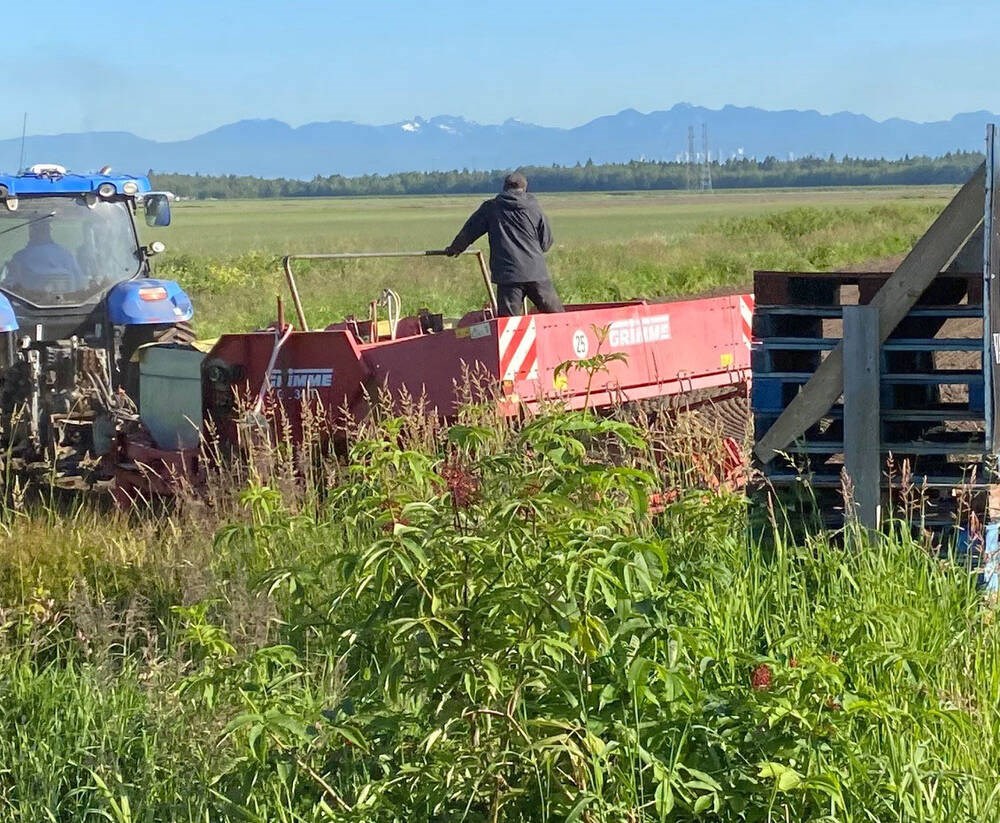
There are portions of the ALR that are not well suited for primary production but are well suited for other uses such as food processing, the province says
The BC government last week announced it would lead a six-week engagement with the province’s agricultural and food processing industry, local governments and First Nations on a proposal to expand food processing opportunities in the Agricultural Land Reserve (ALR).
Aimed at helping strengthen food security, supporting farmers and attracting new investment, the proposal is to encourage more food processing in the ALR on land that is not well suited for primary production, while protecting prime farmland, according to the province.
The proposed regulatory change would allow food processors to build plants on Class 5 to 7 soil, as well as Class 4 if the parcel is serviced by the date the rule is implemented in the ALR, so long as five per cent of the primary product used in the processing is grown or raised in the province.
The government also notes that the soil classification condition would exclude about 90 per cent of ALR farmland in the Lower Mainland and Fraser Valley, with 500-to-1,000 hectares expected to be potentially available for food processing development.
The five percent threshold is the proposed minimum laid out in a discussion paper.
The proposal intends to connect food processing in the ALR with farming in the ALR, creating new markets for farmers and driving more investment back to BC growers, but soil testing and local government support are also required.
The province also notes that those seeking to build new food processing facilities would require an assessment from a registered professional agrologist to ensure the soil classification meets the criteria.
Back in 2021 during a discussion on the City of Delta’s effort to update the community’s Agricultural Plan, members of the Agricultural Advisory Committee noted a lack of food processing opportunities was identified as an area in need of development.
Most large-scale vegetable processing operations have left the Fraser Valley because they rely on a larger farming land base.
It was noted the future may be in small processing operations located on farms.
The plan was approved in 2023, and recommends support for value-added activities that are accessory to farming.
The document states that across BC, there has been a shift away from centralized farm product processing facilities and a consolidation of farm operations. It is leading to greater demand for larger on-farm processing and regional facilities, and that pressure is also being felt by Delta producers.
“There is a tension between wanting to allow processing and agri-tech and innovation directly on farmland or directing it towards industrially-zoned areas. This also includes warehousing for pre-processing (storage) and aggregation facilities such as food hubs,” the document notes. “The development of rural agricultural areas for processing and agri-tech also has implications regarding the introduction of services, such as roads, and utilities, such as increased power and potable water requirements.”
Delta Fresh remains in limbo
Meanwhile, an application to build a cold storage and food processing facility on a farm site in Delta, which is not in the ALR and is located adjacent to Burns Bog, appears to be in limbo.
The almost 15-acre undeveloped property had received preliminary approval by city council in 2023 for an agricultural cold storage business, but it is now up for a court ordered sale, listed at $19 million.
Not farmed for many years, the sale of the 15-acre site in East Ladner at 10555 64 Ave., adjacent to the Highway 91 interchange, is subject to approval by the BC Supreme Court.
Called Delta Fresh, the site is listed as “an exceptional opportunity” for a potential cold storage and agri-food processing facility.
The application was originally submitted by Earth King Investments Inc. in 2020.
The development site went up for sale two years ago, listed as a future cold storage facility, for $45 million.
In July 2025, council approved rescinding third reading of the zoning amendment, providing a new amendment to expand the land uses permitted for the proposed A4 Agricultural Product Management Zone.
A Delta staff report noted the owner requested amendments to the permitted land uses to enable a more inclusive definition of food storage and processing. The owner provided two agrologist reports to support the application.
“Rather than restricting the storage, warehousing and processing use to fruits, vegetables and dairy, the amended A4 Zone would permit storage, processing and preparation of any agricultural product. Restrictions would remain in place preventing the sale of hot or cold food items for on-site consumption; any composting or soilless medium production; an abattoir or poultry, meat, fish or seafood processing, preparation or packing operation; processing or preparation of any form of cannabis product, cannabis production; or cannabis research and development,” the report explained.
The new owner and applicant was Overland Capital Canada Inc.
A letter by Delta Fresh applicant C/O Reid Duthie stated, “We believe the facility could benefit a diverse group of farmers, food processors and all types of food, and not just Diary, Vegetables and Fruit. This type of facility could help alleviate the supply chain challenges in BC’s food supply system by encouraging local food storage and producing capabilities.”
The Delta staff report later noted that, since the 2023 public hearing, no progress has been made on completing the conditions required for final adoption and the property had changed ownership.