
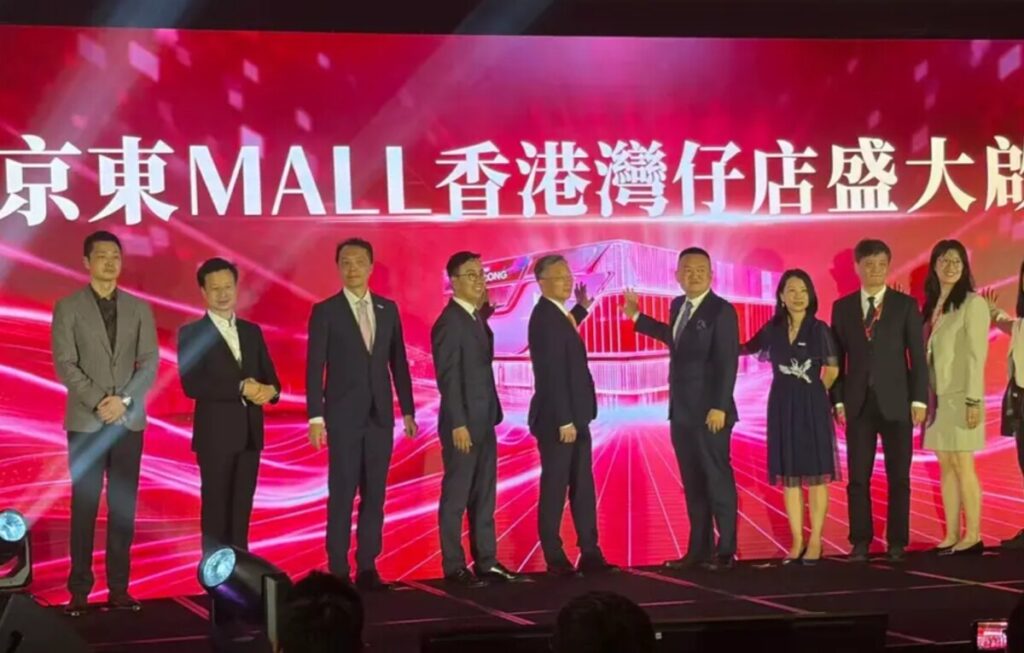
The e-commerce giant has expanded aggressively in Hong Kong over the last year, acquiring commercial buildings, a supermarket chain and establishing an extensive logistics network
image credit: Bamboo Works
Key Takeaways:
- JD.com has been expanding aggressively into Hong Kong, with plans to open multiple signature JD Malls in the city over the next three years
- The e-commerce giant’s Hong Kong expansion will directly challenge longtime local leaders like ParkNShop, Fortress and Watsons
Among China’s leading e-commerce players, JD.com has been the only one to place Hong Kong so squarely in its sights. Last year, the company acquired Kai Bo Food Supermarket, a popular mass-market grocery chain, moving wholeheartedly into the city’s hotly contested grocery space. It wasted no time from there, adding 10 new Kai Bo branches over the last year to take it past the 100-store milestone.
While that was happening, the company’s JD Logistics (2618.HK) unit was setting up hubs across the city, covering all 18 districts, to support product delivery and installation services.
$450 million headquarters
Last year, JD.com also acquired 50% of the China Construction Bank Tower in Hong Kong’s Central financial district for nearly HK$3.5 billion, providing a high-profile base to use as its headquarters in the city.
The company’s JD Health (6618.HK) is also already active in Hong Kong, supplying healthcare and medical aesthetic products, as well as medications targeting several specific categories of diseases. It also provides online health consultation services and is developing a local elderly care business.
This particular store is full of promotional gimmicks. In addition to a free massage area, it will provide complimentary coffee, and an esports arena alongside several designated photo-op spots for social media check-ins. JD.com has disclosed future locations will be equally big, with floor areas ranging from 30,000 to 80,000 square feet.
Limited retail scale in Hong Kong
JD.com’s Hong Kong onslaught involves substantial investments, even though the city boasts a relatively small population of just 7 million. Which raises the question of whether it’s really worth it to spend such vast sums to conquer this relatively small city.
Data from the Hong Kong Census and Statistics Department shows the total value of the city’s retail sales stood at around HK$380 billion over the last two years. That was just a fraction of figures for the nearby mega-cities of Guangzhou and Shenzhen, which logged 1.1 billion yuan ($163 million) and 1.03 billion yuan, respectively. Even the smaller nearby cities of Dongguan and Foshan achieved 445 billion yuan and 395 billion yuan, respectively.
Challenging a hometown champion
Many of the business lines that JD.com is expanding in Hong Kong will also bring it into direct competition with CK Hutchison Holdings (0001.HK), the flagship of Li Ka-shing, the city’s richest man. Among other things, the conglomerate owns the ParkNShop supermarket chain, Fortress electronics stores, and the Watsons personal health and pharmacy chain. Challenging such an entrenched rival won’t be easy.
In the supermarket realm, Hong Kong is already quite saturated with established chains ParkNShop and Wellcome, complemented by the more recent arrival of HKTVmall. With such established rivals, JD.com could well face challenges making inroads with Kai Bo as its main vehicle, especially when one considers the grocery business’ razor-thin margins.
When it comes to electronics, another one JD.com’s strengths, Hong Kong already has its own pool of established players like Fortress, alongside Broadway, as well as China’s own Suning chain of stores, and online platforms HKTVmall and Yoho (2347.HK).
Unremarkable appeal
Then there are the new JD Mall experience shops. Some simple calculation based on local rates shows the monthly rent for the first such shop in the pricey Wan Chai district would amount to a similarly large sum of nearly HK$20 million annually. Given thin profit margins for electronics, such high rental costs won’t be easy to recoup through simply product sales.
The inaugural JD Mall’s site selection also wasn’t ideal, not at ground-level and mostly accessible via connecting footbridges, and distant from popular tourist shopping hotspots.
To subscribe to Bamboo Works weekly free newsletter, click here
Benzinga Disclaimer: This article is from an unpaid external contributor. It does not represent Benzinga’s reporting and has not been edited for content or accuracy.