
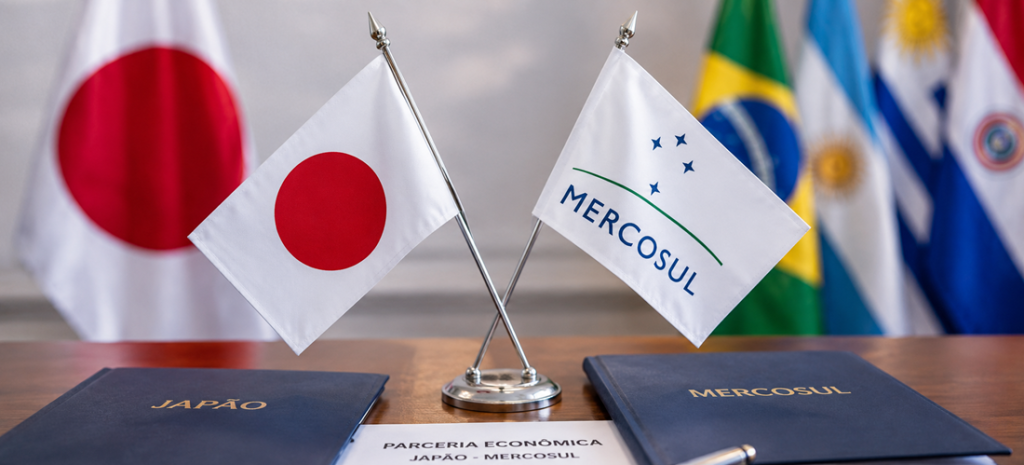
Japan is set to begin negotiations with the South American trade bloc Mercosur on an economic partnership agreement, according to a reporting by Nikkei Asia. Tokyo is seeking alternative sources of oil and critical minerals, as well as lower tariffs for its automobiles in an expanding market.
Preparations are under way for Japanese Prime Minister Sanae Takaichi to meet Brazilian President Luiz Inácio Lula da Silva on the sidelines of the G7 summit in mid-June. Japan also intends to conclude negotiations with other Mercosur members.
The bloc — made up of Brazil, Argentina, Uruguay, Paraguay and Bolivia — has a population of nearly 300 million. Its gross domestic product, at more than US$3 trillion, is equivalent to about three-quarters of the GDP of the Association of Southeast Asian Nations.
Although Japan has expanded its free trade network through agreements with ASEAN members, Australia and the European Union, Mercosur remains one of the few major markets with which it still does not have such a deal.
Trade between Japan and Mercosur still has ample room to grow. In fiscal 2025, Japan exported about 950 billion yen, or US$5.96 billion, in goods to the bloc, while imports totaled around 1.5 trillion yen, according to Japan’s Ministry of Finance. Those figures represented only 0.8% and 1.3%, respectively, of Japan’s total trade.
The following breakdown highlights the top ten product categories imported from Japan to Brazil, based on container throughput data compiled by Datamar:
Top Imports from Japan | Q1 2026 | TEUs
Source: DataLiner (click here to request a demo)
With protectionism advancing in the United States under President Donald Trump, Takaichi’s government has made economic partnership agreements one of the pillars of its growth strategy.
Concerns over the impact on agriculture had prevented the start of negotiations with Mercosur. The picture has changed, however, in light of developments such as the war in Iran, which has increased the importance for Japan of diversifying supplies of oil and critical minerals.
Before shipments through the Strait of Hormuz were interrupted, Japan relied on the Middle East for about 90% of its crude oil imports. The country also depends on China for rare earths and other strategic industrial minerals, increasing concerns over possible export restrictions by Beijing.
Brazil is the world’s ninth-largest crude oil producer and has the second-largest rare earth reserves, behind only China. Argentina, meanwhile, stands out for its lithium production, which is essential for electric vehicle batteries.
“It is significant from an economic security standpoint,” said Kazuyoshi Nakata of Mitsubishi UFJ Research and Consulting, referring to a possible agreement.
Beef could be one of the main points of friction in the negotiations, as Japan has a relatively small livestock industry. Brazil was the world’s largest beef producer in the 2025 trade year, while Argentina ranked sixth, according to data from the U.S. Department of Agriculture.
Japanese lawmakers influential in agricultural policy have signaled support for the talks, provided special attention is given to the beef issue. The Liberal Democratic Party will hold a meeting to build internal consensus and formulate recommendations to the government before negotiations begin.
Given the need to diversify commodity supply chains, “this is not the time to oppose [economic partnership agreement talks] in order to protect the livestock industry,” a senior official at Japan’s Ministry of Agriculture, Forestry and Fisheries said.
Japan is expected to seek lower tariffs for industrial goods. Japanese products currently face average tariffs of 13.2% in Brazil and 13.9% in Argentina, according to the Japan Institute of International Affairs, with especially high rates on automobiles and auto parts.
Japanese companies are pushing for a swift agreement. The Japan Business Federation, Keidanren, and Brazil’s National Confederation of Industry, CNI, formally called for progress in the negotiations in a joint statement released in March 2025, highlighting the need to strengthen the efficiency, sustainability and competitiveness of global supply chains.
“The auto industry, in particular, is seeking these negotiations,” said Kiyo Tsujimoto, head of the Americas office at the Japan External Trade Organization, Jetro. Western automakers currently dominate South America’s auto market, and the provisional free trade agreement between the European Union and Mercosur is increasing competitive pressure on Japanese manufacturers, which could lose competitiveness without a similar deal.
Source: Valor Econômico