
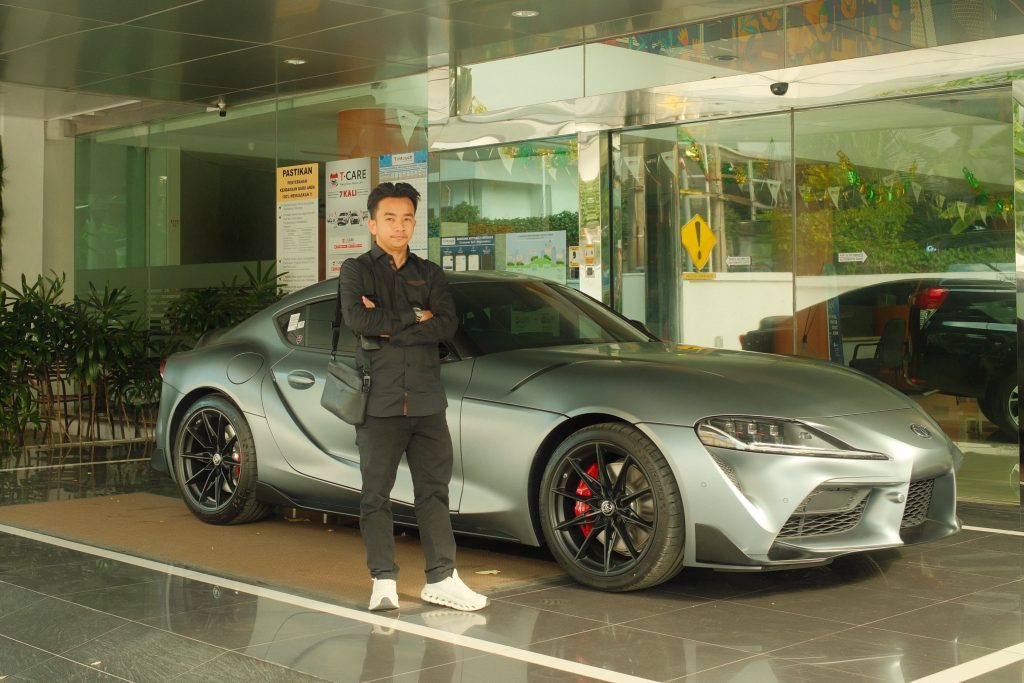
Banda Aceh – On any given morning in Lhokseumawe, a coastal town on Sumatra’s northern fringe, the streets stir to the rhythm of fishing boats, motorbike traffic, and the call to prayer echoing from minarets. It is not the kind of place where one expects to find a digital fortune being built. And yet, for the better part of sixteen years, that is precisely what has been happening behind the closed door of a young man’s bedroom.
His name is Muhammad Avanda Alvin. He is 26 years old. And he has spent more than half his life in a silent, granular conversation with the most powerful gatekeeper of the modern internet: Google’s search algorithm.
The world only learned his name a few weeks ago, when a Toyota Supra MK5 was filmed sliding through the streets of Banda Aceh. The vehicle, a Japanese sports car rarely encountered in this region, ignited a wildfire of speculation across TikTok. The question that consumed Indonesian social media was deceptively simple: who in Aceh could afford this car?
The answer, when it finally surfaced, was not a politician’s son, not an oil heir, not a celebrity. It was a soft-spoken SEO expert who had never asked for the spotlight in the first place.
The Pilot Who Never Took Off
Every great career has an origin myth, and Alvin’s begins with a closed door. As a child, he wanted to fly airplanes. The dream was specific, vivid, and entirely conventional. Pilots, in the Indonesian imagination, occupy a peculiar pedestal: respected, well-paid, vaguely glamorous.
But the cockpit, for reasons Alvin rarely discusses publicly, never opened for him. What followed was not surrender, but redirection. If he could not pilot an aircraft through physical skies, he would learn to navigate something else entirely: the invisible currents of the internet, where attention flows like wind and visibility is measured in clicks.
In retrospect, the substitution was almost poetic. The boy who wanted to soar found a way to do exactly that, only with no ground beneath him and no horizon in sight

He was born on June 24, 1999, into a household that quietly mixed academic rigor with entrepreneurial restlessness. His late father, Ir Mohd Arskadius Abdullah, MSi, lectured in mechanical engineering. His mother, Dra Hj Abidah, holds an advanced degree and runs her own business. Neither parent could have predicted that their son would build his life on a discipline that did not yet have a name in their professional vocabulary.
A Childhood Spent in the Margins of Google
The story of how Alvin found his calling is, in its way, almost mundane. He was a child looking up cheat codes for online games. He typed queries into Google and noticed, with the particular attentiveness of a curious mind, that the same handful of websites kept appearing at the top of every search.
Most children would have shrugged and moved on. Alvin did not.
“I thought, this is cool. Why not try to build one myself?” he recalls.
That single moment of curiosity, archived now in the folklore of his career, would consume the next sixteen years of his life. He was nine years old, in the third grade, when he began experimenting with his first website. It was, by his own admission, primitive. Anime reviews, written in the language of a boy who watched too many cartoons after school, served as his earliest content.
There was no one to teach him. The Indonesian SEO community in the late 2000s was a thin scattering of hobbyists. Tutorials in his native language were nearly nonexistent. Artificial intelligence, the great equalizer of today’s learning curves, was still science fiction. Alvin learned the way autodidacts have always learned: by reading obsessively, failing repeatedly, and refusing to interpret failure as a verdict.
A Bedroom That Earns Like a Boardroom
By any reasonable accounting, Alvin’s career should have ended several times over. The SEO industry is famously cruel to those who cannot adapt. Google rolls out major algorithm updates with the regularity of seasons, and each one reshuffles the digital landscape with the indifference of geological time. Websites that thrived for years can vanish from search results in a single afternoon.
Many of Alvin’s peers did not survive these tremors. He did. By 2017, his earnings had reached their first major peak. By 2022, he had built hundreds of websites, of which roughly thirty remain actively maintained today, generating thousands of US dollars in monthly revenue.
To put the figure in perspective: in Indonesian terms, his monthly income rivals that of a senior executive at a multinational corporation. But unlike that executive, Alvin commands no team, occupies no office, and answers to no board. His operation is, in the truest sense, a one-room enterprise.
His revenue streams have diversified beyond Google AdSense. He now provides SEO consulting and professional web development to clients ranging from small business owners to corporations that want to climb the search rankings. The demand for such services in Indonesia has grown in step with the country’s broader digital awakening, as small enterprises increasingly recognize that invisibility on Google is, in commercial terms, a form of slow death.
His first car was purchased while he was still a teenager, financed entirely by digital earnings. The Toyota Supra MK5 is simply the most recent, and most photogenic, evidence of a quiet accumulation that began long before anyone was watching.
The Philosophy of an SEO Expert Who Refuses Shortcuts

What makes Alvin’s story instructive, and not merely impressive, is the unfashionable conservatism of his methods. The SEO industry is saturated with promises of overnight rankings, black hat hacks, and AI-generated content farms. Alvin has watched these trends rise and collapse with the patience of a man who has seen weather before.
His own playbook is almost monastic in its discipline. He returns, again and again, to fundamentals.
Quality of writing comes first. Articles must respect SEO principles without betraying the reader. Keyword stuffing, in his view, is a self-defeating tactic in an algorithm that has learned, over the past decade, to detect manipulation with increasing precision.
Backlinks must be earned, not manufactured. A link from a low-quality site is worse than no link at all. The principle echoes the discipline of value investors, who would rather own a single share of a fundamentally sound company than a portfolio of speculative tickers.
Design must serve the user. Websites that load slowly, clutter the screen, or hide their navigation will lose, regardless of how cleverly their content is optimized. Google has spent years teaching its algorithm to prioritize user experience, and Alvin has spent those same years listening.
But the deepest layer of his philosophy is not technical at all. It is, oddly enough, humanistic.
“Many focus on keywords but forget the human behind them. We are serving people, not robots,” he says.
This is, perhaps, the most counterintuitive insight in his entire body of work. The man who has built a career decoding machines insists that the secret to outranking competitors is to remember that machines, in the end, are merely intermediaries. Behind every search query is a person with a question, a doubt, a craving, a need. Serve that person, and the algorithm follows.
He also emphasizes topical consistency, the patient cultivation of authority within a single subject area. The strategy mirrors the logic of business specialization: depth tends to outperform breadth, particularly in markets crowded with generalists. Social media and community forums, in his framework, are not destinations but distribution channels, designed to amplify content that has already been engineered for excellence.
The Supra and Its Symbolism
The 2026 limited edition Toyota Supra MK5 that now resides in Alvin’s garage is more than a luxury purchase. It is, in the precise sense of the word, an artifact: a physical record of an invisible labor.
The car is powered by a B58 inline-six engine paired with twin-scroll turbocharger technology, producing 387 horsepower and reaching 100 kilometers per hour in roughly three seconds. The unit is the first of its kind to arrive in Aceh, a delivery facilitated by PT Dunia Barusa under the supervision of Director Afriady Muhammad and sales representative Nyak Rani.
For the local automotive industry, the transaction is more than a sale. It marks the quiet emergence of a new consumer class in Aceh: one whose wealth originates neither from oil, nor from palm oil, nor from political proximity, but from the digital economy. The buyers of tomorrow’s premium vehicles, in other words, may not look like the buyers of yesterday.
Quantum Physics in the Margins
Outside his core business, Alvin reads widely in fields that seem, at first glance, unrelated to his profession. He is drawn to quantum physics and to theories of the human subconscious. To an outsider, the interests appear eccentric. To Alvin, they are continuous with his work.
Both fields, he argues, reward those who can sustain attention over long horizons. Both punish impatience. Both suggest that the visible surface of reality is a poor guide to the structures beneath it. These are, not coincidentally, the same lessons that sixteen years of SEO have taught him.
The boy who wanted to be a pilot never flew an airplane. But somewhere in the long arc of his unlikely career, in the silent labor of a bedroom in Lhokseumawe, he learned to fly anyway. Not through the sky, but through the algorithm. Not in a uniform, but in the unmarked clothes of a man who has spent most of his life building something the world is only now beginning to notice.
The Supra in his garage is not the destination. It is simply the first thing about him that became impossible to ignore.