
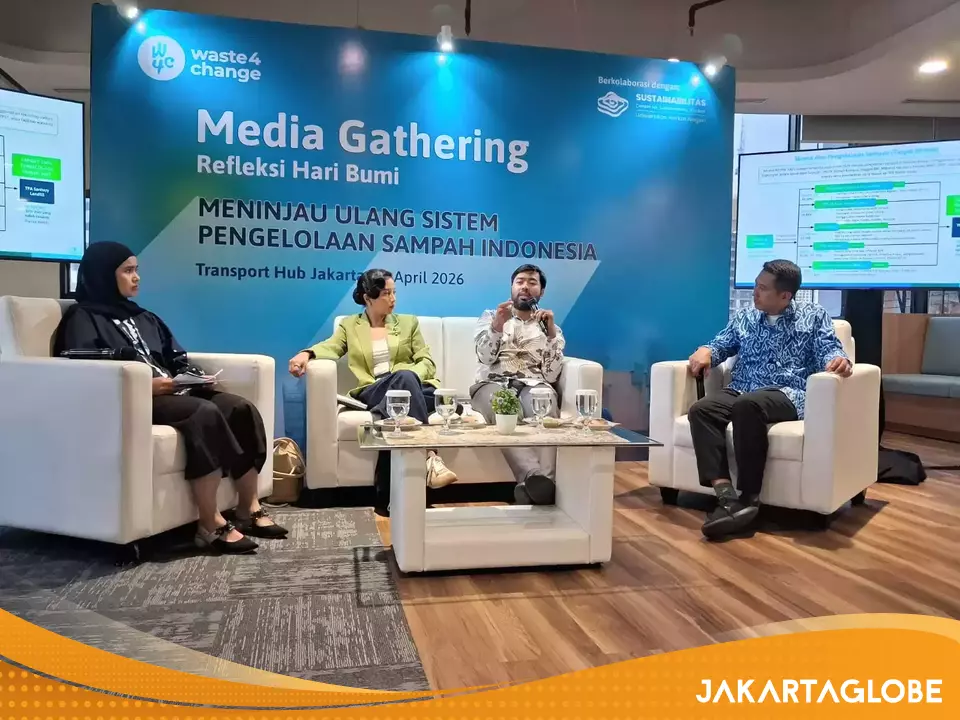
Jakarta. Indonesia’s waste crisis is exposing deep-rooted flaws in regulatory enforcement and system design, with experts urging a shift from fragmented policies to a more integrated, enforceable governance framework.
The country generates approximately 144,839 tons of waste per day, equivalent to the volume of 12 Borobudur temples, yet only about 25% is properly managed.
Indonesia has previously experienced major waste-related disasters, including the Leuwigajah landfill collapse, while sites such as Bantargebang landfill continue to face persistent pressure. Despite this, waste remains a critical and unresolved problem.
Muhammad “Sano” Bijaksana Junerosano, founder and CEO of Waste4Change, said the core issue lies in weak system circulation and inadequate regulation. Indonesia, he said, lacks a holistic and enforceable waste management system.
ADVERTISEMENT
“Regulations and technical standards already exist, but implementation remains weak,” Sano said. “We still rely too much on grants and donor-driven programs instead of building permanent systems.”
Beyond regulatory gaps, Sano highlighted the need for a shift in mindset. He warned that both policymakers and the public often treat waste as a minor issue, despite its systemic impact.

He said reform must begin upstream, particularly through waste sorting at the source. Without it, downstream processing will remain ineffective.
“If sorting does not happen at the source, the entire system will continue to fail,” he said.
Sano added that the waste problem reflects a broader ecosystem failure, marked by overlapping authority among stakeholders and poor system integration. “Unless we fix the upstream side, this crisis will continue to repeat itself,” he said.
William P. Sabandar, director of sustainability at the Center for Sustainability Studies at the University of Harkat Negeri, said that even well-designed policies will fail without clear direction and consistent implementation. He warned that Indonesia’s ambition to become a developed country will remain out of reach if the waste problem is not addressed systematically.
The government, however, has begun signaling stronger commitment. President Prabowo Subianto has set a target to resolve the country’s waste problem within the next two to three years, including by expanding waste management facilities across cities.
Sano welcomed the target as a positive signal but cautioned that success will depend on the government’s ability to build an integrated system. He stressed the need for stronger regulatory coordination, clearer institutional roles, and greater consistency at the regional level.
Cross-sector collaboration, including with private companies and political actors, will also be essential to ensure long-term sustainability.
Public participation is another key factor. As waste generators, communities must take greater responsibility by reducing and sorting waste at the source.
Ultimately, resolving Indonesia’s waste crisis will require comprehensive reform spanning government policy, system design, and public behavior.
Tags:
Keywords: