
![Image Source Japan Ministry of Defense [https://www.mod.go.jp/en/publ/w_paper/index.html]](https://static.wixstatic.com/media/e1b29c_fd94d5588e5b432f9404f034355c490a~mv2.jpg/v1/fill/w_117,h_150,al_c,q_80,usm_0.66_1.00_0.01,blur_2,enc_avif,quality_auto/e1b29c_fd94d5588e5b432f9404f034355c490a~mv2.jpg)
The Japanese government’s white paper on defense is a comprehensive strategy to address the threats perceived by Japan. Despite certain limitations, the policy aims to address shortcomings and fully implement these policies by 2028 says the author Chinmayee R Srinath.
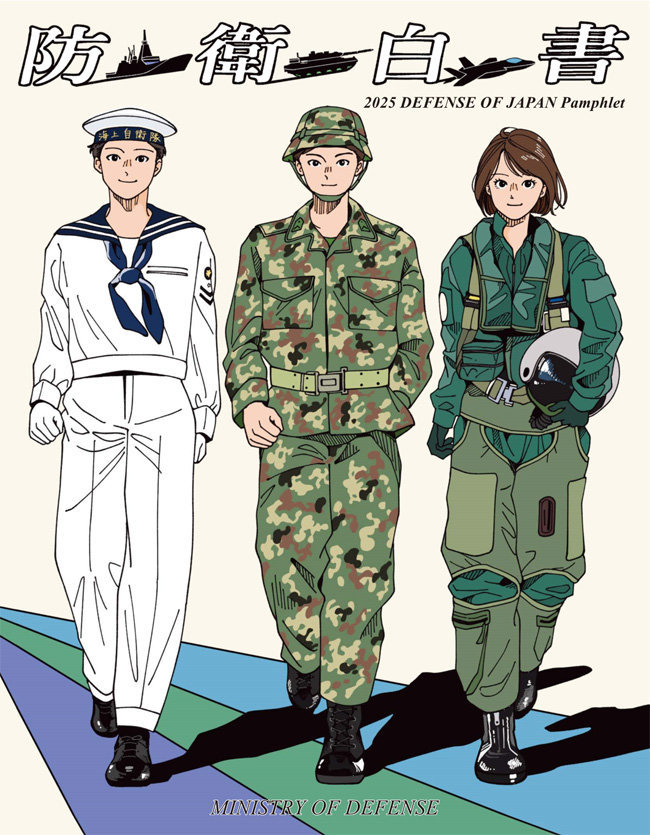
Japan’s 2025 Defense Digest White Paper emphasizes the need to revamp its defense policies. This is due to the security dilemma as laid out by “realists”.
Japan found the need to revamp its defense strategy according to what the document claims as, “the most severe and complex security environment of the post-world war 2 era” (Gen, 2025). By this, the document elucidates the changing dynamics of the Indo-Pacific region, in which Japan faces the greatest security threats from China, North Korea, and Russia. Consequently, this has marked a drastic shift in Japan’s defense policy, as outlined in the government’s white paper.
This white paper primarily entails a detailed description of the security threats posed to Japan in the Indo-Pacific, along with a policy solution to address these threats, coupled with testimonies and timelines for implementing the policies in their entirety. This review does not dispute the legitimacy of threats posed to Japan. However, aims to analyze the policy solutions as mentioned in the white paper.
The document has been categorized into five parts: security threats, defense policy frameworks, operational approaches, personal reform, and industrial and technological base. Regarding security threats, Japan is concerned about China’s activities in the region, such as airspace intrusions, coast guard vessels approaching the disputed Senkaku islands, and military drills near Taiwan. North Korea’s development and testing of ballistic missiles also pose a threat to Japan’s security. Japan is also skeptical of Russia’s relations with China and of Russia’s war in Ukraine. According to Japan, this poses a threat to various aspects, including its citizens, and moves away from traditional definitions of security. The document further argues that an alliance with like-minded countries, such as the USA, which is both ‘democratic’ and ‘capitalistic’, would help deter the threat.
The policy mentioned in the white paper draws heavily from Japan’s defense frameworks published in 2022, collectively known as the National Security Strategy, comprising the National Security Strategy (NSS), the National Defense Strategy (NDS), and the Defense Build-up Program (DBP). The RAND Corporation has described this as “an almost revolutionary departure from longstanding defense practices”. The document calls the NSS as the ‘Supreme’ security document, providing strategic guidance across diplomacy, defense, economic security, technology, and intelligence. The NSS is implemented with the help of NDS in seven ways: stand-off defense, integrated air and missile defense, unmanned defense, cross-domain operations, command and control, mobile deployment, and sustainability and resiliency. The DBP sets the financial and procurement targets to deliver these capabilities, with total expenditure of approximately 43 trillion yen over five years from FY2023 to FY2027.
The most significant development, as mentioned in the White Paper, is the establishment of Joint Operations Command (JSF) in March, 2025, which centralizes command of Ground, Maritime, and Air Self-Defense Forces under a single commander. The testimonies provided in the document are in favour of JSF. Japan has also committed to a defense expenditure equivalent of 2% of GDP by FY2027. Priority defense sectors for investment include stand-off missiles, such as the US-made Tomahawks; Aegis-equipped vessels; a satellite constellation for targeting intelligence; and the joint development of a next-generation fighter under the Global Combat Air Program (GCAP) with the UK and Italy.
1. The reliability question:
The White Paper has frequently emphasized its alliance with the USA, terming it the “key pillar of our national security policy and the cornerstone of peace and stability in the Indo-Pacific region” (Gen, 2025). This highlights the historical background of Japan’s bilateral ties with the USA, with the latter as Japan’s key ally. This raises the question of reliability in contemporary times.
The Trump administration presents a sense of unpredictability regarding US ally commitments. For instance, Trump’s statements regarding Greenland have been characterized as “potentially “the worst crisis in NATO’s existence (Wieslander, 2026). Various scholars have also characterized Trump’s policy towards allies as heavily transactional, leading allies to reassess their ties with the US. In this context, the White Paper has no framework for Japan to implement its latest defense strategies if US support is delayed or shelved, as important defense equipment such as the Tomahawk missiles or the reliance on American intelligence and technology, under this lens of unreliability, given that Japan’s defense policy, as per the paper, is mainly focused on its ties with the US. (The International Crisis Group, 2026), noted that Tokyo is “worrying about Washington’s reliability even as it continues to deepen alliance structures”. Given this depth of Japan’s ties with USA since world war two, the path to strategic autonomy would likely be a slow and a gradual process.
Despite being primarily US-centered, the document has also proposed defense strategies and partnerships with other countries. This involves developing GCAP with the UK and Italy, engaging with the Philippines, Indonesia, and India, and proposing OCEAN, a framework for Indo-Pacific cooperation. However, these engagements complement the defense ties with the US. This calls for a wider cooperation and diversification beyond US. For instance, the (Australian Strategy Policy Institute, 2025) has highlighted Japan’s potential to expand its defense partnership with Australia and Southeast Asia.
It is important to note the extent to which this deterrence is successful against China, Russia, and North Korea. Japan’s defense policies are largely due to the security dilemma. It has been noted that North Korea has been testing missiles concurrent with Japan’s defense policies. The (South China Morning Post, 2025) reported that “China’s security calculus in 2025 is already being complicated by simultaneous military build-ups in both Japan and South Korea, with the Korean peninsula arms race heating up”. This was also seen in China’s response to Japan’s statements regarding Taiwan, prompting China to send coast guard vessels to the Senkaku Islands. Japan’s defense policies are intended to enhance Japan’s security and deter the threats it perceives. This could also lead to further escalation. A balance between defense policies, coupled with confidence-building measures and diplomacy, also seems plausible.
The defense policies initiated by Japan were long overdue and were significant reforms. This includes the JSF and other such reforms. (RAND Corporation, 2026) has called this the “return of Japan as a major geopolitical actor”. These policies also have budgetary limitations, the burden of which ultimately falls on taxpayers. The (CSIS, 2026), has further noted that “Japan’s yen weakness has undercut the purchasing power of its defense investments”. Another limitation would be Japan’s aging population, which poses challenges and indicates personnel shortages in the military. Japan’s new policy has sought to address this issue by offering higher pay and incentives, as well as improving women’s participation in the military. As mentioned above, Japan is also focusing on the development and procurement of defense technology, such as unmanned drones.
The Japanese government’s white paper on defense is a comprehensive strategy to address the threats perceived by Japan. Despite certain limitations, the policy aims to address shortcomings and fully implement these policies by 2028.
Chinmayee R Srinath is a Research Intern, Security Risks Asia
Ministry of Defense, Japan. (2025). Defense of Japan 2025 (Digest). Ministry of Defense, Japan.
Gen, N. (2025). Defense Digest of Japan 2025.
Ministry of Defense, Japan. (2025). Defense of Japan 2025 (Digest). Ministry of Defense, Japan.