
Published on
May 31, 2026

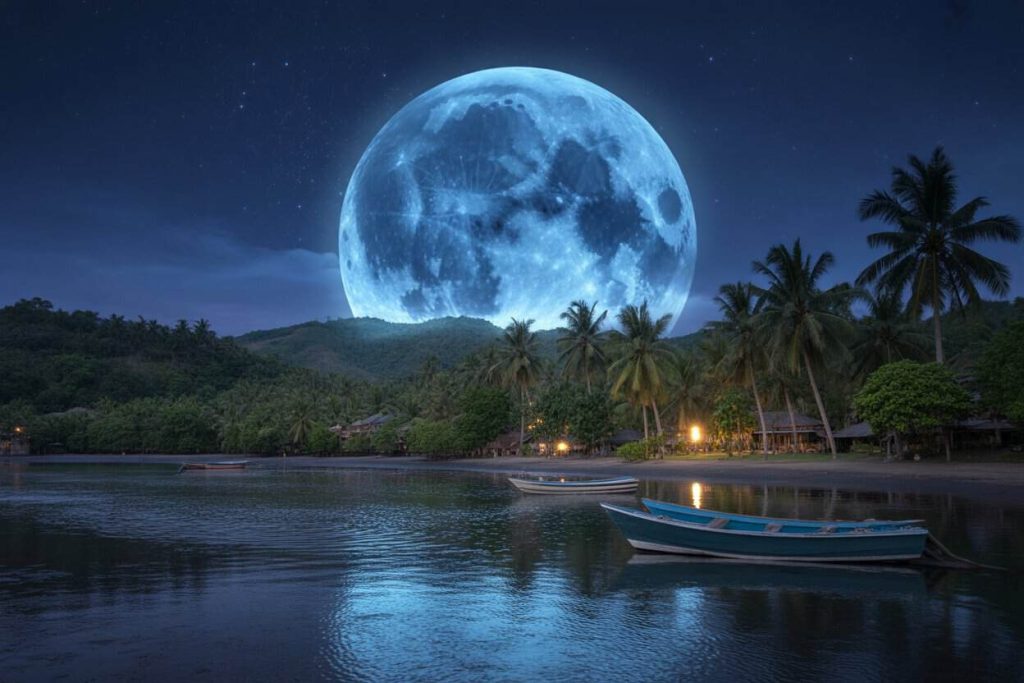
Image generated with Ai
A celestial event drawing sky‑watchers and travellers alike will unfold over Indonesia on May 31, 2026, when a Blue Moon — the second full moon in a single calendar month — rises after sunset. Though its name suggests an unusual colour, the moon will remain its familiar pale glow, offering a rare nighttime spectacle that adds value to travel itineraries and astronomy‑focused tourism across the archipelago.
This phenomenon occurs because lunar cycles last about 29.5 days while calendar months typically have 30 or 31 days. When timing lines up just right, two full moons can occur in the same month — the first at the start and the second at the end — creating what astronomers term a Blue Moon. The next event in this pattern will be on May 31, 2026, following an earlier May full moon.
What a Blue Moon Really Means
According to NASA — the authoritative space agency whose educational materials explain lunar cycles — the phrase Blue Moon does not signify colour or an atmospheric effect but instead refers to the second full moon in a single calendar month. This modern definition gained popularity in the mid‑20th century and forms the basis of most astronomical descriptions used today. NASA clarifies that a Blue Moon looks no different than any other full moon when viewed with the naked eye. The moon’s hue remains unchanged — colourful appearances only happen under rare atmospheric conditions, like widespread airborne particles from volcanic activity. For travellers planning visits around this event, the visual experience will be familiar. Still, the context — a second full moon in one month — is what makes the night special and worth planning for as part of a broader cosmic exploration.
Best Times and Viewing Conditions in Indonesia
In Indonesia, the Blue Moon will be visible beginning at moonrise after sunset on May 31, 2026, and will remain observable through the night, weather permitting. Because the peak full phase will be early morning in some time zones, observers are encouraged to watch the sky starting at dusk for the best chance to catch the moon as it ascends above the horizon. Clear skies and minimal cloud cover are key to a satisfying view. Regions with low light pollution — such as rural landscapes of Central Java, northern Sumatra, or parts of Bali and Kalimantan — provide open horizons and darker skies that deepen the spectacle. These areas are also often part of night‑sky tourism circuits, where travellers combine cultural or nature tourism with astronomy‑related experiences.
Advertisement
Advertisement
Travel and Tourism Opportunities
The appearance of the Blue Moon presents a compelling angle for travel planners and visitors to enrich their itineraries with astronomy tourism. Packages built around this event can pair daytime experiences — such as heritage tours in Yogyakarta, beach outings in Bali, or jungle trekking in Sumatra — with guided evening sky‑watching sessions. Hotels, lodges and guesthouses in locations with panoramic night skies can market special Blue Moon viewing nights, offering guests telescopes, night photography workshops, music by moonlight, and dining under the stars. Landscape spots like Bromo Tengger Semeru National Park or the tranquil lake shores in West Java provide atmospheric backdrops that make this celestial event visually memorable. For international visitors, timing a trip during this lunar event adds an astronomical draw beyond usual sightseeing. Indonesian skies around full moons are often clear and photogenic, making them ideal for night photography and astronomy‑themed travel content for social media, blogs, or travel journals. Many travel experts note that moonlit nights in scenic regions can feel uniquely serene and awe‑inspiring, enhancing overall visitor satisfaction.
Practical Tips for Sky‑Watchers
Witnessing this Blue Moon does not require telescopes or specialised equipment. A comfortable location with good horizon visibility is the primary requirement. Still, binoculars can enrich the experience for those interested in seeing lunar features more closely.
Advertisement
Advertisement
Travelers planning a trip should consider the following:
- Choose remote or high‑altitude spots: Avoiding urban light pollution deepens the night‑sky experience.
- Check local sunset and weather forecasts: Clear sky conditions significantly enhance visibility.
- Arrive before dusk: The rising moon shortly after sunset offers dramatic views and photography opportunities.
These simple guidelines will help travellers, honeymooners, astronomy enthusiasts, and casual observers alike to maximize their Blue Moon experience.
How Rare Are Blue Moons?
NASA notes that Blue Moons occur only when the lunar cycle aligns with a longer month — an event that happens approximately once every two to three years. Because lunar phases generally advance in 29‑ to 30‑day increments, a second full moon in the same month is uncommon, which helps sustain public fascination with the phenomenon.
The next calendar Blue Moon after May 2026 is not expected until late in December 2028 or early in January 2029, depending on time zone, making this May event a timely highlight for night‑sky watchers and travellers.
A Night‑Sky Highlight Worth Planning Around
Whether observed from a balmy beach in Bali, a coffee plantation in West Java, or the high plains of Sumatra, the May 31 Blue Moon offers travellers a chance to connect with Indonesia’s night sky and celestial rhythms. Though it won’t glow blue, the rarity of two full moons in one month makes this a noteworthy event for sky enthusiasts and adds an enriching dimension to travel planning in 2026.
Advertisement
Advertisement
