
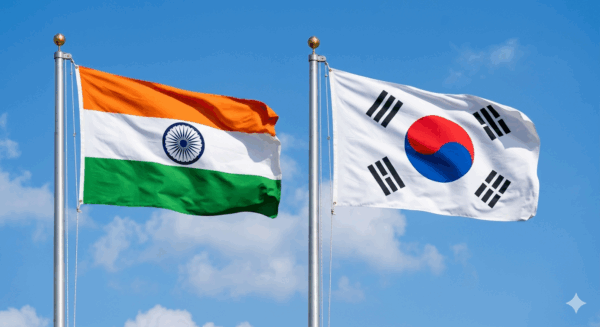
2023 marked the 50th anniversary of India-South Korea diplomatic relations. 2025 marked the 10th anniversary of the India-South Korea Special Strategic Partnership. Yet, both years passed without much fanfare in the two countries.
It is perhaps not a coincidence that there have been limited top-level meetings between South Korea and India. The last state visit by the Korean president to India was in July 2018, and the last state visit by the Indian prime minister to South Korea was in February 2019, more than seven years ago. Other than having brief meetings at international events, the two countries’ leaders have had limited interaction.
This lack of energy is puzzling, considering that India’s strategic position has skyrocketed over the past decade. Amid rising global instability, countries’ and companies’ search for a reliable partner has led them to India. India has surpassed France and the United Kingdom to become the world’s fifth-largest economy and is expected to overtake Japan and Germany to become the third-largest by the end of this decade. The world’s most populous country and the largest democracy has also improved its business environment by investing heavily in infrastructure and liberalizing foreign direct investment rules.
Recently, major economies have declared strategic papers on India: the United Kingdom announced the “2030 Roadmap for India-U.K. Future Relations” in 2021, Germany followed with it “Focus on India” in 2024, and Australia proclaimed “A New Roadmap for Australia’s Economic Engagement with India.” Some have announced long-term cooperation plans with India, such as “France-India Horizon 2047,” the “Japan-India Joint Vision for the Next Decade,” and “Joint India-European Union Comprehensive Strategic Agenda.”
These overarching strategies cover diverse areas including trade, investment, technology, defense, sustainable development, security, science, education, culture, and migration, and specify the institutions and platforms in charge of discussing and operationalizing collaboration.
Leaders and high-ranking officials from India and these partner countries have frequently met and produced a dizzyingly long list of outcomes, including roadmaps, memoranda of understanding, and declarations of intent between various stakeholders. These results show the breadth of agendas as well as the willingness to go beyond rhetoric and create something substantial. For example, at the Japan-India Summit Meeting in August 2025, in addition to 12 memoranda and documents exchanged between governments, no fewer than 170 memoranda of understanding were exchanged between companies and organizations.
In contrast, South Korea currently does not have an official India strategy and has not held high-ranking meetings covering broad agendas to such an extent in recent years. Unfortunately, India and South Korea have not yet discovered the synergies in their multi-alignment strategies, but conditions are rapidly falling into place.
The mood is expected to change dramatically as President Lee Jae-myung visits India from April 19-21. The current Korean government, which took office in June 2025, is dedicated to inheriting and advancing the New Southern Policy of the Moon Jae-in administration (2017-22), which focused on deepening relationships with Asia’s emerging economies. The government is implicitly preparing for a multipolar world by using the term “Global South” in its 123 National Policy Agenda. The document highlighted the diplomatic and economic significance of the Global South and the government’s intention to upgrade partnerships. In this context, it is not surprising that the current South Korean government will make its utmost effort to strengthen its relationship with India, the leading voice of the Global South.
While government-to-government interaction has been limited, Korean businesses have been accelerating their entry into India. Since Samsung Electronics inaugurated the “world’s largest mobile factory” in Uttar Pradesh in 2018, India has been its main smartphone producing location. Hyundai Motor has its largest overseas manufacturing base in India, with its Tamil Nadu factory producing 762,900 cars in 2024-25. It continues to bet on India and plans to expand production capacity to 1 million by leveraging a new factory in Maharashtra. LG Electronics is constructing a large factory in Andhra Pradesh. When completed, its three factories in India will have the capacity to produce 4.7 million air conditioners, 3.75 million washing machines, 3.6 million refrigerators, and 2 million televisions. Hyundai and LG’s investment will be backed by capital raised through listing shares in India in 2024 and 2025, respectively. Korean investment in India goes beyond manufacturing and covers diverse sectors such as R&D, games, and finance.
Where the two countries lack cooperation is in strategic industries, which require intense collaboration and coordination between the public and private sectors. Strategic sectors involve partnerships on multiple fronts, such as governments, research and education institutions, industrial bodies, and businesses. Given the two countries’ strengths, there is great potential to reinforce value-chain resilience and economic security by working together in strategic sectors. Prominent sectors include defense and shipbuilding in which the interests of both countries are clear.
The South Korean president’s visit to India will be a key turning point for upgrading the two countries’ relationship not just in the economic arena but also in security, culture, and people-to-people ties.
Unlike 2023 and 2025, 2026, at the start of a new phase in the Special Strategic Partnership’s second decade, will hopefully be remembered as something special.