
During the COVID lockdown, I downloaded and looked the same—soft gradients, ambient sound, a calm voice telling me to focus on my breath. I used it for a few weeks and then stopped, not because it was bad, but because nothing about it gave me a reason to continue. It was content dressed up as practice, and at some point my brain noticed the difference even if I hadn’t consciously clocked it yet.
What I was experiencing, and what most people who have cycled through these apps will recognise, is the gap between technique and system. The global wellness industry is very good at lifting a practice out of its original context and presenting the extracted version as the whole thing. Bhastrika becomes the Wim Hof method.
Yoga Nidra becomes NSDR (Non-Sleep Deep Rest). Anuloma viloma becomes a nervous system regulation hack. Pranayama becomes breathwork. The underlying practices are largely unchanged. What changes is the framing, the vocabulary, and the attribution—and with those changes, something functional is lost, even if it is hard to put a finger to it. “Somehow, when we hear it from a Western voice, we trust it more easily,” says Aastha Gupta, Founder of Still, a meditation app. She says it plainly, without grievance, as someone who has watched it happen long enough to have built an entire product in response.
The wellness app market in India alone is projected to reach around $1.44 billion by 2030, and globally the industry sits somewhere around six trillion. Those numbers reflect genuine demand. But the dropout rates are high, the complaints consistent, and the core problem is not that it needs more features or better design.
Most of these platforms, however well made, are working with a fraction of what these traditions actually contain. “Much of the Western wellness world still does not see yoga as a complete science,” says Vishal Arora, Co-founder of Yog4Lyf, a yoga app that has crossed a million downloads.
“For them, yoga is largely a system of stretching exercises and affirmations that deliver certain benefits— stress relief, better sleep, relaxation. But that is a very narrow window into something vastly more profound.” Mehr Singh, who built Jña¯na after leaving a neuro-tech job in London, frames it in terms of what the industry does to the user over time rather than what it fails to deliver in a single session. “It has convinced us that we need an app to tell us how to sleep, eat, think, feel,” she points out. “The algorithms get so good at mirroring us that we start to believe they understand us better than we understand ourselves. Over time, you outsource that knowing.”
What makes this worth paying attention to now is that the people building these new apps aren’t outsiders—they come from within the tech world, have seen its limits up close, and are now trying to reclaim the depth of wisdom these platforms often leave out. Singh spent a year watching companies describe themselves as revolutionary while building products that, in her reading, were doing the opposite of what they claimed. “Every company began to feel like a copy of the next, as if they were all simultaneously writing and following the same shared Google Doc called Startup Playbook,” she says.
“When you really look at consumer health tech, you start to notice how well marketed it is. But if you sit with yourself and ask what it has actually given you, you might realise how much you were sold on the idea of change, rather than the thing itself.” What kept pulling her attention during that period, were studies on yoga, Ayurveda, and meditation—their capacity to address chronic physical and mental health conditions relying on the body and its environment rather than an external device. The pride she felt reading them surprised her. “This was the science of my ancestors. And I kept asking: Why are they so often dismissed as pseudoscience?”
Arora’s entry point was more immediate—he and his wife were trying to practice yoga through YouTube during the Covid lockdowns and finding the experience—the mismatched intensities, the instruction styles that didn’t land, the exhausting scroll before you could even begin—more stressful. “If two reasonably motivated people were struggling this much, there had to be countless others facing the same friction,” he says.
In 2019, Gupta experienced the Sivananda lineage— days started at 5 am and ended at 10 pm, doing asanas, pranayama, meditation, karma yoga, and everything was stripped of the comfort and novelty that most modern wellness experiences are built around. “It was strict, unglamorous, and very real,” she recalls. “I remember being in awe of how a few simple practices, especially pranayama, could shift so much internally.” What each of them found, coming out of those experiences and looking at what the market offered, was a category full of content and short on context. “The wellness app space was already saturated,” Singh says. “Yoga alone has millions of creators, platforms, and products. But something felt distinctly missing.”
“Most of these platforms are working with a fraction of what these traditions actually contain.”
CONTEXT, NOT CONTENT
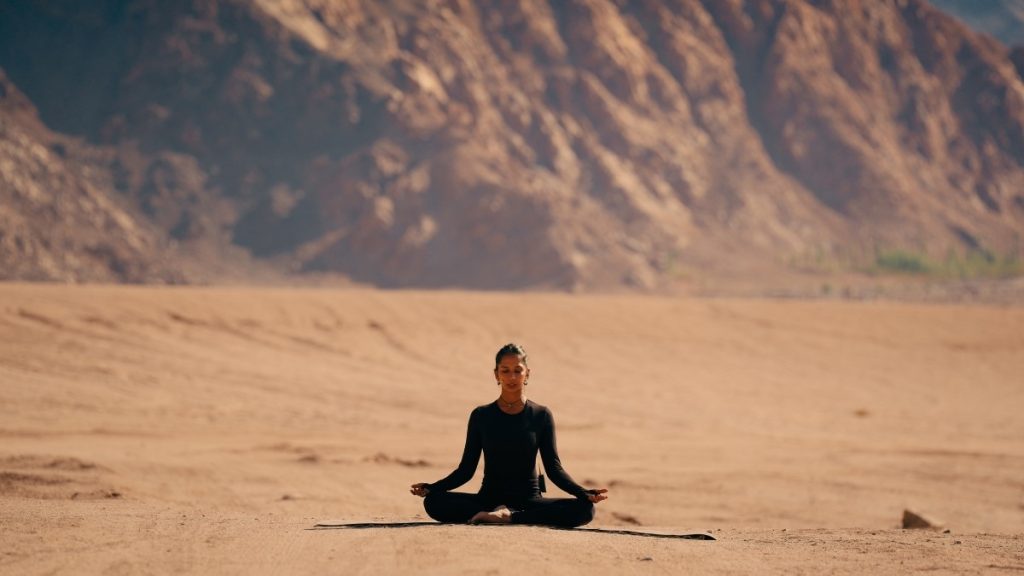
The response each of them built is less about adding what is missing and more about refusing to subtract what the industry typically removes. Jña¯na, built with an entirely Indian team, shoots classes in environments where these practices evolved in rather than neutral studio settings, and features teachers who have spent their lives inside these traditions. Singh travelled extensively across India with a single director of photography to make this happen. “What I found back at home was both profound and confronting,” she says. “These were living traditions, taught by people who had spent most of their lives studying, practising, and embodying them. And yet, when translated into global wellness culture, so much of that depth had been flattened.”
The visual language of the app is a deliberate departure from the clean, aspirational aesthetic of Western wellness platforms, because she wanted users to feel the presence of place, culture, and lived experience rather than a generic container for content. Arora made language the central design decision at Yog4Lyf—scientific, plain, without the mystification that makes these practices easy to dismiss or over-romanticise.
When the platform addresses PCOS, thyroid disorders, or fertility through a yoga framework, it does so in terms that an user can question and verify. This matters particularly given who the platform ended up serving. Yog4Lyf’s focus on female hormonal health was not a strategic decision, he says, it emerged from listening to where the community’s need was most acute, in areas where women had been navigating largely without adequate support from conventional healthcare. “We just kept showing up where the need was greatest.”
The scientific framing, he found, was what gave users the confidence to discuss things that had long been treated as taboo. “When the platform treats these topics with calm, scientific matter-of-factness, users feel safe to do the same.” Still contains almost nothing by the standards of the category—no browse function, no mood-based selection, no streak pressure, no library of hundreds ofnclasses. The app is designed like a journey of five progressive phases—begin, centre, focus, deepen, and still. Each phase has 20 sits/sessions. “One sit at a time. You don’t browse, you don’t choose based on mood. You show up, press play, and close your eyes.
There is repetition, solitude, and a slow progression in duration and breath ratios. That is how a practice deepens,” says Gupta. The sequence of the sits comes from the Hatha Yoga Pradipika, a 15th century manual of hatha yoga, and the Yoga Sutras. The practices are presented in their original form with their original names, because, as Gupta puts it, “the knowledge is most powerful when it is undiluted.”
The repetition that most apps would treat as a design problem—returning to the same practice, day after day—is the entire mechanism. “In most classical yoga lineages, there is usually one practice that you return to every day. The repetition is the practice. There are no notifications pushing you back, no hooks designed to manufacture a habit. You either return because the practice is working, or you don’t.”
RETHINKING ENGAGEMENT
Customer engagement is where all the three apps run into the same structural tension, because their product philosophy sits directly against how the app economy is built and measured. Engagement, retention, time spent on platform—none of this maps well onto a tradition whose actual purpose is to reduce your dependence on external input over time. “In the tech world, scale usually means addictive loops. Jña¯na is built differently. If the app helps you disconnect from the noise and reconnect with yourself, it’s working—even if you spend less time on it.”
Gupta has made the anti-hook logic explicit in the architecture: the absence of notifications and streak pressure is not minimalism as an aesthetic choice but a reflection of the yogic principle of mauna—the removal of everything unnecessary, including the platform’s own hold on your attention. Arora stayed bootstrapped by choice, kept pricing accessible as a non-negotiable, and says the freedom of building without investor pressure has allowed Yog4Lyf to keep orienting toward what the community actually needs rather than what produces the cleanest metrics.
What each has found is that users recognise the difference. “People aren’t just looking for another health tool,” says Singh. “They are genuinely looking for a way to be content with what they already have, in a system built to keep them striving and exhausted.” Arora describes users who come to Yog4Lyf due to a specific condition and stay because the platform gives them a way of understanding the relationship between how they live and feel that nothing else had provided.
“A person who has truly understood the relationship between their lifestyle and their well-being—that is a change that cannot be undone.” Gupta says the challenge Still has never really faced is convincing people that the practice works. The challenge is consistency, getting people to return, and what she has found is that the stripped-backstructure, the absence of choice, the repetition that most products would see as a flaw, is precisely what produces it.
What they are arguing for is something narrower than ownership. It is about representation…
RECLAIMING THE SOURCE
None of them frame what they are doing as a confrontation, and all three pushed back when the conversation moved in that direction. Arora is clear that Western apps are well-made products and that the global spread of yoga is something to feel grateful for rather than defensive about. Singh acknowledges that Jña¯na could not exist without the Western platforms that made the category legible.
What they are arguing for is something narrower than ownership. It is about representation—ensuring that the communities closest to these traditions have a genuine stake in how they are shaped and understood globally, and that the knowledge arrives intact rather than flattened in transit.
Singh’s conversations with older teachers in India—several of whom were hesitant to accept payment, because the transmission of this knowledge has not historically been a commercial transaction—shaped how she thinks about what this actually requires. “It’s about widening access and ensuring that the voices closest to these traditions are part of the global conversation around them,” she adds. Gupta puts the cultural dimension in terms of a word from the yogic tradition itself—vivek, or discernment.
The ability to know what is right for you before you adopt it, particularly when the next wellness trend arrives with confident branding. “There was a time when anuloma viloma was done in most homes. It was passed down, it didn’t need branding. Today the same practice comes back with a new name and we receive it differently.” The goal, for all three, is to put the source back in the room, to make sure that when these practices travel, what travels with them is more than the surface. “Jña¯na is my attempt to bring more context back into these practices because from what I’ve seen so far, that context is what allows them to actually transform you.”
Lead image: Courtesy Jñāna
This article first appeared in the April 2026 issue of Harper’s Bazaar India
Also read : Why everyone is suddenly ‘water stacking’ to stay hydrated
Also read : Why “wellness music” is the next big audio trend in India