
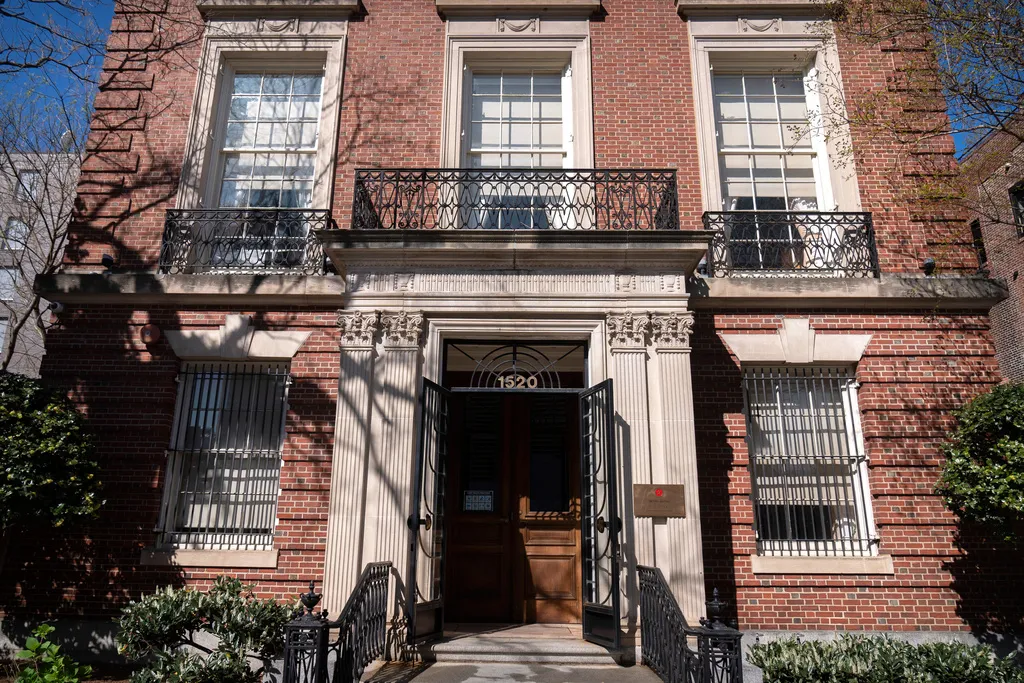
Last week a court in London delivered the first convictions under the UK National Security Act for assisting a foreign intelligence service. The defendants were Bill Yuen, a senior manager at the Hong Kong Economic and Trade Office in London, and Peter Wai, a U.K. Border Force officer working on his orders.
Their operation involved surveilling Hong Kong dissidents on British soil, mining government immigration databases to track them, and attempting to physically remove a Hong Kong woman from her home.
The U.S. has three Hong Kong Economic and Trade Offices of its own in Washington, D.C., New York and San Francisco. They enjoy quasi-diplomatic privileges and immunities. Congress has spent three years introducing a bill that would require the president to certify whether those privileges are still warranted. It has never passed both chambers. In fact, it has barely moved at all.
The Hong Kong Economic and Trade Office Certification Act requires the president to make an annual determination about whether these offices should continue to enjoy immunities and privileges, including protection from lawsuits and exemption from property taxes. If the president determines Hong Kong no longer merits them, the offices have 180 days to close. It is a mechanism for accountability, not confrontation.
The House passed it 413-3 in September 2024. The Senate received it, placed it on the legislative calendar, then ran out the clock. When the 118th Congress adjourned in January 2025, the bill died. It has now been reintroduced in both chambers in the 119th Congress, but neither bill has moved.
The London convictions remove any remaining excuse for delay.
For years, civil society groups have documented the gap between what Hong Kong Economic and Trade Offices claim to be and what they actually do. Hong Kong Watch research found that these offices exist not to support Hong Kongers abroad, but to promote the Chinese Communist Party’s agenda and narratives, providing the budget, staff, and diplomatic cover to do so. Following the passage of the Safeguarding National Security Ordinance in Hong Kong in 2024, their mandate to strengthen ties with mainland China only expanded.
Meanwhile, Hong Kong Free Press reported that the Hong Kong Trade Development Council paid close to $11 million to U.S. lobbying firms between 2014 and 2020 to kill legislation supporting Hong Kong’s pro-democracy movement, with the Economic and Trade Office in Washington directing the operation. These are not neutral trade offices: They are political actors operating behind a shield built for a different era.
That shield was constructed by executive order on June 30, 1997, the day of Hong Kong’s handover, on the assumption that the city would retain autonomy. That assumption is dead. Beijing imposed the National Security Law in 2020. The Hong Kong security law followed in 2024. The free press is now gone. Dozens of pro-democracy figures, including British citizen Jimmy Lai, are in prison. The legal and political basis for those 1997 privileges no longer exists.
The London trial makes plain what that means on the ground. A Hong Kong Economic and Trade Office official directed a shadow policing operation against people living in Britain. He tasked operatives to surveil a Hong Kong woman in her own home and ultimately force their way in. She held a British National (Overseas) passport, exactly the kind of person a democratic government had made a commitment to protect. London’s Hong Kong Economic and Trade Office had become a command center for transnational repression.
There is ample reason for concern about whether the three American offices are categorically different, because China likes to throw its weight around on U.S. soil. Bounties have been issued against Hong Kong activists in the U.S., including a U.S. citizen and a U.S. resident. Liu Jianwang was convicted this week of running a secret Chinese police station in Manhattan’s Chinatown on Beijing’s orders. This is a reminder that this infrastructure is already present in America.
These trade offices sit within that broader ecosystem, protected by privileges that make oversight harder and accountability rarer.
The Certification Act would not automatically shut anything down. But it would require the president to go on record, once a year, about whether these offices still deserve the protections given them in 1997.
The House has voted with near-unanimous bipartisan support. The Senate has twice let the bill die without a vote. Both chambers have now reintroduced it and let it sit. But London just showed the world what a Hong Kong Economic and Trade Office looks like when nobody is watching. Congress should not need yet another lesson.
Megan Khoo is policy director at Hong Kong Watch.
Copyright 2026 Nexstar Media Inc. All rights reserved. This material may not be published, broadcast, rewritten, or redistributed.